


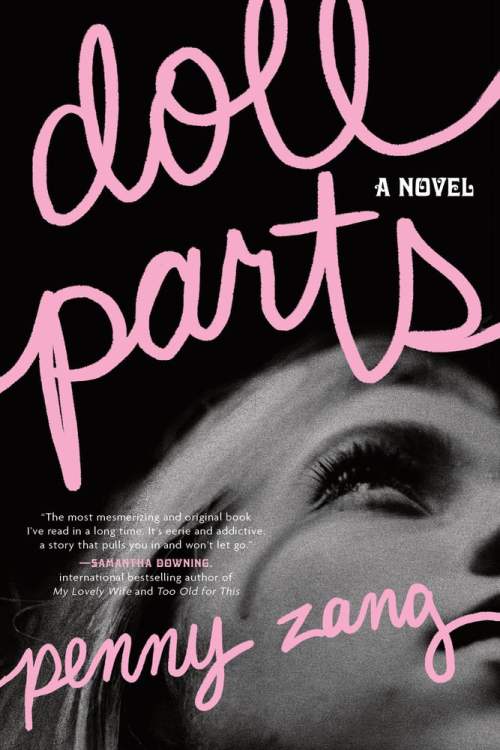
Penny Zang’s debut Doll Parts opens with a list of instructions for how to write about a dead woman. While the list includes practicalities fit for a dark literary suspense novel—ensure she’s dead; source quotes from her journals—the most important on the list hints at depth and care that sets this thriller apart: “Do not let the reader forget that she was once alive.”
Zang herself approaches her characters with a similar depth and care. The dual-timeline novel follows Sadie, a journalist and new mom, as she uncovers the truth about the circumstances surrounding her estranged friend Nikki’s recent death. In flashbacks to their shared experience at the all-girls Loch Raven College, Nikki becomes preoccupied with the school’s so-called Sylvia Club, campus lore that invokes Plath’s name to connect a series of deaths by suicide on campus. As Sadie learns about the last few months of Nikki’s life, she finds that her friend began researching the Sylvia Club again, confirming that the deaths were real and drawing suspicious connections between them. Over the course of the novel, both women become obsessed with following the threads to learn more about these mysterious deaths that defined their campus experience and led to the abrupt dissolution of their friendship.
This is a suspense novel, with the search for answers driving the plot and gripping the reader. But it is also a novel of friendship, with Sadie and Nikki’s relationship at the heart of the story. In the 1990s, Nikki and Sadie are first-year students at Loch Raven, an elite liberal arts college. The childhood best friends are inseparable, bonded in part over their own losses, Nikki’s mother and Sadie’s parents. While their interests align, their personalities diverge. Both writers and readers, Nikki studies literature while Sadie studies communication. While the friends are both involved in the theater department, Sadie commands attention on stage, and Nikki works behind the scenes. These clean, opposing characterizations may have fallen flat if the present-day timeline hadn’t complicated them.
Before Nikki’s death, she was a successful, beloved, and anonymous self-help author with a thriving newsletter and media brand. She married Harrison Walsh, a doctor with family money, and they had a daughter young. The family lived in a new, tastefully decorated house in a wealthy, gated community. Sadie, on the other hand, struggled to find her footing after leaving Loch Raven. She eventually carved out a career in journalism, but the industry contracted and her opportunities for stability and growth all but disappeared. Shortly after Nikki’s death, when Sadie meets Harrison, they begin a romantic relationship. Sadie gets pregnant and moves into his house, which is still decorated with Nikki’s art and filled with her belongings, including her abandoned research on Loch Raven.
Loch Raven is an elite liberal arts college in Maryland, complete with storied stony paths, wrought-iron gates, and ornate gargoyles that establish not only a legacy of academia but a constructed location of privilege. At Loch Raven, Sadie and Nikki are both outsiders. Nikki, in particular, is part of a competitive and high-stakes scholarship program, a program that becomes a point of interest while researching the Sylvia Club. In the present day, Sadie is a first-time mother with a three-month-old baby living outside of Baltimore in an upper-class subdivision where she doesn’t have any friends. The fixtures are gilded, the community gated, and the neighbors aloof. Sadie walks in loops on the empty roads, passing by the manicured lawns and decorative double-sized doors, with her daughter, Rhiannon, in her stroller.
At first glance, these settings aren’t similar. They have different rules, structures, inhabitants, and spaces. But an insular campus, like an elite suburban community, can feel isolating and claustrophobic for anyone, especially for someone feeling unmoored during a period of transition, like grieving a mother or friend, having a baby, or leaving home for the first time. Zang intensifies the isolation by depicting both settings as sparsely populated—unsettlingly so. Sadie’s neighborhood is often empty, with no people washing cars in a driveway or kids playing outside. Nikki meets with two professors regularly, with few mentions of other adults at the college, let alone depictions of other classes and campus activities. Many of the other students fade into the background and blend into archetypes fitting the Plath-obsessed campus. As Nikki explains it, all versions are represented: “Smart Scholarship Sylvia. Fashion Magazine Sylvia. Sex Fiend Sylvia. Wife and Mother Sylvia. Dark Poetess Sylvia. American Sylvia. British Sylvia. Sylvia on the Beach. Sylvia in the Library. Sylvia, Inexperienced with Men. Sylvia, Who’d Bite Off the Best One’s Cheek.”
By placing these disparate settings in parallel, Zang balances the lore of a campus mystery with the reality of the adult outside world. This encourages readers to recognize that these characters have a stronger connection than their ages and life stages might suggest. In a novel deeply concerned with friendship and connection, this is particularly effective.
The structure of the novel is also effectively balanced. Sadie narrates the present-day sections, while Nikki narrates the chapters set in the past timelines. Both sections include snippets from other texts, including research documents, emails, and even sections from Nikki’s self-help writing, which works well in a mystery that requires research. For both narrators, Zang includes interjections with repetitive reactions similar to intrusive or spiraling thoughts written down, reading like a stream of conscious diary entries. “Old case files Loch Raven what the fuck nikki nikki,” and “Wake up, wake up, wake up.” Also: “For me, for me, for me.”
It’s fitting that Doll Parts begins with a list of instructions for writing. Sadie and Nikki are both interested in writing, enough to study the subject in school and forge their careers on the skill, even after leaving their formal education. The novel itself is interested in writing not only as a subject or vocation, but as a means of connection, particularly with informal, personal writing. The Plath devotees find affirmation and identity in the poet’s works—both the poems and the novel prepared for publication and the journals and letters released after her death. Sadie and Nikki, too, communicate in handwritten notes in both timelines, through notebooks and handwritten marginalia. This writing is intimate.
The instructions for writing about a dead woman end with a clear action: “It is sad, yes, but here you are. Someone needs to tell her story.” The result is a smart thriller with satisfying literary references, intriguing academic lore, and, most importantly, a dark and doomed friendship at its center.
FICTION

By Penny Zang
Sourcebooks Landmark
Published August 26, 2025


