


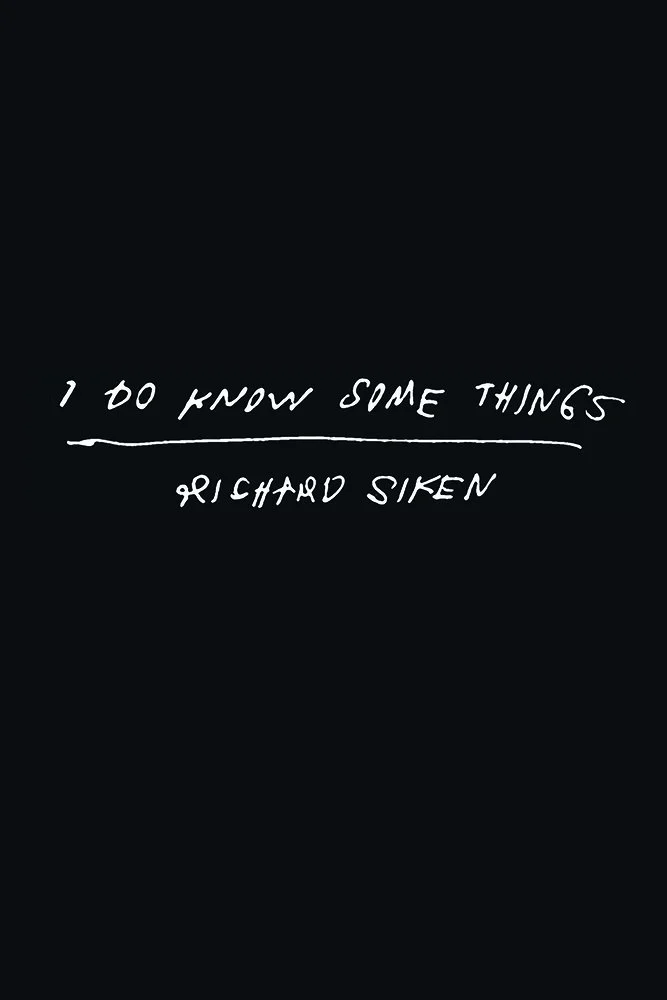
Richard Siken’s long-awaited new collection I Do Know Some Things—a decade after War of the Foxes, two decades since Crush—is an astonishing feat of poetic prowess. On the surface, part of that could be attributed to the wonder of these sharp, crafted, singular prose poems in light of his stroke about six years ago. That would be enough to make it a cause for celebration. But such a qualification doesn’t do these 77 poems justice.
Siken has created “an encyclopedia of myself,” a kaleidoscope of memory, language and identity that reveals—at times revels—in the faultiness of our own narratives. Siken’s voice—and language—is both rooted and aloft, even as he avers that these are not “poems of song.” Beyond such marvels, this is a virtuosity of candor and technique, bound by a seemingly effortless linguistic choreography that leans into multiplicity and mutability, with continuous sparks and joys, from one of our finest contemporary poets.

Mandana Chaffa
One of the things I enjoyed most about this collection—other than the delight of more of your work in the world—was considering prose poems and how they serve the writer and reader. Each page is a stanza—in the Italian sense of the word—with doors, windows and sometimes, secret hidey holes to similar themes in other pieces, in different sections. When did you start contemplating this collection, and how soon in the process did you set the architecture? Were the vignettes always poems? Or always in this form?
Richard Siken
I had a stroke. I was paralyzed on my right side, lost my short-term memory, and couldn’t make sentences. This was the experience of it. This is all I could do. There are some memorable lines in these poems but mostly they hinge and swerve in the gaps between the sentences. It’s associative. It’s broken logic. The goal was to say a complete thought. That’s what I was going to measure my recovery against: a solid, complete paragraph. The sequencing of one word after another was excruciating. In conversation, I would trail off and get lost.
A fundamental power of poetry is the friction between the unit of the line and the unit of the sentence. When you break a sentence into lines, you create simultaneous units of meaning. Meaning becomes a chord, not a single note. But I couldn’t break the line anymore. Everything was so broken, I didn’t want to break an additional thing. So, I had a form—the paragraph—and everything would have to be poured into identical molds. I set the margins to try to contain the thoughts. I made boxes, rooms, and sat in them and moved the furniture around.
Mandana Chaffa
Memory is one of the foundational columns of the collection, especially as it relates to the Venn diagram of memory and the truth, or at least a truth. There’s that lovely line in “Strata,” one of the last poems of the collection: “We tell ourselves the story of a bright day in November. It isn’t accurate but we have to live as if some things are true.” I found this embrace of an unreliable narrator—of all of us as unreliable narrators—a freeing construct.
Richard Siken
It’s terrifying to realize that you’re no longer an authority on yourself, that other people know more about you than you do. Most of this book deals with the fact that I was an unreliable narrator. I just couldn’t remember myself. My feelings were valid but were my representations accurate? I made a document, which means I made some formal and public proclamations. If there are no counterarguments, it will become the historical truth.
Also, in “Strata,” I ask “Where is the point where nostalgia turns into history?” It’s hard to find evidence of yourself. The further down you dig, the older and more broken the artifacts are. In a way, writing things down is what keeps them from deteriorating further. Writing things down gave me a way to frame and clarify my experience, which made it history, but I was also thinking of history as something unemotional. Nostalgia is emotional. The line between them is the threshold where you stop feeling the damage, where you can remember it without reliving it.
Once you let go of the idea that you have to be a reliable narrator, you can begin to consider letting go of the idea of being a narrator at all. I was lying in a hospital bed with no nouns, no story. There was no narrator and yet something remained, existed, continued. It was both terrifying and liberating.
Mandana Chaffa
Even with all the biographical components of these poems, the narrative first person employed through the collection still resists being you completely, a kind of Richard/not Richard. I’d love to talk about your intentions with this poetic memoir and how you offer both intimacy and distance that so deftly and emotionally draws the reader in.
Richard Siken
Metamodernism: it’s characterized by an oscillation between seemingly opposing forces like enthusiasm and irony, sincerity and self-awareness. It’s not so much a tactic as a paradigm. Meaning can be both staged and honest. In some sense, meaning is staged on a foundational level. All language is staged; all sentences are speech acts. Similarly, all actions—even walking—are choreographed to some extent. Practice and intentionality are needed. When I was relearning how to walk, I was constantly falling down on the padded mat. It took a lot of focused attention to get one foot in front of the other.
The authentic self and the constructed self can exist simultaneously. What’s the distinction between expressing and performing? What’s the distinction between hope and prayer? Is it simply a distinction between verbs of being and verbs of action? It’s subtle, if there is a distinction. Maybe it’s the framework we’re thinking in, in the moment: am I disconnected or am I part of an interaction?
Mandana Chaffa
I had a medical situation about 18 months ago that has altered my cognitive function, my memory and how I make language, so I am especially taken by how expressively you describe being unlanguaged following a stroke. This remarkable, ironic superpower: to poetically describe an experience that defies expression. How has your relationship with language altered? What and how you read? Your writing process? And perhaps an unanswerable question: how did you begin again to access your essential poetic nature?
Richard Siken
I’ve written three books. They’re about identity and representation, though they have different strategies and manifest in different ways. My first book blurs the lines between self and other, deals with multiples of the self, and explores variations and iterations of the same events. It relies heavily on the use of the second person to make the reader a character in the story, to make the reader complicit. My second book uses the third person and personification to explore identity. There are poems where bunnies and deer are characters, where fish sticks think and the moon speaks, where the speaker and representations of the speaker interact. This new book is in the first person. There are no fables. There is no artifice. It is autobiographical and it does not fabricate or lie.
These are not poems of song. I didn’t want to be in my damaged body. I wanted a life, and a poetry, of the mind. I wouldn’t fill my lungs. I wouldn’t let myself resonate with sound. It was unpleasant. It was conceptually disgusting. In “The Horns,” I say “The body: I’m insulted by the physicality of it.” The line break is part of the lyric gesture. You can’t sing without a body. I didn’t have a body, not a reliable one.
William Carlos Williams wrote, “No ideas but in things.” It was a central tenet of his poetic philosophy, emphasizing the importance of image and observation. I struggled with the idea. I wanted to talk about the ineffable. I wanted to show it. I couldn’t do it. I couldn’t do it without landmarks, without objects. The idea has to be manifested in the image. The image has to stand in for the premises of the argument. In “Cloud Factory,” I say, “Imagination—image is the coal that fuels its little engines. Shovel coal. Call it love, call it a day’s work.”
“They have been thinking. That he will be better. That they are hoping. That he come back. That he come back soon. That he come back to the way he was soon. Whether or not he comes back to the way he was soon. If he does. When he does. He is reaching. He is running. He is sleeping and running. May he be sleeping and running back to the way he was.”
Mandana Chaffa
So many of these poems operate in nuanced multiplicities. In “The Subjunctive” one meaning could be the expectations or hopes following a severe injury that one “returns” to whatever constituted normalcy—that a heavily-freighted term as well—yet read another way is also the literary expectations of an artist, of a poet, to keep creating, publish, to be successful. Such possibilities as both heaviness and light. These fragmentary, breathy repetitions, the conditionality of the “if,” the forced hope of the “when.”
Richard Siken
There was the possibility that I wouldn’t return. There was the realization that I wasn’t obligated to return. There was the fact that several people were concerned that I wouldn’t return and they fled. And they never came back. In “The List,” I say, “I had a grief counselor, like everyone, and a suicide counselor, because I had said the wrong thing. […] The suicide counselor said the people who hadn’t shown up weren’t going to show up, that the ones that had stopped coming would not be coming back. She had seen it before, she saw it every day. The person they knew was gone. To them, I had broken the contract: I had left first and they were already grieving.” I slept most of the first few weeks. I was out of it. For everyone else it was endless hours of conditionality and forced hope. There are only two poems in the book where I imagine what’s happening while I’m not there. “The Subjunctive” is one of them. (The other is “Room Tone.”) I know what people did, but I don’t know what they were thinking. I probably never will. In “Doubt,” I say “I didn’t know the truth, he wouldn’t tell me, so I had to decide for myself.”
Mandana Chaffa
I appreciate how you wield language, as meaning to be sure, but also as a gesture. How in “Pain Scale,” there’s the friction between the linguistic structures we’re often forced to operate under, in this case, the almost ludicrous expectation that pain can be numerical rather than adjectival, and equally, how often people hear, but still don’t listen. What use is language, if those we speak to can’t understand?
Richard Siken
I fell down. I was taken to a hospital. I said, “I’m having a stroke.” They said, “No, you’re having a panic attack” and they sent me home. I kept thinking, “Something is terribly wrong. I do know some things.” That’s where the title for the collection came from. I went to a second hospital the next day and they admitted me. I was hard to understand and not many people tried. My premises didn’t add up, so my conclusions didn’t make sense. There were fish moving under the ice; I was running fast at a plate-glass door. They didn’t get it. I didn’t know how else to say it. Speaking in figurative language with the doctors didn’t work. They didn’t try to understand. They ignored some very important things I was saying. I just wasn’t able to say everything literally. But when you write, there’s an understanding that there will be a reader. The audience inside the poem might be impatient or dismissive but the reader is leaning in, listening very closely, trying to understand.
Mandana Chaffa
“My memories were inaccurate and out of order. They did not accumulate.” Is there ever a true chronology to memories? The older I get, the more I doubt a one-directional instruction manual of a life, and some of these narratives, at times repeating across sections—in one vignette a question is raised that may be responded to a section later—reflects a fluidity that may feel untethered at times, but can also be buoyant. From a craft perspective, when putting the collection together, how did you determine the order of the sections and narratives? How important was structure and form to your early drafts as well as the finished product?
Richard Siken
The presentation is very structured. It has a very solid armature, like a sculpture, to bear its weight. Like a body, the book has a skeleton that holds it up. You never want to show the bones, though. You only see bones when they break and rupture the skin. Best to have the bones stay beneath the skin and support the parts, help them move.

There are three propulsions in the book: a narrative of physical recovery, a meditation on the moments that defined me, and an exploration of the conceptual terms I used to rebuild myself. The narrative is the story of the stroke, in the present, chronologically ordered. The meditation follows my recovery of memories, out of order, scattered across my far and recent past. They are related in their sections by theme: ownership of death, ownership of history, ownership of body, ownership of language, ownership of autonomy, ownership of imagination, and ownership of creation. Finally, there are poems that take place in a hypothetical space. They grapple with the concepts I used to reconstruct myself.
The book also tracks my mental recovery as well as my physical recovery. In the poem “Bed,” I am noun-less. As we move through the poems I recover my nouns, my ability to string words together, my ability to make sentences and then paragraphs, my ability to argue and communicate abstract thoughts, and finally the ability to synthesize the parts of the book into a finished book.
Mandana Chaffa
Speaking of “Bed,” it begins with: “You have to understand: There was no noon, no down. Time passed. Day turned to night. I woke and slept. I drank, I ate a bit, I slept. There were few nouns. They wouldn’t connect.” As in so many of your poems, one has the temptation to close-read like an archeologist at a fresh dig. Beyond the gorgeous musicality of this section, which begs to be read aloud, I feel especially word-nerdy, and taken with your use of “nouns:” are nouns a rooting agent, perhaps? As something concrete? Whereas verbs might be the atemporality?
Richard Siken
I refused naming in my first two books. I described, I evoked. I never used the words “longing” or “panic.” Often, when I used a naming term, I would subvert it almost immediately. This book is a compilation of the nouns I used in an attempt to define myself and my world. Each poem is an attempt to investigate what I meant when I used the terms in the titles. In “The List” I say “I made a list, a working glossary. My handwriting was big and crooked. Meat. Blood. Floor. Thunder. I tried to understand what these things were and how I was related to them. Doorknob. Cardboard. Thermostat. Agriculture. I understood north but I struggled with left.” And yet, even with an extreme focus on definition, on naming, the poems swerve and self-erase. They complicate and contradict. It’s not that definitions are inaccurate, it’s that they’re incomplete.
“This side of myself, now on this side of myself. I am over here, now I am over here. I remember you and I don’t remember you. I remember things that might have been you and I remember things I thought were you and I remember things that weren’t you, that were actually me. Identity is self-defense. I was no longer the authority on myself.”
Mandana Chaffa
“Superposition” is such a knockout of a poem, and is a velvet sledgehammer about what it is to lose one’s center of gravity. “Identity is self-defense” to be sure, but identity is belonging as well. A (seemingly) unwavering, narrative identity is the entry-fee to societal acceptance. Or perhaps, “don’t look at the man behind the curtain” from The Wizard of Oz, another staple of identity narratives. Until I felt I lost myself through illness, I don’t think I thought enough about my identity, or at least the myth of a constant self. I wonder: was I ever the authority on myself? Are any of us?
Richard Siken
Societal acceptance. That’s the kicker. Insanity is a culture of one. No one cares if you have a solid sense of self. They just need you to have a self solid enough to interact with. You need to know your name so we know where to send your mail, so we can notify you when your table’s ready. Narrative identity really is the entry-fee. And to build a narrative, you need to build a language.
When you name something, you are pointing at the world. When you describe it, you are sharing it or evoking it through your filter. Are we our filters? Are we the prisms that the light shines through? I think great literature is about the reader, not the author. The author is an example or a possibility for the reader. We use ourselves as representations of something larger than ourselves. People used to ask me if the stories in my books were true (which is silly because the stories in War of the Foxes are about talking animals.) I think they were really asking, “Can this happen to me?” and the answer to that is “Yes.”
Mandana Chaffa
In “Doubt,” you wrote: “It was starting to weaken, the premise that I could build an encyclopedia of myself.” More than a hundred pages and through seven sections of eleven poems each—there are so many meanings of eleven, though my favorite might be Saint Augustine’s comment that it is “the blazon of sin;” a representation of “internal conflict and rebellion” as well as the number 77’s association with “spiritual awakening and personal transformation.” Do you feel that you’ve built a compendium of who you are now, and how you’ve arrived here? Has your self-recognition changed?
Richard Siken
More than ten and less than a dozen. An awkwardness between counting sets. One more than fingers can represent; one less than inches in a foot. Eleven is a clumsiness, both spiritually and physically. And, of course, I had to shoot for a total number of poems, so I chose 77—a nod to John Berryman’s 77 Dream Songs.
As a compendium of self, it’s flawed and strangely weighted. There are topics and concerns I don’t address. There are events that were important to me that are never mentioned. I think it’s complete when it comes to the things I needed to wrestle with in my attempt to recover, but I look at the table of contents and it seems incomprehensible, it seems impossible that these terms—Real Estate, Cult Leader, Beet Soup, Parataxis—could add up to a self, a life, but they do.
POETRY
I Do Know Some Things
By Richard Siken
Published by Copper Canyon Press
August 26, 2025


