


We rarely ask someone directly, “Who are you?” but there are certainly attempts to triangulate an answer—What do you do? Where do you live? Where are you from? The assumptions based on their response stack up rapidly.
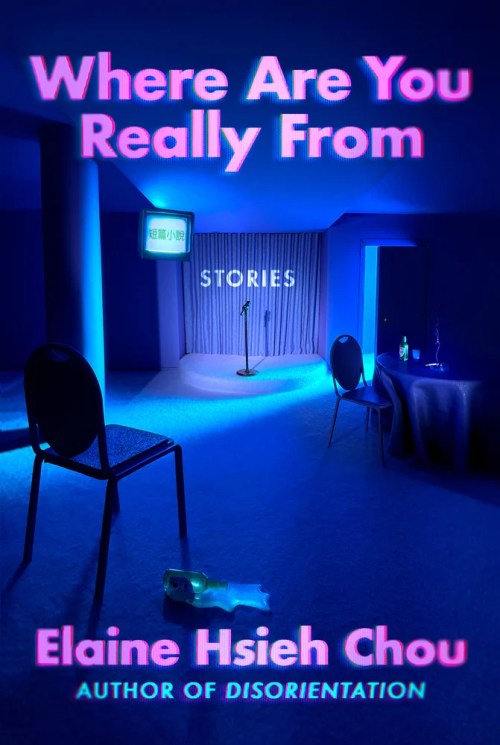
In Where Are You Really From, her new collection of six short stories and a novella, Elaine Hsieh Chou is relentlessly weird in her approach to this question. Two teenage cousins spend their summer in Taiwan plotting how they will cook their neighbor in a stew (“Carrot Legs”), a man purchases his new wife via mail (“Mail Order Love”), a girl moves to Paris to find herself and literally finds a French version of herself (“You Put A Rabbit On Me”), a father seeks out his estranged daughter on the set of her new film (“Featured Background”), a man patronizes a virtual reality brothel (“Happy Endings”), a woman recounts her time as a worker at a birth tourism operation (“The Dollhouse”), and a writer starts an affair at a five-person writer’s retreat (“Casualties of Art”).
The title evokes the commonly cited microaggression about nationality, but the book is interested in where one originates in a more existential sense than that. Many of the characters in Chou’s stories are Asian American without that fact being the one that everything else orbits around. It textures their worlds without engaging too many stereotypes or tropes.
Most of the stories involve the main character fixating on someone in their proximity they perceive as cooler and better that they base their relative self-assessments on. The narrator of “Carrot Legs” is in awe of her older, prettier cousin. Elaine A encounters her chic French doppelgänger, Elaine B, in the frozen food section of a Parisian grocery store and is immediately envious (“You Put A Rabbit On Me”). In “The Dollhouse,” the main character is intrigued by Fantasy, a reserved “doll” who has come to Dreamland so her child will receive Dreamland citizenship upon birth. Chou is consistent in her ability to create an eerie, uncanny version of circumstances we could expect in real life. Each story ends in a way that makes you tip your head back in bewilderment, a reminder that there is no base reality on which everyone’s narrative is built.
One of my favorite features of Chou’s writing is the physicality she bestows on everything. Birch trees in a storm, “bow their shoulders, as if ashamed they’ve been caught in a flaccid state of undress” at the start of “Casualties of Art.” Frank, the widowed older man who has purchased a mail-ordered Taiwanese bride, in “Mail Order Love” decides to “remove his heart from its safe little kennel. He would let it sniff around, take in the fresh air.” Everything and everyone shimmers with vitality, if only we are willing to perceive it. Objects are mammalian and mammals are objectified. The viscerality keeps you grounded as you suspend your disbelief about the logistics of French doppelgängers.
These characters nurse fantasies of vengeance and reconciliation and convince themselves that they’re just one surreal step away from all that they yearn for. As Elaine A puts it, “All I wanted, really, was to find the bottom of myself. Like a perfect reduction, in a gastronomical sense: heating myself down in a saucepan until I reduced and reduced and reduced, until I couldn’t be reduced any further.” What this reduction analogy neglects, however, is the impact of the environment on a person, whether that refers to real places like Taipei, a Hollywood set, and an insular writer’s retreat or the logic of a body optimization-focused techno-dystopia.
The uncomfortable transformational experience of adolescence arises again and again, the ambiguous path from childhood to adulthood sometimes literal and sometimes metaphorical. Figuring out where you’re really from requires getting away from that place, examining it at a remove, both physical and temporal. Characters define themselves in opposition to parental figures, peers, partners, colleagues, clients, and rivals.
Chou offers up her characters mid-reduction, though it isn’t necessarily a voluntary self-reduction. In “Happy Endings,” the main character is reduced down to the form of an irredeemably cruel sex pest. Athena, the director daughter in “Featured Background,” embodies the impulse to oversimplify, pseudo-therapize, and commodify intergenerational trauma for public consumption in the eyes of her father: “A line drenched in unspeakable terror and bloodshed, all so Athena could make derivative art about it from the comfort of her tastefully decorated apartment.” It is simultaneously easy to fit known personas onto these characters and to immediately question whether this is a completely different story from another angle.

Frequently, Chou demonstrates sympathy and curiosity for the characters in her stories that are most easily flattened in our minds—the lonely white man trying to understand his young Taiwanese wife, the baffled father seeking reconciliation with his adult daughter, the insecure male writer pining for a married woman he puts on a pedestal. Though each of these men could easily be a laughable villain, Chou complicates the dynamic. “Sometimes I hate the man who bought me. Because what kind of person buys another person? Sometimes I hate myself because I let myself. Because what kind of person lets herself be bought?” wonders Bunny, the Taiwanese mail-order wife.
Where Are You Really From sparkles in the way it infuses dark concepts with whimsy and detail. Chou seems less invested in establishing a firm stance on anything and more about unsettling assumptions and questioning the first version of the story that you hear—her answer to the titular question is infinitely more questions.
FICTION
Where Are You Really From
By Elaine Hsieh Chou
Penguin Press
Published August 19, 2025


