


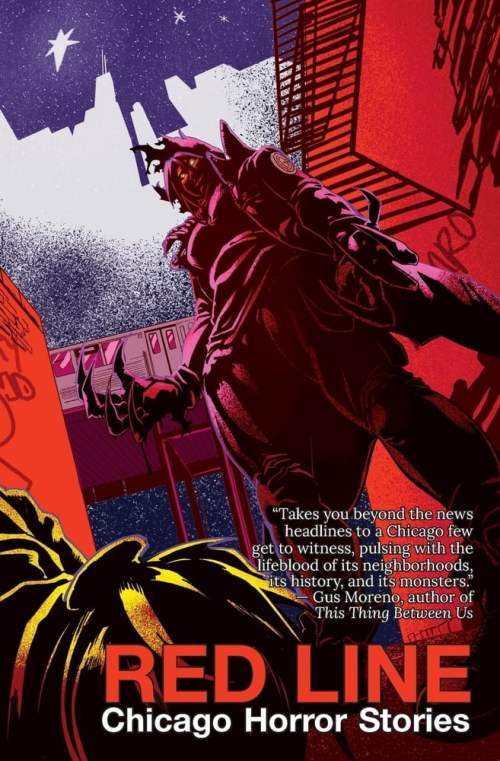
With Red Line: Chicago Horror Stories, Editor Michael W. Philips, Jr. has mined Chicago’s considerable pool of talented horror writers to curate an entertaining, if uneven, mosaic of the city. The meter of his diverse collection is irregular, but Red Line: Chicago Horror Stories is an ode to the city for which Mr. Phillips and the authors have a collective love. The book’s nineteen stories don’t coalesce around a central theme, preferring instead to paint a multifaceted abstract of the city’s soul with splashes of ghost stories and sci-fi highlights. In foregrounding the love of Chicago in his collection, Phillips creates a metaphor for loving horror. Disaster, mass murder, genocide, abuse, torture, ghosts… all things one should run from, but horror fans with their love of a good story, cannot look away. Chicago is like that. The stories in this collection aren’t ripped from the headlines, but Phillips’ selection of stories uses Chicago’s grittiness to create a tragically flawed protagonist that readers will love. It’s a short leap to imagine Chicago Horror as an emerging subgenre. I suspect readers will want to see more.
Bringing a melting pot like Chicago to life demands a diverse collection of authors. Mr. Phillips has done that intentionally and well, his mea culpa in the Editor’s Notes for not having an East Asian voice represented, notwithstanding. The collection is representative of Chicago’s diverse literary community not only in authors’ backgrounds, but also in the range of horror tales presented. Two of the most notable are time-travel stories. In Sandra Jackson-Opoku’s “Lucky Charms”, a racist leprechaun from the earliest days of the city’s founding is tricked into a time portal that lands him at a George Floyd protest on the Michigan Avenue bridge. As satisfying as that is, Jackson-Opoku’s elegant portrayal of the diverse cadre of frontiersmen and Native Americans passing through Chicago founder Jean Baptiste Point du Sable’s trading post is the thing that struck me most. Hers is a uniquely Chicago tale. In Priya Chand’s lyrical story that closes the collection, “The Battle of Forgotten Prairie”, a disembodied narrator who “resent(s) the millennia of physicality weighing me down” finds the essence of Chicago even further in the past. She/They/Everyone seeks to possess Chicago by uniting time and merging into an existence with the prehistoric prairie located miles and millennia beneath Lower Wacker Drive. There’s an ominous gash beneath that street; in case you didn’t know. The narrator lingers with their fingers in pure prairie dirt not wanting “to return to that warm mouth of a place, roaring pollution of gas, noise, minds.” There’s a purity about the spirit’s argument for exile that is appealing if one has the requisite rune encrusted crowbar needed to peel back Lower Wacker’s potholes.
Chicago insiders are privileged by this collection. There’s enough Midwestern self-deprecation and snark to delight the most ardent Chicago afficionados, and a plethora of historical references as well. That said, all of the stories are intended for a general (adult) audience. The reader doesn’t need to get every joke or make every connection to appreciate the collection or to grasp the feel of Chicago that is embedded throughout. Red Line: Chicago Horror Stories is diverse in its appeal to horror fans. In addition to time-travel, readers get ghosts (Cynthia Pelayo, “Saint Maker”, RL Gehringer, “The Papergirl”), monsters (Jen Mierisch, “The River’s Revenge”, K. Saab, “Feed the Monster Evil”) post-apocalypse (Theodore C. Van Alst Jr., “Li’l Flubber”),suspense (Aleco Julius, “Notes from the Dunning Asylum”, TJ Cimfel, “Body Cam”), sadistic revenge (Lauren Emily Whalen, “Just Another Friday Night in Bucktown”), madness (Tina Jenkins Bell, “The Avalon Haint”), and a stylized vampire in a homoerotic tale of possession, adoration and neon (Bendi Barrett, “All You Are Is Bright and Clear”). There’s more to Chicago horror than John Wayne Gacey, Richard Speck, H.H. Holmes and the Iroquois Theatre fire… but of course, they’re all mentioned.
Chicago is the lone unifying content element across this collection and the range of styles among the authors is… well, diverse. Those two things present a significant sequencing challenge that Phillips meets with admirable dexterity overall. Cynthia Pelayo’s film noir narrator in “Saint Maker” opens doors and drags the reader into Chicago’s ghost world heart to kick things off, and Priya Chand’s “The Battle of Forgotten Prairie” provides a lyrical and satisfying climax. In between, the energy drops in spots but it’s unclear that rearranging could eradicate that lull entirely. Each story in the collection contributes something essential to Phillips’ mosaic, and unevenness is baked into his concept. Red Line: Chicago Horror Stories is a winning collection. Hats off to Michael W. Phillips, Jr. for attracting some of Chicago’s big names in horror to his project and for spotting the talent of some lesser-known writers as well. Horror is vibrant in Chicago, so perhaps we will see another volume.

FICTION
Red Line: Chicago Horror Stories
Edited by Michael W. Phillips, Jr.
From Beyond Press LLC
Published August 12, 2025


