


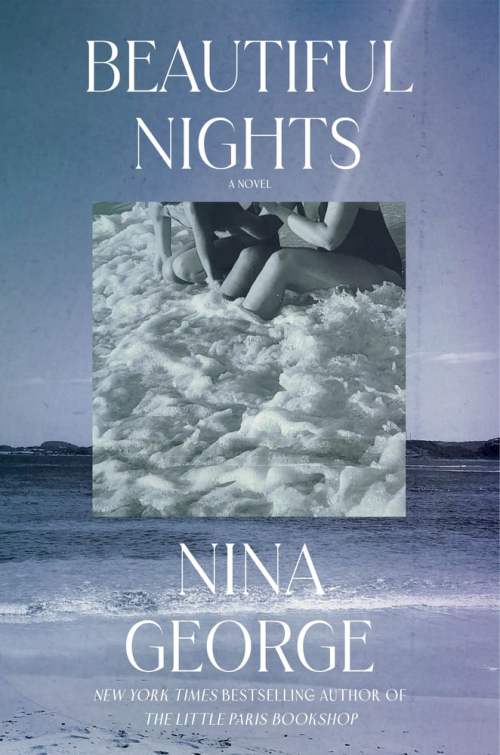
Centered on a French behavioral psychologist and her tension-filled love affair with her son’s girlfriend, Nina George’s new novel, Beautiful Nights, examines themes of desire, belonging, and what being free as a woman actually means.
The story begins with Claire and Gilles, a long-time married couple that seem to get along well enough, but are certainly lacking in the long-time love that is achieved by some married couples. Both are engaging in consistent affairs, and while their demeanors toward one another are friendly and kind, there is certainly that “missing link” they just can’t find. Enter Julie, their son Nicolas’s new girlfriend. Julie has the vibrancy of youth and the aching desire for more: more love, more excitement, simply more. When Claire and Julie meet, there is an instant moment of connection that neither can shake. As Julie embarks on the family holiday with aloof Gilles, semi-charming Nicolas, and ever-enigmatic Claire, tensions begin to boil between the two women until the overflow is inevitable.
This book tackles a lot of themes that are consistently present in our contemporary world. Women have always faced the dilemma between duty and desire. Women feel pressured into traditional roles of “wife” or “mother” at a young age, and if that is not already their true want, can fall victim to the picket-fence dream that is packaged and sold to young women who have barely stepped into adulthood. Such was the case for Claire, and as the story goes on, Julie is challenged with the same decision, and whether to choose the complacency that Claire up to that point had chosen. Seeing the two women mirror each other was a clever choice and emotion-evoking.
George does an excellent job with the setting of this story to amplify the feeling of longing between the women, specifically the use of the sea. It’s a familiar feeling to most, that when one looks out into the ocean, one feels small and like there are infinite possibilities in front of them. This is how Claire and Julie both feel throughout the story, yet remain locked into their sense of duty to men.
While this book juggles themes that are themselves profound, I had a hard time reading it due to its inability to allow the reader to come to these profound conclusions themselves. At least once every two pages, the third-person narrator meditated on either the situation of women, desire, or regret in a fashion that allowed me to do no work for myself: I needn’t draw any conclusions about Claire’s choices because they were told to me; I needn’t think about how Julie may be feeling in moments because it was always explained in painstaking detail; I needn’t try to take something away from the heart of the story for myself because I was fed every answer, observation, and “lesson” from the very first page.
As a writer myself, I know the “show don’t tell” mantra is one that is told to writers of all levels from the very beginning, but the reason that it is is because it is an extremely difficult thing to do. It is our impulse to tell the reader exactly what we mean, to not leave room for interpretation because what if the reader interprets incorrectly? But at the end of the day, the joy we get from reading is what we can take away from a story ourselves, not what we are told to take away. I found that often George was trying so hard to be profound that I found myself annoyed that I wasn’t trusted to see what she was saying through simply the story of Claire and Julie—I wasn’t allowed to interpret anything for myself, and it ultimately came across as somewhat pretentious and difficult to enjoy.

To me, art is meant to be left to the eye and imagination of the beholder. Whether in film, art, or novels, this is a sentiment I hold as truth. There is a lot of good in this novel; the story of Claire and Julie is a moving one, and one that I think is important to be told as we take steps to change expectations of women and make them simply for a woman to be herself, whether that be a mother or President or just happy. While Beautiful Nights to me has room for improvement, I trust that there is an audience for it out there, and at the very least one can read stunning descriptions of the sea and France in the gorgeous evenings of summer.
FICTION
Beautiful Nights
By Nina George
Ballantine Books
Published July 29, 2025


