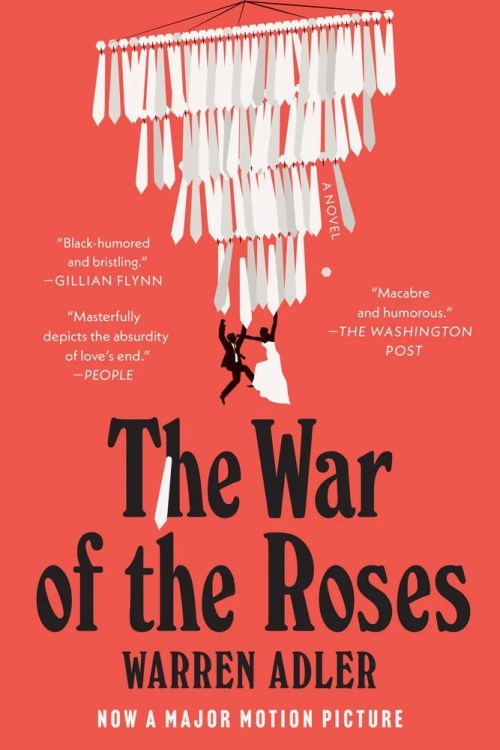
If ostentatious summer weddings and tax cuts for the rich have you feeling nostalgic for the Eighties, you’re in luck. Warren Adler’s The War of the Roses (1981) is set to be republished. With an updated cover and author revisions, this novel continues to delight dark-humored souls. While there is no shortage of romance novels to take to the beach, you might find a cutting satire about curdled love an amusing respite. A cold plunge of a novel, if you will.
While Adler’s book about an acrimonious modern divorce may be better known for the 1989 film adaptation starring Kathleen Turner and Michael Douglas, the novel is much more wicked. Booby traps and cruel hijinks abound though math-averse readers get a reprieve. The new edition’s chapters are numbered with Arabic rather than Roman numerals (think 14 instead of XIV). And if you read the book right away, you’ll be able to determine how the new film adaptation—The Roses, starring Olivia Colman and Benedict Cumberbatch and releasing in the US on August 29—measures up to this now-classic commentary on marriage and materialism.
Love clichés have no place in The War of the Roses except to be skewered. The couple at the center of the novel—Jonathan (Oliver in the first edition) and Barbara Rose—put one in a mindset that it might be better to have never loved at all than to have loved and lost. Loving and losing have turned the Roses into monstrous, vindictive people. Perhaps you too have had such a former spouse or partner. You might feel more charitably towards them if they never rigged the household furniture to try to cut short your life.
The now-deceased Adler’s best-known work opens like a romance novel: two young people “meet cute” at an auction where they both bid on the same Staffordshire figurine. She outbids him, he chases her down, they fall in love, then marry. Nearly twenty years later, what began as playful competition for stuff and things takes a venomous turn.
At the time of their 1960s marriage, Barbara followed the practice of the day by dropping out of college to become a homemaker while Jonathan continued his studies at Harvard Law School. Jonathan’s career flourished while Barbara served as the primary caregiver for their two children. They moved into a huge, beautiful Washington, DC, home they spent years decorating with geegaws and antique furnishings. It was a trad wife dream decades before Utah moms flooded the internet with housewifery content. What could possibly be amiss in the soft glow of a so-called good life? Sometimes all it takes is a tiny match to set fire to the dry kindling illusion of a happy marriage, turning that glow to a brilliant flame. In the case of the Roses, Jonathan’s health scare is such a match.
As Jonathan lies in a hospital bed wondering why his wife hasn’t visited him, Barbara realizes she would be happier with her husband dead. When he returns home, Barbara tells him she wants a divorce. So begins the war for full possession of the house and its contents—not including the children, whose future living arrangements seem to be an afterthought.
The War of the Roses has a strong feminist message, much more so than the Danny DeVito-directed 1989 film adaptation, which undercuts the feminist messaging thanks to the casual inclusion of gratuitous sexism. In the novel, when Barbara has her epiphany, she is furious and feels she has been cheated out of years of personal and professional growth, all because she bought into the narrative of romantic love and made the compromises expected of her. For Barbara, only compensation of the house, its furnishings, and financial support can ease her resentment. Jonathan, meanwhile, is blindsided by Barbara’s seemingly sudden about-face and is outraged she would dare stake claim on what his hard-earned money purchased. As the obedient wife she was adored, yet after her announcement Jonathan despises her with a passionate and inspired violence.
Given the 1980s era in which the novel and first film adaptation are set, one might see similarities between the fictional Barbara Rose and home and hospitality mogul Martha Stewart. Stewart built her empire after first establishing a Connecticut-based catering business. In the 1989 film, Kathleen Turner is seemingly costumed and styled to resemble Stewart. Could the business-savvy domestic goddess have been Adler’s inspiration for Barbara Rose? If so, it makes Barbara’s black-hearted and imaginative use for her husband’s dog that much funnier (assuming the reader thinks fictional harm to animals can ever be funny).

What makes The War of the Roses such a delightful read is the author’s ability to capture the intense hatred a person can feel for someone they so recently professed to love. That and the creative lengths a person will go to in order to antagonize an ex and hold on to what one feels is rightfully theirs. For those with a taste for revenge and the darkly comic, for those who would enjoy a sharply written story filled with dynamic, puerile acts of antagonism: this beach read is for you.
FICTION
The War of the Roses
By Warren Adler
Zando
Published July 22, 2025 (originally published 1981)