


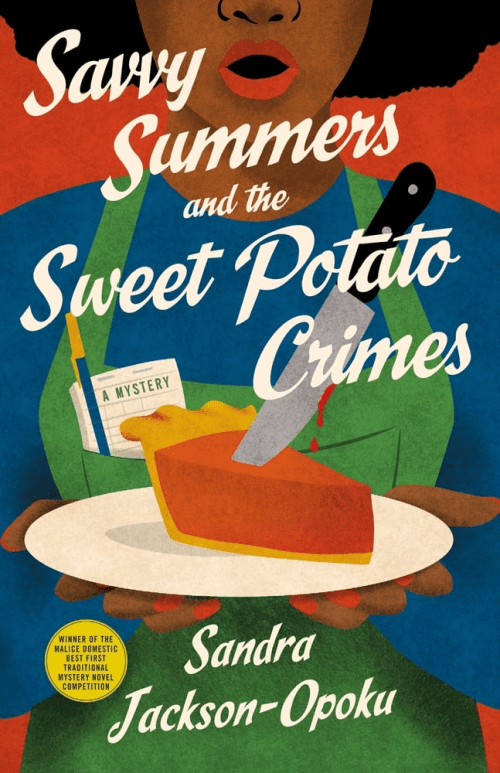
Savvy Summers and the Sweet Potato Crimes is a cozy food mystery, slightly edgier than what many people may expect when they think of the genre. Like many cozies it features a middle-aged protagonist, Savvy Summers, and a quirky cast of characters. Fittingly for a food cozy, it ends with several delicious recipes to showcase Savvy’s love of cooking. More atypically for a cozy, it’s set in Chicago, has Pan-African influences and doesn’t shy away from the ramifications of engaging with the criminal injustice system. It’s a refreshing change of pace when you want a mystery where the violence occurs off-page but still has some semblance of reality when it comes to both characters and setting.
Jackson-Opoku is an impressively versatile writer; she has traveled around the world extensively and that influence can be seen in her writing across genres. In addition to writing fiction, she wrote scripts for original and adapted works for stage and screen, including as a co-author of Indignant Women: A Conversation with Lorraine Hansberry and Gwendolyn Brooks, and the novel adaptation, Hungry Ghost Festival, a play with music. She has taught literature and writing at the University of Miami, Columbia College Chicago, and Chicago State University.
For readers local to Chicago, the book launch event will be held at Call & Response on August 6th.

Ariana Valderrama
I really admire writers who seek versatility in their careers. You touch on this a bit in the acknowledgements, but can you expand on your decision to write a mystery after a career in literary, historical fiction and poetry?
Sandra Jackson-Opoku
I’ve always been a fan of mystery novels and had long thought of writing one. Life and intervening interests led me down the path of literary fiction, which mind you, I haven’t given up. When I turned 70, I found myself facing a series of “put up or shut up” decisions.
When I retired from full time university teaching and transitioned into a life of full time writing, I decided I would try my hand at as many literary interests as I could manage that I’d been considering over the years. So, in addition to my work in historical and adult literary fiction and nonfiction, I’ve been working on children’s book projects, playwriting, screenwriting, and crime writing.
Ariana Valderrama
As a follow up I enjoy reading some cozy mysteries but often find the majority a little too twee. I loved that you wrote you wanted to “test the boundaries” of the genre and I think it paid off. Your book struck a really good balance between having a lighthearted tone while covering serious topics. Why was it important to you to defy or push genre conventions?
Sandra Jackson-Opoku
I think I came along at the right time to test boundaries and have accepted this. While readers love the quaint, old-fashioned intimacy of traditional cozies, I think they’re finally open to trying something a little different. While genre fiction has traditionally been formula-driven and notoriously resistant to change, there’s also a growing momentum toward more diverse offerings in crime fiction, including cozy mysteries. Several years ago I received a Sisters in Crime grant to research multicultural cozies, and I was surprised to discover cozy and amateur sleuth titles going back to the 1970s. When Barbara Neely came along in the 1990s with her Blanche White mystery series—not technically a cozy, but cozy-adjacent—it opened the door for a whole new generation of writings with Black, Latino, Asian, ethnic European, and LGBTQ+ characters and storylines. While some of these offerings stick closely to the traditional cozy tropes—small town settings, and PG13 ratings for sex and violence—others have expanded the landscape into urban and suburban communities, social justice issues, and distinctly cultural viewpoints.
Other than a couple of children’s books, there has never been, to my knowledge, a cozy mystery set on the Southside of Chicago. I wanted to portray the kind of authentically Chicago, authentically Southside, and yes, authentically Black experience I grew up with. While cozy mysteries are far from erotica or urban fiction, I didn’t want to pretend these characters don’t have a sex life, or that an epithet isn’t occasionally uttered. A fellow crime writer of color cautioned me that writing too close to the culture might risk turning away white readers. Time will tell if that’s the case. So far, fingers crossed, I’ve had positive responses from readers across all experiences and walks of life.
Ariana Valderrama
While this book is more serious than the typical food cozy it seemed like you had a lot of fun developing character names. Many of the characters are unwittingly hilarious and their unique names made it even more entertaining. Savvy Summers, Delbert “Do-Right” Dailey, Shyseteen Shackleford! How did you come up with these?
Sandra Jackson-Opoku
Black people have always had an irreverent attitude toward the English language, and that includes the culture of naming. You can go back to the slave narratives and find distinctively Black names like Suki, Coffee (a possible retention of the West African “Kofi”) and Araminta (Harriet Tubman’s given name). People sometimes ridicule the “made up” names Black people give their children, but I think it reflects boldness, creativity, and resistance to the status quo. I adore all those unconventional given names, the Keishas and Laquitas, the Keyshawns and DiAndres. Then there’s the tendency toward humorous and ironic nicknames. You may have met the 300-pound guy called Tiny, or the light-skinned person who goes by a moniker like Midnight. In Savvy Summers, sidekick Penny Porter Lopés is uniquely prone to christening people with irreverent nicknames like Shystie, Do-Wrong, and Henpecked Henry.
Ariana Valderrama
While the characters are entertaining, they also have intriguing backgrounds and strong characterization. I was especially drawn to Fanon Franklin, a cop who used to be a “college militant.” You note that you drew inspiration from a former Black Panther who was a retired CPD officer. Both Fanon and his real life inspiration really surprised me as I did not expect their politics to mesh with the criminal justice system. How did you approach writing his character, and what made you want to examine “law enforcement activism?”
Sandra Jackson-Opoku
I can’t vouch for other places, but I distinctly remember when a cadre of “culture cops,” whose ranks included a number of women, began to enter Chicago law enforcement ranks for the first time. These included people I count as friends, family, and comrades in struggle. Of course, the city also has a rightfully earned reputation for brutal high-handedness and over-policing, especially involving communities of color. Yet I believe the situation could have been far worse were it not for the small but active presence of politically and culturally conscious peace officers.
When Savvy Summers and the Sweet Potato Crimes went through copy edits, one of the editors thought Sgt. Fanon Franklin’s character and activist background “strained credibility.” Yet he’s modeled after a real-life person, a family friend and former member of the Black Panther Party. There were many in the 1970s Chicago Black Power Movement who opted to effect social change from “the inside out.” Black Panthers ran for and won elected office, became state and federal Congresspeople, and yes, police officers. Barack Obama himself had a background in community activism before becoming a state, then federal Senator, and eventually US President.
Ariana Valderrama
A friend who was also reading the book noted her appreciation for the exploration of the changes to soul food. It’s yet another way your book stands out from the typical cozy. Why was it important to you to not only include delicious food recipes but also food history in the book?
Sandra Jackson-Opoku
Giving credit where credit is due, I owe a debt of gratitude to my editor, Hannah O’Grady. She’s not a native Chicagoan, but spent her undergraduate years at the University of Chicago, where she developed an appreciation for the Southside and its Black communities. In retrospect, I originally wrote a rather unfortunate storyline in which traditional soul food was viewed—at least by one character—as a fat-, carb-, and sugar-laden cuisine with deleterious effects on the health of the community who loved it. It was even implicated in the death of one character. Hannah gently suggested that I rethink this angle, and I’m so glad I did. Even though I knew better—after all, I grew up eating soul food—I subconsciously internalized prevailing myths that proliferate from both within, and outside of our community that “soul food is unhealthy.” While I’m now a born-again proponent of this culinary culture, I also appreciate its evolution from its peasant origins to a cuisine that’s now a bit more cosmopolitan. Soul food has changed as the community changed, while still holding onto aspects of its agrarian origins. Culinary cozy mysteries tend to include recipes for dishes mentioned in the story. This gave me an opportunity—with the help of food writer, Christilisa Gilmore—to do some recipe testing and formulation.
Ariana Valderrama
This novel is a lovely ode to Chicago, the Southside and Woodlawn. You mention a lot of actual Chicago history, sites and sports lore. As a Cubs fan I loved that a particular character was living on the Southside but proudly rocking Cubs gear, although that may be too controversial for some! Did you do any additional research into Chicago history or was it all innate knowledge? Are there any specific businesses or attractions you want more people to discover?
Sandra Jackson-Opoku

We all read books and watch so many movies and TV shows set in New York City, that even those who haven’t been there can speak with some authority on places like Radio City Musical Hall, Times Square, Coney Island, and Harlem. I wanted to do equal justice to Greater Chicagoland. Visitors never fail to be amused, for example, that a Chicago neighborhood called Beverly Hills actually exists. We’re rightfully known as “The City of Neighborhoods,” a reputation whose downside is severe racial and ethnic segregation. Yet there are also many striking distinctions among our various communities and cultures… the unifying presence of Lake Michigan, fondly known as “the Lake,” the way the landscape changes as you move into the North Shore, all the different “towns”—Bronzeville, Little Italy, Chinatown, Boystown, Little Bombay, K-Town, Wrigleyville. Chicago is also a big sports town. I’m not much of an aficionado myself, but I wanted to explore how people “root, root, root for the Cubbies” and represent the Bulls and Bears with civic pride, and all its attendant loyalties and rivalries.
Ariana Valderrama
One of the most Chicago things about this book (unfortunately) is the corrupt alderman. What drove your decision to include that kind of character, and do you feel more optimistic about local politics today?
Sandra Jackson-Opoku
I partially grew up on the Westside, where it was open knowledge that ward committee people and precinct captains, in the pay of corrupt aldermen and the Democratic Party machine, would buy people’s votes for the price of a Christmas turkey. In an early draft of the novel, I had renamed Woodlawn as “Woodmoor” because of breaking news about an actual disreputable alderperson in that area. Yet the character wasn’t even based on this person, as it was written long before the scandal broke. It does try to acknowledge the painfully corrupt and checkered political landscape the city has contended with over the decades, even centuries. I have to be optimistic about the possibilities of change, but I remain dismayed at the corruption that often happens when people enter the political arena.
Ariana Valderrama
Switching gears a bit from the novel itself. I’ve been meaning to read Trumbull Park, in part because it seems to be an underrated Chicago novel, so I loved your essay in the Sun-Times last year talking about the influence the author had on you as a child. Can you talk a bit more about what it meant to you seeing your neighbor making a living as a writer? Did he influence you to want to write specifically about your Chicago, or merely to write whatever came to mind?
Sandra Jackson-Opoku
Trumbull Park was an autobiographical novel by Frank London Brown, chronicling the violent backlash unleashed in the late 1950s when a group of Black families integrated the Trumbull Park Homes, a previously all-white Chicago Housing Authority development. Even though I was preliterate at the time, it was tremendously inspiring having a neighbor who made his reputation as a writer. I think it infused me with the power of “nommo,” a West African concept about the power of the word to effect lasting change. The author died tragically young at 34, and I often wondered what may have happened had he lived—what he’d be writing now, how he’d view the changes (and lack thereof) occurring over the past 70 years since the novel was written.
Ariana Valderrama
My favorite question to ask Chicago authors, especially those as well-versed in our history as you are, what are your go-to recommendations for lesser-known Chicago fiction or nonfiction stories?
Sandra Jackson-Opoku
As an emerging writer of crime fiction, I’d recommend the works of two lesser-known but nonetheless important Black Chicago crime writers. Willard Motley was arguably one of the first, if not the first Black writer of crime fiction. Like Frank London Brown, Langston Hughes, Richard Wright, and Gwendolyn Brooks, he cut his teeth writing for the venerable Black newspaper, The Chicago Daily Defender. Motley then went on to write hardboiled detective fiction like Knock on Any Door and Let No Man Write My Epitaph, eventually becoming a Hollywood screenwriter. Motley was a Black writer who did not write Black fiction. Perhaps because of the racial restrictions of the mid-20th century, he opted to write mostly about White characters. I’d also recommend Hugh Holton, a Black Chicago police officer for three decades, who wrote 15 works of crime fiction including Windy City, Presumed Dead, and Chicago Blues.
MYSTERY
Savvy Summers and the Sweet Potato Crimes
By Sandra Jackson-Opoku
Minotaur Books
Published July 29, 2025


