


In the town of Kitakyūshū nestled by the Golden Villa Apartments, for aging seniors, sits The Convenience Store by the Sea, eponymously named Tender. Shiba, the enigmatic manager, draws a crowd of Golden Villa Ladies, a bittersweet retiree, a student struggling with the social scene, and the son of Shiba’s employee. Narrated in a close third person, which oscillates across chapters—from worker Mitsuri, manga amateur Yoshirō, sweets lover Azusa, honorary grandfather Takiji, lovelorn Kōsei, concluded by Mitsuri and Shiba—the reader traipses the aisles of Tenderness into each character’s life.
If you’ve ever worked a service job, you know the fine line between clocking in and clocking out of your personality, or altruistically your persona and its severance to service. But what if these lines also existed when playing the role of student, friend, parent, and so forth? The Convenience Store by the Sea spans across ages and societal roles within Kitakyūshū, featuring a rotating cast of characters who also appear in chapters in which they are not the primary narrator—take Mitsuri and Yoshiro bonding over a passion for manga, within their own chapters, then observed by Kōsei.
For lovers of Japanese translated fiction with an element of fable, comparable to The Blanket Cats and We’ll Prescribe You a Cat, this feline-free novel adopts the tone of small-town magic built on community caring and store manager Shiba. Fans of The Authenticity Project by Clare Pooley will draw similarities between the multigenerational band of residents working through marital qualms, coming of age, or feeling seen by their peers or closest relations.
Like the mundane but overlooked convenience store, magic in The Convenience Store by the Sea lies inside Shiba, a manager who charms each customer with elongated interactions and compliments. Beginning with Mitsuri, manga artist by night, the narrator observes Shiba in the workplace and asks the nagging question of what makes him so charming—his face, his aura, even pheromones—these questions find their way into the pages of “The Phero Manager’s Indecent Diary,” priming the audience to observe the manager, while placing readers in the hands of a meta-narrator, whose creation is never directly quoted.
Reminiscent of a short story collection, each chapter posits its narrator in a time of tumult, such as Yoshirō’s waning interest in manga as he’s imperviously called out by students at his teaching job—one of whom we later meet, and conclude on an upward swing of finding themselves (he’s later mentored by Mitsuri) italicizations clue the reader into deeper parts of the monologue.
However, some characters are further ingratiated within the community than others. Following his retirement Takiji festers a resentment towards his wife Junko for her involvement in the community, leaving him alone in the home he once tended. A chance encounter in the convenience store brings him into the life of Haruki, the son of a hardworking father in need of a relative for the field day three-legged race. While this story is heartwarming and brings the reader into the walls of the Golden Villa, the purpose of the yellow flag bento lunches, and backdrop to Tenderness, Takiji’s role falls more to a background character as other narratives take shape. In a novel with multiple perspectives, each narrative may not be rendered equal.

However, the novel’s premise lies in the heartbeat of Tenderness. A noun, tenderness serves as the anchored point of return throughout the novel, situating the third space of the convenience store as a place to dine and exchange thoughts and ideas as the suggestion box permits. Though Tender also envelops a noun and verb when stripped of its suffix: an individual who takes care or the act of taking care. The duplicitousness of this literary term was first introduced to me in Jhumpa Lahiri’s story by the same name, “Tender,” though the dissection of the convenience store’s name serves as the story’s thesis. And leaves us with the question: why is the story’s title The Convenience Store by the Sea instead of Tender by the Sea? Perhaps a question the reader may not know, but will have to ponder along the imagined aisles of perishable goods.
FICTION
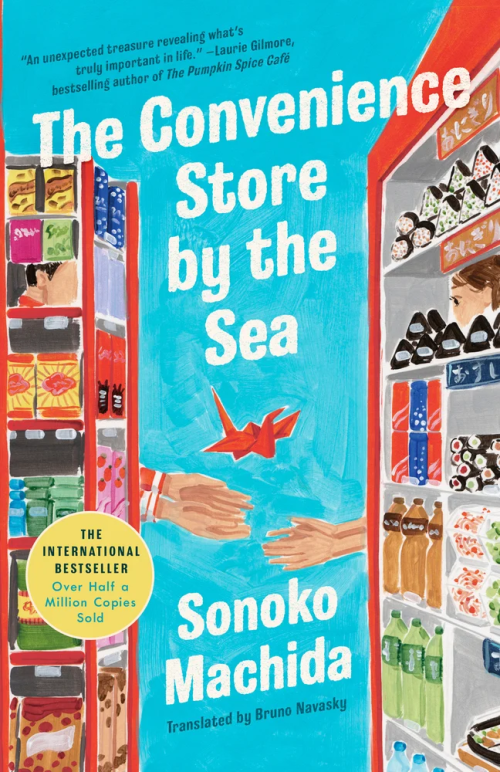
The Convenience Store by the Sea
By Sonoko Machida
G.P. Putnam’s Sons
Published July 15, 2025


