In tech discourse today, dread predominates, and for good reason. Unlike other pressing topics, like global warming—unambiguously bad—and unfettered capitalism—nice in theory, but minus the fetters, really quite bad—technology has a bright side. It’s also magical, and life-changing. Like power, technology is not inherently evil or destructive. It’s neutral. A tool to wield. Acheulean hand axes are technology; the wheel is, too. And the web. (You wouldn’t be reading this piece without it!) And writing. (It couldn’t exist without that!) No technology? No CHIRB!
There’s a lot to say about Big Tech re: the surveillance state, autonomous war, and a million other domains, but since we’re having this conversation via a digital medium, let’s focus specifically on digital technology. How can we remind ourselves that our current setup—a series of outrage-fueled, pay-as-you-go, infinitely scrolling walled gardens weeded through with AI slop, which we squint at through the tiny rectangles of glass we carry with us 24/7—is merely one of many possible worlds we could create with our astounding powers of ingenuity? Are we really stuck in our constricted, constructed reality of how this tech functions in our lives, and how we remain subservient to it? We’re not stuck, but it’s hard to peer over those tall garden walls. If only we could more easily separate our technologies from the people and institutions that wield them, in order to make better, less manic judgments about where we’re being led, and why, and by whom.
What once felt liberatory—do you remember the energy and possibility of the early web?—now feels oppressive and omnipresent. Many credible experts insist we are destroying our brains with it. How have we gotten it so wrong? (Spoiler alert: capitalism is implicated.) Can we save it, or at least save ourselves? We’re faced with many tangled and complex questions. And that usually means we need to rely on books, one of our species’s crowning technological achievements, to help us assemble the pieces of possible answers.
This list attempts to organize a tiny section of the puzzle.

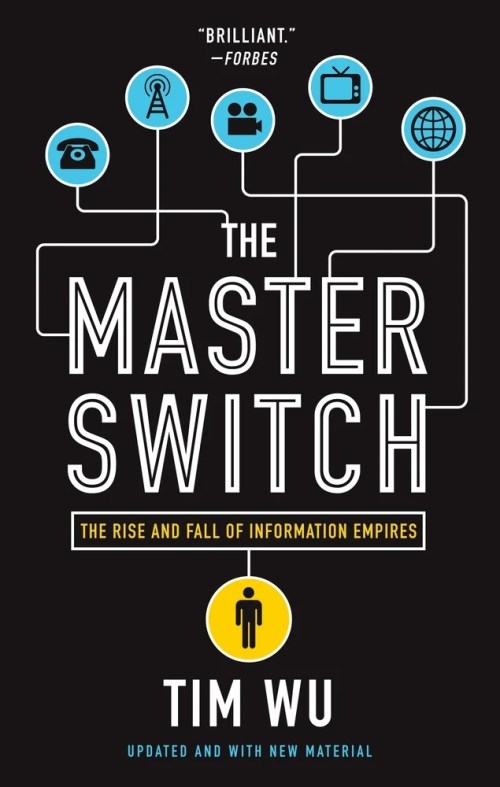
The Master Switch: The Rise and Fall of Information Empires
By Tim Wu
Vintage
November 29, 2011
Wu is a preeminent scholar of media, law and business who coined the term “net neutrality.” Before he dissected the attention economy, before he served in the Obama and Biden administrations, and before he became a New York Times opinion page mainstay, Wu wrote this eye-opening and fascinating history of information technology companies—from the telegraph to the telephone to the film industry to the internet—in which he shows how new innovations begin with open, democratized free-for-alls, but gradually evolve into closed systems as American monopolization takes hold. When these monopolies aren’t broken up—like the book’s case study, Ma Bell—or disrupted by the next wave of new technology, and if they’re allowed to accumulate enough financial and political power, they’ll choke off and consume any nascent competition. Wu’s thesis has only been bolstered since publication, as the likes of Google and Facebook have consolidated their hegemonies. Reading this book will turn you into a crusading trust-buster, if for some reason you aren’t already.

Little Brother
By Cory Doctorow
Tor Teen
April 13, 2010
Wu’s childhood friend from Toronto, Cory Doctorow, also became a clear-eyed Cassandra of the digital age, possessing a downright comprehensive knowledge of how modern technologies are used and abused. In 2022 he coined his own term, one which has come to describe not just the morass of degraded and bricked consumer products and software, but our entire crumbling societal infrastructure: “enshittification.” Charmingly, Doctorow is, among many other things, a prolific fiction writer, and sci-fi is one of his primary modes for showing us other paths. Little Brother tracks a group of teens using digital tech to fight back against a rampaging Department of Homeland Security intent on shredding their civil liberties. It’s a story and an ethos that reinvigorates Orwell within the details of a post-9/11, always-online world, and which feels more relevant every day.
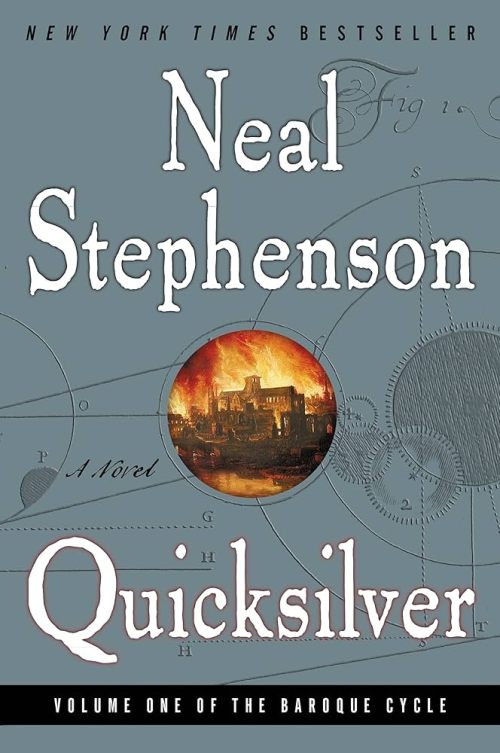
The Baroque Cycle
By Neal Stephenson
William Morrow Paperbacks
September 21, 2004
Stick with me on this one. It’s true, this is a nine-book work of historical fiction (Volume 1, Quicksilver, containing the first three books, is linked here). It’s one for the nerds, and it’s worth it. If you’re looking for more than doom and gloom, if you want to feel inspired and regain touch with technological ideals worth fighting for, you want Stephenson. It’s not as though he’s uncritical, but few authors better convey the senses of awe and wonder that learning about our world brings. The Baroque Cycle traces the origin of what, during the late 1600s and early 1700s, was called “natural philosophy,” a new way of seeing the world and attempting to empirically deconstruct it (today we call it “science”), which birthed calculus and the steam engine, and even the earliest glimmers of digital computing. You’re signing up for plenty of exposition and info dumps, but Stephenson knows how to keep it entertaining. Oh, and there are also explosions, espionage, and raising the dead.


How to Do Nothing: Resisting the Attention Economy
By Jenny Odell
Melville House
December 29, 2020
When it comes to “resisting the attention economy,” the subtitle of this book, you have a myriad of options (including from Wu), but nobody nails the “resistance” part like Odell. Her writing is at once contemplative and fire-breathing, focused on her immediate surroundings yet immensely concerned with exposing the underpinnings of our sociopolitical regimes. The idea of doing nothing—which is, of course, never actually nothing—as an act of political resistance, is a revolutionary concept that illuminates the backwardness of our technological lives. Every other animal on the planet is, right this second, doing nothing as a matter of course, as much nothing as possible, only taking action when it becomes absolutely necessary. Somehow, we’ve become the one creature that does the opposite. We’ve developed the mistaken belief that we can do everything, all at once.

A Dream of Wessex
By Christopher Priest
Valancourt Books
February 2, 2016 (originally published 1977)
If allegory appeals to you as a way to process weighty matters, turn to sci-fi author Christopher Priest, muse to Christopher Nolan (who adapted his novel The Prestige). This recommendation comes by way of cultural critic Mark Fisher’s extraordinarily prescient 2013 lecture on the “cyberspace-time crisis.” Fisher explains how the introduction of broadband internet, now living in our pockets at all times, has forced us to have to opt out of digital technology, whereas before it was strictly opt-in—we’re still unraveling the implications. The worst part is, we often don’t realize how hooked we are. A Dream of Wessex is a sort of proto-cyberpunk novel, exploring this hooked-ness via the idea of a collectively constructed virtual-reality simulation to which people escape from dreary 1977 Britain. The dreamworld is unhurried and idyllic—endlessly enticing but, after all, not real. The illusion can only be sustained for so long.