


In 2022, Korea’s suicide rate was 25.2 in 100,000. When the global youth suicide rate decreased (2000–2019), Korea’s rate increased. It’s in that nation, one haunted by generational death by suicide and a darkness that feels not solely genetic but nearly contagious, that the moody Blowfish by Kyung-Ran Jo, translated from the Korean by Chi-Young Kim, begins, before spooling out to split its time between Seoul and Tokyo. In the novel, an artist and an architect circle death by suicide: how it impacts those left behind, how it haunts generations like a curse, how it feels to fight the darkness of serious depression, all while feeling the urge to create, to build.
The unnamed female sculptor is haunted by the same story that haunted her father as a memory: her grandmother preparing and drinking a bowl of deathly poisonous blowfish soup. The artist has watched her father flounder all her life. She flees Seoul, and her art, for Tokyo, where she decides to wrestle directly with the source. She wants to learn everything there is to know about blowfish, about the taste, the preparation, the innards, the danger.
Our young architect met the artist once before, briefly, but now, seeing her on the top floor of a skyscraper, he sees and recognizes the look in her eyes. His brother died by suicide, falling from a five-story apartment building not long ago. Now, his father fights his own clinical depression, and the architect struggles to understand how his mother can get through each day of that illness. He wants to understand love; he wants to learn how not to flee as he did from his brother’s death. He dives into the artist’s life, grasping for something he’s not sure how to name.
On the surface, this novel is deceptively simple, even at risk of feeling trite: two people circling death, find each other. But it’s all much twistier than that. The writing is urgent and fevered, even among the detailed descriptions of public transit, or meditations on art and architecture. The artist’s battle with her suicidal ideation is not straightforward. She approaches it the only way she knows how, as an artist, presenting the blowfish and her darkness with questions, vision, and intention. Planning, sketching, tasting, probing.
Meanwhile, the architect moves around his life in a haze. He is unmoored, but his dream is a building made of brick that could sustain itself through any earthquake, as if rooting a structure deep enough within the ground will save him, or stop his brother from falling again and again. As the artist thinks about how it would be like to grow old, he tries to figure out whether he knows what love is, or could find out. They are both forced to confront their own reflections, their own secret griefs and deep fears.
It’s a winding, poetic narrative with few stable platforms on which to rest. Memories weave with jarring transitions. Time moves improperly. Death lurks at the corners, too-familiar, too recognizable. Our artist makes sculptures that change as the viewer watches, turning young, then old again, blowing up, deflating. The novel sometimes leaves readers adrift, unclear where they are, unsure of what was said in the in-betweens or what was done in the shadows, filling in the lines, drawing the connective tissue. It’s all in the spirit of the novel, a snowballing tale of wanting to die, and wanting to live, framed by two compelling, haunted protagonists.

Readers willing to come along for the ride will be equal parts startled and moved by this bold tale, described by the author as the novel she always wanted to write, but didn’t want to put to paper before she was ready. It’s now on the page, translated vividly from Korean, and ready for English readers to come in and witness these artists—sculptor, architect, and author—at work. In exploring the object of blowfish, our female sculptor studies her family’s relationship to death by suicide, and tries to pin down her own obsession with death; similarly, Jo’s novel is itself a mediation on death and being haunted by death.
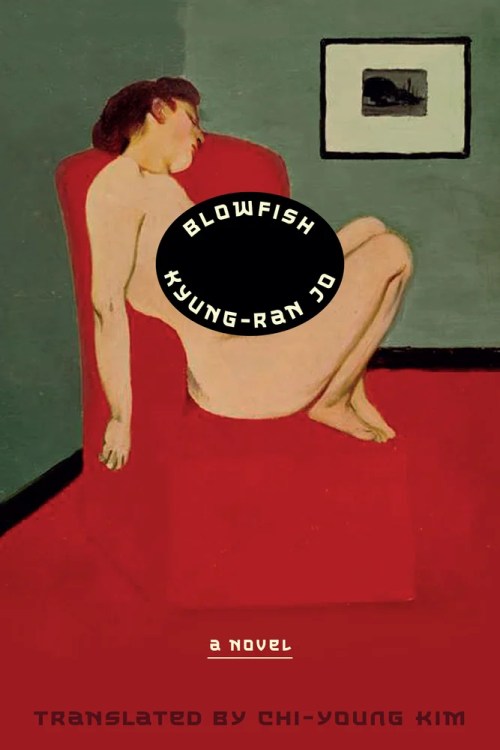
FICTION
Blowfish
By Kyung-Ran Jo
Translated from the Korean by Chi-Young Kim
Astra House
Published July 15, 2025


