


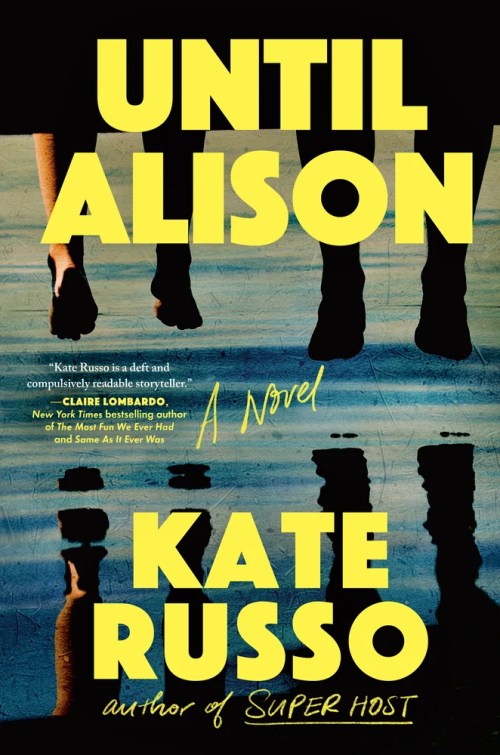
Kate Russo’s Until Alison is billed as a literary thriller, a seamless combination of Rebecca Makkai’s I Have Some Questions For You and Curtis Sittenfeld’s Prep, and while this description is in some ways apropos, the book ultimately begs the question of whether unmet expectations can make or break the quality of a novel as a whole.
Set in a Maine college campus right before the 2016 election, Until Alison opens with a raucous house party that ends with the titular Alison leaving the party with an unnamed male. Our narrator, Rachel, watches Alison enter and leave and tosses out a cruel parting word. The next day, Alison is found dead by a local pond, and Rachel is left simultaneously blaming herself and having to report on the death for her collegiate newspaper. As the novel progresses, it becomes less about the specifics of Alison’s death and about Rachel’s long suppressed childhood memories, which find their way piecemeal through the early narrative and then told in full. It is this narrative choice that skews Until Alison‘s classification as a literary thriller. Really, this novel is an incisive, painfully detailed account of childhood cruelty using the murder as a framing device.
This reality in and of itself does not detract from Until Alison‘s quality as a novel. The childhood memories are told unflinchingly, with details of early Facebook cyberbullying and the complex relationship between class and social status brought to life. Rachel is a college upperclassman in 2016, making us the same age, and so for younger millennials such as myself, these aspects of our familiar middle school existences are palpable and real. Cringe is a valid emotion and a visceral one, and I felt it many times in these pages. Similarly, Russo is able to create nuanced young characters, with Rachel, Allison, Brad, Ethan, and numerous others feeling multifaceted in this narrative.
As a thriller, however, the book does not deliver. The details of Alison’s murder are drowned out by Rachel’s own guilt, as well as conflict among the newspaper staff. Real investigative work is largely left out of the narrative, apart from a single scene where Rachel visits the crime scene and follow-up work once suspects are found towards the end of the book. Unlike the child characters, the adult women that Rachel works with on the paper feel vague and interchangeable, existing only to call Rachel out on her privilege. Because the focus of the novel is Rachel and Alison’s shared childhood, one wonders if Alison’s death occurs only to keep Alison herself from having agency in the narrative.
On the subject of agency, as the mystery of Alison’s death becomes more complicated and we are inundated with Rachel’s memories, we begin to realize that Rachel herself also lacks agency, and while this is a feature of her younger self and explains her existence as bystander, she continues to lack agency in her older years and even as she hunts for the killer. Her relationship with Cam is meant to exemplify the relative privilege white women can occupy, maintaining some semblance of victimhood while in a relationship with a snide conservative man, but the self-reflection we yearn for from Rachel simply doesn’t exist. She is a passenger in her own life story, much to the chagrin of not only the reader, but the supporting cast of the novel. This is not to say that a passive character cannot add richness to a narrative, but Rachel also lacks the incisive commentary and interiority of some of the best passive characters. She is neither observant nor active. Her emotions are kept at a distance. If the novel dedicated some of this emotional energy to the ins and outs of the murder case, that would be more than sufficient, but instead the energy is withheld.
Ultimately, we are left to wonder how best to interpret the genre terms ‘literary thriller’ when considering Until Alison. As a story reliving the painful but illuminative melodramas of youth, the novel shines. But as a novel taking these melodramas and casting them in a retrospective light, interspersing the memories with adult themes and narrative stakes, the novel leaves much to be desired.

FICTION
Until Alison
by Kate Russo
G.P. Putnam’s Sons
Published on July 15, 2025


