


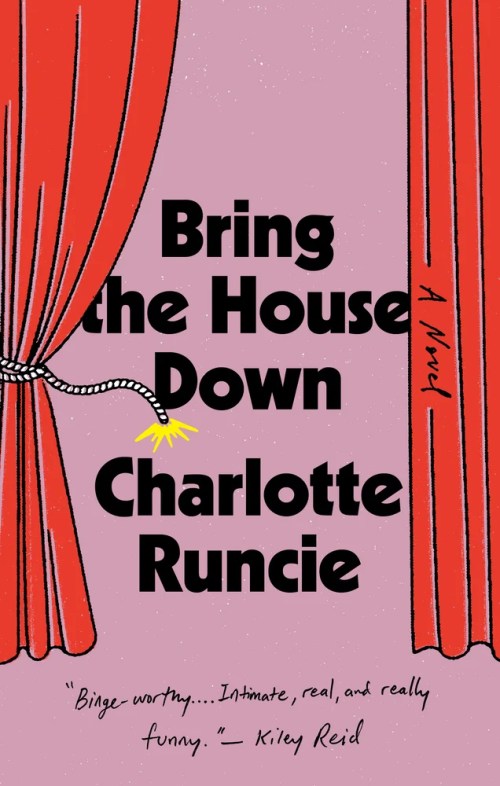
In Charlotte Runcie’s Bring the House Down, Alex Lyons is a well-known, and widely-read, London-based theater critic who is incredibly difficult to please. His reviews are blunt, overtly critical, but above all—his honest opinion. His thoughts about any art he is consuming seem to appear in print without difficulty and without remorse. His words are held in high regard amongst the British theater scene.
Alongside Sophie, the junior culture critic for their newspaper, Alex is attending the Edinburgh Festival Fringe, reviewing performances for the entirety of its month-long run. The story opens with Alex in the midst of writing a scathing, sarcastic, off-the-cuff, one-star review of a one-woman show that discusses the climate emergency and patriarchy, among other things, on its opening night. He does this quickly, in 45-minutes, leaning against a wall outside the venue.
After submitting to his editor, Alex goes out for dinner and a drink where he meets Hayley Sinclair, the star of the one-woman show herself. The two seemingly hit it off, and sleep together in Alex’s apartment that night. Hayley is completely unaware of the words her intellectual hook-up has used against her art—until she finds the review in the newspaper the next morning on his kitchen table.
Enraged, humiliated, and hurt, Hayley rebrands her show in the matter of a single-day to “The Alex Lyons Experience,” revealing to the festival, and the world, what Alex did to her, and what a huge piece of garbage he is outside of his infamous writing career by slowly incorporating testaments from ex-girlfriends and other ex-somethings into the performance. Hayley’s new show is a hit, has rave reviews—and lights an online feminist fire that presents counter-criticism about women and their art—two things often at the whims of insensitive, hardhearted men.
Written from the point of view of Sophie, Alex’s coworker, Bring The House Down is a turbulent and harrowing ride on what it really means to criticize a culture, and discusses what the “cancelling” of a person looks like outside of a social media doom scroll. Sophie observes:
“When you write something that actually says something, actually means something, and then you go looking for what people think about it, you’ll just end up hurt, while the people that came gunning for you move on to the next thing in two days. Grow a thicker skin and do the work of contributing to the culture and insisting on high standards, because someone has to.“
There were multiple instances throughout this novel that had me wishing I was reading with a book club rather than with just a pen in hand. The difficult genius of Bring The House Down is how hard it hammers the idea of there really being two sides to every story—even if those two sides are relatively simple to label as “good” and “bad” from multiple perspectives. One side is a pretentious, privileged, rather crusty man who is not unlike any other 30-something bachelor, and the other a young woman that turned something negative and misogynist that happened to her into a performance that many women found uncomfortably relatable. The narrator, Sophie, absorbs the festival’s dramatic events, both online and off, and resides in the morally grey epicenter of the discourse.
It was pleasing for me to find it obvious through her writing that Charlotte Runcie has a long history of working for magazines and newspapers. As much as Bring The House Down is a thought provoking novel with evolving themes, characters and subplots, there were pages and passages that could have easily been transferable to a compelling profile out of The New Yorker. Runcie writes with a voice that can only be achieved through the bird’s eye view of an objective, observant journalist.
It was also obvious that the plot of Bring The House Down is uncannily similar to an array of debates and smear campaigns that the online Western world has stopped in its tracks for, many having taken place just over the last few years. This novel addresses questions about culture wars that no one wants to be the first to answer, at least not without checking in with our feeds and “for you” pages first.
Everything is a performance in today’s culture. Whether it’s participating in trending online discourse, posting an Instagram story, or writing a book review—there are many environments where not having an opinion is like not having your clothes on. Even when one party is (probably) obviously right and the other is (probably) obviously wrong, can it still be argued that cultural criticism and online “cancellations” have reached such a high level of deconstruction that it breaks humanity, personhood, circumstance, and privacy down to dust—leaving no clear path forward? Once the fires have cooled, after the headlines have become monotonous, and the typing thumbs are tired—is there always a winner? Is one side so obviously right that the culture changes beyond a publicly tarnished career? Or is the actual discourse where most hard questions about our society peak, before they are temporarily forgotten and repeated in some other fashion down the line? Same soup, different recipe. The answer to these questions is discourse within itself, but I am glad to be discussing it alongside Charlotte Runcie and her formidable debut novel, Bring The House Down.
FICTION

by Charlotte Runcie
Doubleday
Published on July 8, 2025


