


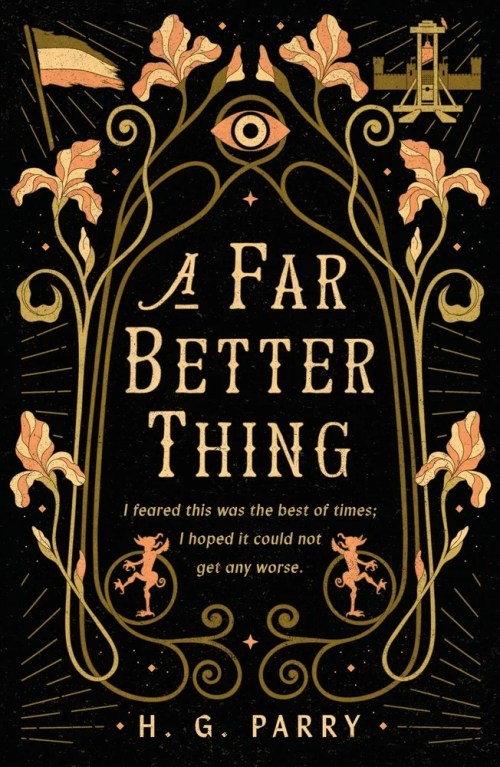
Charles Dickens’ opening sentence in A Tale of Two Cities is filled with foils: light and dark, good and evil, hope and despair, to name quite a few—but nestled in this parable is the premise that we begin “with the best of times.” Of course, I knew next to nothing about this infamous novel when cracking the spine of H.G. Parry’s newest historical fantasy, A Far Better Thing, or its premise to reinterpret A Tale of Two Cities with a hint of magic, realm silver, and fairies.
We begin in a courtroom, inside the first-person narration of Sydney Carton, a mortal servant to the fairy realm and a law professional by day. However, here is where the cardinal rule–to never meet your changeling–is broken: Carton, known as Memory to the fairy world, is met face to face with his own doppelganger, that is, Charles Darnay, inheritor of the Darnay fortune and the atrocities they’ve committed. He is also Memory’s changeling, the sentient being who replaced his life after being robbed from the cradle, like so many children, to live in the Realm. Lucie Manette, when called to the stand, resembles Ivy, Memory’s deceased childhood friend from the realm; fueled by love and revenge, he becomes entangled in fairy politics. Thus begins a decade-long tale set in the backdrop of the French Revolution, including political allegiances, scheming fairies planning to open doors between the realms for perhaps a new land and soul grab in the mortal realm, and Memory’s descent to uncover the hidden plot of the fairies called Shadow and Bartholomew.
Similar to H.G. Parry’s The Magician’s Daughter, the element of magic is infused in historical Europe. In this case, it’s during the backdrop of the French Revolution, with the second half of the novel set in Paris. However, how magic winds into the story is critical to politics in the Realm homeland of the fairies, where the Summer King’s current power wanes in parallel to the French government’s control over its Citizens.
Magical settings in the book are often inaccessible to the public, like the goblin market, pocket doors, and the fairy realm. Furthermore, Memory’s painted disdain for magic, himself, and those involved creates a first-person narrative infused with harsh criticism. In world building, the fairy realm is filled with full-time fairies and a Children’s quarter constructed of eerie white bone—all robbed from the deceased, some by Carton himself—where cradle robbed children run wild until they must decide to become mortal servants or full-time fairies. Due to meeting Memory first as the character of Carton, then by his fairy ties, access to the Realm is a point of return and tension under questioning by the King, or a point of memory (on the nose) through recalling his childhood with Ivy. Bearing this in mind, readers who desire sprawling landscapes will find magic as a means of surveillance in this novel, both of mortal servants and the Realm’s liminal, yet undefinable space.
Stylistically, the novel’s adopted first-person narration of Sydney Carton situates the reader deeply within his self-hatred and loathing for the crimes he has committed as a mortal servant. Upon meeting his changeling and accompanying cast of characters, the reader, too, is simultaneously introduced to the political intricacies of the mortal world and their effect on fairy counterparts. However, as a fan of The Magician’s Daughter’s third-person narration, part of me yearned for some of the distance that narrative structure afforded, which could have increased further insight into Darnay as a foil, in addition to some scenic descriptions.
To conclude, A Far Better Thing begs the question of what exists behind the veil. What if, underneath revolutionary moments, there was a tinge of magic? Readers may find Sydney Carton’s catalogue of fairy and mortal politics—both personal in connection to his mission to avenge the death of Ivy and Nick Caraway-esque in his desire to understand the systems that have ensnared them. And perhaps, like Dickens’ opening sentence, this novel of foils compares mortal to magic and sacrifice to selflessness, and most of all, who is better off with the outcome?
FICTION

By H.G. Parry
Tor Books
Published June 17, 2025


