


Capturing the allure of the divine is no easy feat. Religion in and of itself is a difficult thing to define, to describe. How can you bring substance to something you can’t see, something that exists in the intangible world, something that many deny exists at all? I’ve read many who try, but none who have done it quite so movingly, quite so eloquently, as Megan Hunter.
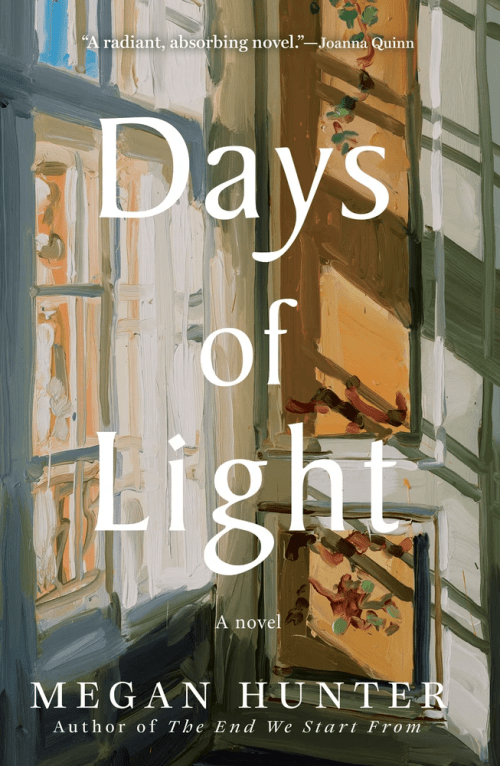
Set over the course of six Easter Sundays in six decades (1938-1999), Megan Hunter’s third novel Days of Light follows Ivy, who, on her 19th Easter, loses her beloved brother, Joseph, to a drowning accident in a river near their home. His death is shrouded in mystery: just as he was drowning Ivy laid eyes upon a glowing light, and upon its disappearance she found all traces of her brother gone. We then watch in quiet awe as Ivy and the rest of the inimitable cast (Ivy’s mother, Marina; Joseph’s girlfriend, Frances; problematic family friend, Bear) weave in and out of each other’s lives throughout the decades—falling in and out of love, grief, and hope in stunning detail.
This book grapples with many things, but Ivy’s obsession with the light she saw when her brother died fuels her choices all throughout the book. There is something about having no closure in a premature death that causes an atmosphere of “what if” to shroud the mind. Joseph’s body was never found, and thus Ivy was never able to let go of that sense of maybe, of that dire need to know and to understand.
What makes Days of Light special is that the sense of wonder so beautifully undercuts the sense of loss, and vice versa, as Ivy explores every avenue of answers: religion, spiritualism, psychics, and more. I think it’s a central part of human nature to question what comes after death, but to me, the whole point of this questioning should be that it informs how you spend your time here. This is what I feel Hunter understood and what she channeled into her protagonist.
Ivy isn’t the most likable character—she often seems to lack agency, and when she does act it isn’t always in the most morally straight manner. She finds herself often trapped by her own decisions, forced to live out the semi-if-not-totally-permanent consequences of them. But at her core, Ivy reflects something that I think all of us experience: the determination and the unfaltering hope of finding what we need, even when that need changes shape over time. Where Hunter strikes gold is in her ability to show us that wants and needs are all about perspective. Ivy fails a lot in this story, but she also succeeds in spite of that failure. In some ways she is a victim and in some ways she is a villain, but at her very core she is what we all are: human.
The can’t-put-this-book-down element of this story is most certainly how the unknown is investigated. The speculative marries the spiritual as Ivy obsesses over Joseph’s death and her white light: this is the driving force of the plot, but the need-to-know-more is the eloquence and mystery with which the otherworldly is investigated. I grew up religious—and am less so now—but this book is the first time I think I’ve really come to understand what draws people so powerfully to religion, what it offers, and how it fails.
(Next is a spoiler, so skip the following paragraph if you prefer not to know.)
——-

Ivy never finds out what happened to her brother. Whether he was truly dead and drowned, had disappeared, or was taken: or if he was still out there, somewhere. If she had discovered the truth, it would have defeated the whole point of the story. It is in the unknown that we can find solace, in the uncertainty that we can trust. If there is one thing that Ivy comes to know, it’s that she doesn’t know, and can only move forward…and really, isn’t that all that’s given to any of us?
Days of Light is a tribute to those who wonder and receive no answers, to those who search their whole lives for a someone, just to find themselves. Hunter has captured something ethereal and haunting in Ivy and Joseph’s story, a sense of what-if that pervades even the hardest skeptics. This book is for everyone, for we are all victims and villains, we are all ephemeral infinities, we are all Ivys, in the end.
FICTION
Days of Light
By Megan Hunter
Grove Press
Published June 10, 2025


