


Trying to tell someone else about your life can start to feel like rambling on about a dream you had last night. There’s a certain quality you can never locate the right words for, a strong sense of “you had to be there” with the full knowledge that there’s no way they could have or can ever be there. What is the point in telling a story that inevitably falls short of its subjects? Where does such a story start and how does it end?
In Susan Choi’s new novel, Flashlight, the Kang family is dogged by the silence of what goes unsaid. Serk, formerly Seok, grows up an impoverished Korean in Japan. He immigrates to the US as a grad student after his family sets off for the Democratic People’s Republic of Korea (the DPRK, better known as North Korea), lured by the false promise of socialist paradise. Anne receives annual Christmas updates on Tobias, the child that she gave birth to at nineteen and signed away to her older lover and his wife. Her college plans are derailed, but she is able to find work as a transcriptionist for an eccentric academic, which is how she meets Serk. When Serk and Anne connect, “Each disclosed his or her life to the point of their meeting, with an air of cool regret that tended to ratify their prior isolation, ratify their meeting. The world had not been fit for either of them; this suggested they were fit for each other.” There is a mutual identification in their remoteness yet neither can figure out how to overcome it.
Setting the past aside may successfully obfuscate details, but negative space is a part of the picture. Louisa—Serk and Anne’s only child—is not consciously aware of all that precedes her, but it is the water she swims in. Anne welcomes Tobias back into her life without consulting Serk, and Serk takes an opportunity to relocate to Japan for a year without telling Anne of his primary goal: surreptitiously seeking out a path of return for his family. Louisa bears witness to shreds of each of her parents’ secrets and over time learns to nurture her own.
The book shifts mainly between the perspectives of Serk, Anne, and Louisa. The story ripples outward from one night: Serk and Louisa walk along a beach in Japan to examine the constellations. Louisa, ten years old, is found hours later, “Hypothermic, blue and gray, her small jaw grotesquely hinged open by the plug of sand filling her mouth” and Serk is gone. She herself cannot recall the time between when they left for the beach and when she wakes up in the hospital.
As the reader, it feels like the scope of the book is evident. An immigrant narrative, an illegitimate son, a marriage adrift, an obstinate and traumatized daughter, cultural barriers, a sad and mysterious accident, quiet grief. Louisa lacks empathy for her mother’s burgeoning and not-yet-diagnosed degenerative illness, Anne knows little about her husband’s alienated childhood, Serk cannot empathize with the hypervisibility and culture shock that Anne experiences moving to Japan. If only they could see what the reader sees, then they’d understand! If only they could find a reason and a way to talk about it all!
The ways that proximity can make it hard to see the people around you recurs again and again; Serk is stunned by Louisa’s maturation, “…amassments—of composure, curiosity, insight—would escape him in their increments, then ambush him all of a sudden,” and Louisa wonders while talking to her mother, “How could the woman in this story, and the woman telling it, possibly be the same person?” It is through the changing points of view and third-person narration that the reader is better able to triangulate who each character is. Even then, huge swaths of each of their lives are omitted, filled in by assumption and approximation.
In reality, the audience is also only holding a flashlight, perceiving what is revealed by a single beam of light. Plodding along in an intimate, often banal story of one family’s tragedy in the first half of the novel, the pacing can seem to drag but the form also evokes how memory can linger in vivid detail for a few specific moments and then zip through multiple years. A trip strawberry-picking takes several pages while decades slip by in a similar amount of text; time unspools in irregular ways.
Choi is able to weave personal stakes, under-discussed history, and geopolitical forces together to form a propulsive second half. The effect recalls something Serk says to his family when they excitedly show him a flyer promoting the supposed wealth of the DPRK with a photo of high-rise apartments. “’I see a building,’ he tried to say kindly, ‘and all that tells me is one single building exists…’” Underneath any story is more story; beginnings and ends are determined by the storyteller. Who knows what’s just out of frame?

Flashlight is acutely aware that for every miraculous survival, there are countless stories that remain mysteries, the “presumed” in “presumed dead” freighted with many unanswerable questions. Even what might read as a happy ending from the outside does not eliminate the scars of what it took to get there, all the minutes that slogged by, hard to explain but crucial.
The novel balances the urgency of an emergency with the reality that many emergencies involve much waiting and uncertainty. The long aftermath of Serk’s disappearance is not just conversations with police or Anne and Louisa’s abrupt move back to the US. It is also offhanded mention of Anne’s “late husband,” or foreign last name and neglected boxes of objects from their life together as a family and Louisa’s insistence on chaperoning her children’s field trips “to keep her hawkeye on them.”
Oftentimes trauma is not an obvious, dominating feature but instead a mélange of behaviors, habits, fears, and feelings. It is not inherently compelling or obvious, it does not make any of them suddenly better. The characters in Flashlight are complex, sometimes stuck in their ways. Each carries their own shard of a bigger story, accidentally cutting themselves and others on the sharp edges. Putting the pieces together wouldn’t render a complete picture, but it can form a beautiful mosaic.
FICTION
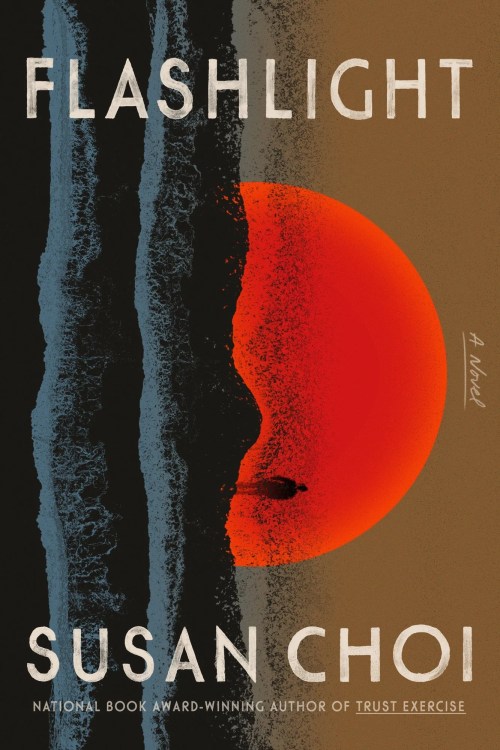
Flashlight
By Susan Choi
Farrar, Straus and Giroux
Published June 3, 2025


