


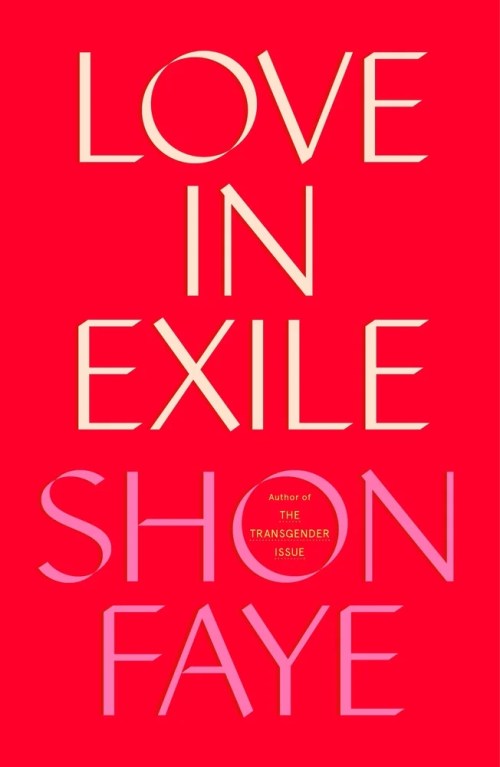
Shon Faye’s new book is an expansive, radical examination of love in what can feel like an increasingly narrow-minded and hate-filled world. In mid-April this year, the UK Supreme Court ruled that the definition of “sex” in the Equality Act is limited to a binary based on “biological sex,” effectively excluding trans women from the definition of woman. In the US, the current presidential administration has taken its own steps to attack trans people, from sports and military bans to restricting gender-affirming care and signing executive orders which state the federal government only recognizes two sexes, male and female. Meanwhile, Hungary has banned freedom of assembly during events like Pride, and a rise of authoritarianism across the globe has led to further persecution and oppression of LGBTQ+ rights. It can be challenging to sit in discomfort and listen to oppositional feelings to one’s own, especially when an opinion might be harmful to the livelihood of oneself or one’s loved ones, yet Faye’s perspective offers grace in the face of disheartening and admittedly terrifying worldwide developments.
Love in Exile acts as an extension of the broader discourse of Faye’s bestselling The Transgender Issue, a thoroughly-researched survey of trans politics. It’s concerned with the persistent scaffolding of contemporary romance and connection in relationships, which Faye argues is anchored in consumer capitalism. The (un)attainability of love is affected by systemic “exile”—an isolation induced by class, gender identity, sex, religion, family, and community. The socialist feminist lens through which Faye approaches the topics of her books, in this case a “crisis” of love, radically redefines these issues as a shared crux, rather than an individual failing within personal relationships, that must be addressed for the betterment of society.
The first chapter of Love in Exile opens with the universal experience of heartbreak after the end of a relationship. The wit and humor of Faye’s writing is evident from the first few pages, where she jokes about others not needing DEI training to empathize with her, “all I had to say was ‘bad breakup.’” Yet between quips, she is sincere in recounting her personal experiences of loneliness and brokenheartedness. As a trans woman, Faye has “every right to feel abandoned and excluded by the dominant culture,” not the least because there are limited examples of romantic relationships between trans women and men. Trans women may further be excluded from narrow understandings of heterosexuality for not fulfilling a reproductive “purpose.” To this point, Faye notes that the restrictive norms we place around love—often to meet ideals set by capitalism—such as procreation to create a larger workforce for eventual profit, will “confine and curtain us all.” This is not an argument against having kids or even ascribing to norms such as traditional representations of femininity and masculinity, but to say that restricting culture to conform to a narrow ideal—a “crisis of expectation”—limits our ability to connect, evolve, and love one another. Likewise, with nuance, Faye advises to look beyond the pedantics of culture; it’s easier to write off a nuclear family with a white picket fence than address shared issues such as poverty, lack of health resources, and injustice. Coercion and shaming are ineffective tools for liberation, warns Faye.
Often the experiences of trans women are sequestered as irrelevant, or indeed harmful, to society at large. Trans-Exclusionary Radical Feminists (TERFs, such as those who campaigned in favor of the UK’s recent Supreme Court ruling), might argue that “trans rights threaten women’s sex-based rights,” as Faye notes. Trans women might then be painted as a threat to cis women, particularly mothers. She explains why this line of thought is misguided, countering that women’s “problems are not caused or even obscured by trans people, but by the way a heterosexual, patriarchal, and capitalist society has devalued her body, her mind, and her work.” This argument, again an extension of topics explored in The Transgender Issue, brought to mind a workshop I recently attended on LGTBQ+ history and activism in Ireland at University College Dublin, where panelist and trans activist Morrigan O’Malley (involved with Transgender Equality Network Ireland) contended that trans people’s fight for representation and recognition is more closely aligned with feminist-led movements for reproductive rights than marriage equality campaigns. It was a reminder that trans and cis women are both engaged in fights for bodily autonomy, and unnecessary segregation and hate only allow the structures that exploit, isolate, and harm trans and cis women alike to remain in place. The point further underscores the importance of intersectionality in all activism.
Faye’s study of these bigger-picture crises—a frequently-used word in this book—are juxtaposed with excavations of her own struggles and education. There is an element of Love in Exile that does feel journalistic, but this doesn’t necessarily feel jarring against most of Faye’s anecdotes, which she employs to call attention to both the privileges and obstacles unique to her life. Her writing is self-aware and lacks the stiffness of pretense.
Interspersed with relevant, well-researched information from academics and critics, such as bell hooks, are pop culture references which lend an accessibility to the book’s overarching socioeconomic analysis. In one chapter, Faye explores a paradox of femininity and heterosexuality within the songs of singer-songwriter Lana Del Rey’s discography, particularly Normal Fucking Rockwell. “It’s all very transexual,” says Faye. In examining a twenty-first-century Western idea of love, she deftly shifts “from ancient philosophy to Beyoncé” and later challenges the beloved catchphrase of RuPaul’s Drag Race in a chapter on self-love: “If you can’t love yourself, how in the hell are you gonna love somebody else?” Faye advocates for a more imperfect scenario: you can work on loving yourself while also learning to love others.
One of the more compelling memoiristic chapters in the book centers on Faye’s alcohol abuse and its role in her prior relationships. It brings to mind Dolly Alderton’s Everything I Know About Love. Addiction, for Faye, sometimes “feels more like a love story than a disease.” She likens the edge of a blackout to the beginnings of a crush or infatuation in a new relationship. Once the rose-colored glasses come off, or the drink wears off, gaps in information might arise that lead to misjudgement or self-betrayal. Faye holds a fascination with salvific relationships—a common notion in both straight and queer relationships that a partner (or partners) might be able shield one from “the brutality of the world.” Anything can be overcome with love. Unfortunately, there is a two-fold issue with that conviction: it places pressure on relationships to be perfected, and likewise ignores the very “social conditions that create the loneliness that prompts some people to self-medicate.” Although she cautions against self-pity, there is no obfuscation for Faye: “Our search for love is collective and political.” The onus is on our communities.
While Faye’s endeavor to explicate the relationship between her personal experiences of love and a broader societal crisis is convincing, some of the momentum of the previous chapters is lost by the final chapters, perhaps due to digressions in the text. For example, the final chapter of the book opens with a teenage fixation on Thérèse of Lisieux. Several pages explore the saint’s background before Faye ties the figure’s story into her own spirituality and religiosity. For her, seeking God is akin to seeking love. There’s no doubt queerness and Catholicism and love are fascinating intersections—Seán Hewitt’s All Down Darkness Wide beautifully explores this—but arguably this requires some intimacy with the reader to be fully effective. Unlike Alderton, Faye often eschews deep exposition in her anecdotes, thereby keeping a firmer distance. To be clear, this is not to suggest trans and queer folk owe anyone their pain or loss, and Faye pushes back against an urge to derive “neat lessons” from personal agonies. Rather, perhaps for the secular reader, contextualizing feelings around faith against an individual situation may allow for communion. Nonetheless, any digressions are not so far-fetched within the collection to be out of place, and Thérèse’s story might have an appeal for religious readers. Further, Faye’s spirituality is critical to her sociopolitical point of view.

In this, Love in Exile is a hopeful meditation on humankind’s possibilities. At the outset, Faye states that “seeing and knowing love, in whatever form it takes, is the meaning of life.” Other chapters in the book touch on a wide range of topics necessary to productive conversations about love, from heteropessimism to trans fetishization, the “crisis in male friendship” to the transformative power of female friendships, motherhood to “mothering” in queer communities, and more. For the most part, all of these ideas fold into each other with ease, and the collection is well-tied together by an overarching intrigue with “the politics of love.”
Yet the book’s postscript effectively urges readers to go beyond self-education in practicing love—connections aren’t cultivated by reading a book. Love is a universally uncharted terrain, like life itself. Each of us, Faye reminds, has a body, a beating heart, and “a future beyond.” That future is shared, and it will require a community fixed in love for survival.
NONFICTION
Love in Exile
By Shon Faye
FSG Originals
Published May 13, 2025


