


Ocean Vuong is one of my favorite novelists, because he is a poet. His long-anticipated sophomore novel, The Emperor of Gladness is an admirable compliment to his resume of work and widens his stance as an artist that continues to provide irreplaceable commentary on American life, speaking not to his readers, but through.
I am left with the memories of my old coworkers, and the lost rhythm of our rapport on a busy Saturday night. I am thinking of the cashier at the gas station next to my parent’s house who has been there since I was a teenager. I am thinking of my own grandmother with a dementia diagnosis, and where in the world her memories are. Vuong creates both a smooth page-turner, to be evaluated—and a lyrical poem, to be experienced. His writing makes me question what the difference is really, between a novel and a poem—and the Emperor of Gladness is no exception.
East Gladness, Connecticut is a town that feels like a participating character. It has American small town qualities: blue collar, working class, immigrant families, full of tired castaways, just down the road from better towns with happier people and more money. There is a weak feeling of real community behind closed, locked doors. There is hardly a sliver of local pride in its streets and strip malls, because what would be the point? Full of people with grit, but at what cost? East Gladness is a commercially caught fish in a big sea.There is an ambiance of being forgotten by its country, as there are too many just like it. Perhaps like a lot of our hometowns, it has that American energy of being simultaneously unique and unremarkable. This is where Hai lives, our nineteen-year-old protagonist, who we first meet as he stands on a bridge over a dark-watered, choppy river, considering whether or not to jump.
Hai’s decision is interrupted by what seems to be a laundry debacle between a clothesline and an elderly woman, who is cursing into the night from the porch of a rail house on the river’s edge. Though her bedsheets have been taken by the wind, her attention is quickly turned to the person she notices standing on the edge of the bridge. Hai meets Grazina, an eighty-two-year-old widow, as she callously, almost comically, calls out to Hai and instructs him to wrap up whatever he thinks he’s doing, and demands he come inside her home. With a feeling of being found out, exposed, and with seemingly no other place to go, Hai backs away from bridge’s ledge, and does just that.
An unlikely pairing, the two quickly become acquainted with the ways they can help each other, and Hai becomes Grazina’s caretaker. She is near the end of a long life but in the middle stages of a dementia diagnosis. Hai is responsible for keeping her fed, well rested, ensuring her medication is taken, and serves as a person of interest in her many hallucinatory episodes. She often mistakes their reality with her memories of home, in Lithuania sixty years ago.Together, Hai and Grazina are often fleeing Stalin’s invasion of her homeland, fighting off German troops, or addressing other ghosts, all from the comfort of their shared bathroom. He does all this in exchange for a place to live. Soon after adjusting to this new routine, Hai finds a job through his younger cousin Sony, who gets him hired at a local fast casual chain restaurant, Home Market.
As we spend more time with him, we find out just how unsure and complicated Hai’s young life really is. He makes it through the days on the wings of a pain killer addiction, he idly maintains a complicated relationship with his mother, his sexuality a lingering secret, just out of grasp. He is out of money, and low on stamina for the cruelty of capitalism. Yet we also get to know Hai as a delicate caregiver, a protective cousin, and a loyal coworker. The Emperor of Gladness covers nine months of Hai’s life as he attempts to rebuild from where we found him on the bridge in the rain.
This novel explores a variety of themes that fit together like puzzle pieces: labor, perseverance, found families, decades- long side effects and consequences of war. East Gladness, its inhabitants, and Hai’s observations of them serve as a petri dish for recession era, early-Obama American life. Every character has intention, and they read like familiar friends. Hai’s coworkers are all surviving or recovering from something. Hai finds belonging in each of them, and they each bring their own little piece of America to the table with their personhood. Through dialogue, shared experiences, the revisiting of memories, and depictions of the average day at Home Market, Vuong finds a way to encounter a list of things America does well. The violence in our crime, the attitude towards our addicts, the idolization of our wars, the unjustness of our prison system, the quantity over quality in our food, the disregard for our unhoused, and the abandonment of our elders—to name a few.
The Emperor of Gladness is a reminder that to be an American, no matter how or why you got here, is to be a product of something else. Vuong writes for the very real and individual lives that exist within the blur of an average day—passerbys, gap fillers, the numbers that occupy your local census. We are all background characters in someone else’s heartfelt, painful life, functioning together in the workplace that is our country. Somewhere in these poetic passages, there is a love letter for those who spend everyday just trying to get through their shift.

Despite it all, a nineteen-year-old Vietnamese boy and an eighty-two-year-old Lithuanian woman can find each other in the scuffle to stay alive. Of two different generations, two different mother tongues, and the consequences of two separate sadistic wars, Hai and Grazina find each other in the shared silence of a soft chair, a buzzing TV set, and the warm sodium of a Salisbury steak—some place in Connecticut. “To be alive, and try to be a decent person, and not turn it into anything big or grand, that’s the hardest thing of all,” Grazina says. I found reading The Emperor of Gladness was undemanding, despite the large and challenging themes. A reader’s high is imminent with Vuong. The dialogue is natural, the settings consistent, his characters welcoming me home like turning on a favorite sitcom and drifting into the reality of a whole meaningful life lived between 2-5 rotating sets. I am one of the gang. I am a fly on the wall during a busy shift at Home Market, a shampoo bottle in the bathroom while Hai and Grazina hide from the Germans behind enemy lines. I am participating, a part of it, an invisible onlooker, until he finds me. Vuong finds me in the words and it feels like making eye contact across a crowded room, a shattering of the fourth-wall into shards around my feet. His prose often forces you to look up from the page to fully absorb them and remember where you really are, a different time, or whatever we’re calling America in 2025—a place that feels like a really long way from home.
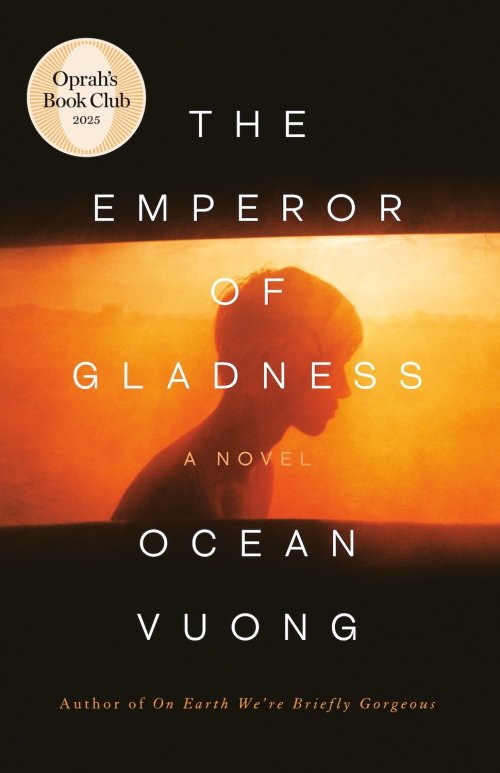
FICTION
The Emperor of Gladness
By Ocean Vuong
Penguin Press
Published May 13, 2025


Such a beautiful tender hearted novel with a cast of unforgettable characters. I loved it.