


In the wake of a punishing publishing cycle, novelist and editor Tom McAllister attempted to rekindle his writing life with a challenge: write a flash essay per day, one for each year of his life, in chronological order. As he hoped, these arbitrary constraints presented new freedom and energy; they also returned to the fundamental questions of memoir—memory, truth, and how we think about ourselves. His survey of forty-two years also explores issues including masculinity and violence; the evolution of social media, and the roots of anger and division online; and complicated and mysterious family relationships. Tom and I caught up over email to discuss the evolution of It All Felt Impossible, and his own journey as an artist, published author, and literary community member.

Stephanie Feldman:
What’s it like to return to memoir, in flash form, fifteen years after debuting with your conventionally structured memoir Bury Me in My Jersey? The structure here is different, but what else has changed in how you approach personal writing?
Tom McAllister:
When I wrote that first book, I had no idea what I was doing. My MFA program had a strict firewall between fiction and nonfiction—it was weird and there was a pretty clear sense from the faculty that nonfiction was an inferior genre. So I stumbled into it, and everything was instinctual. Since then I’ve become a better and more thoughtful writer. I’ve read so much more in the genre and I understand its possibilities. I’m also not constantly trying to prove how smart I am, as I once did.
Stephanie Feldman:
This deep into your career, you can think back and ahead to how readers will receive your work. There are consequences like your uncle’s angry response to your first memoir; critiques from readers who think your jokes are too sad and your sad stories are funny; and the knowledge that your past “hasn’t aged well.” How do you carry all of this and still write honestly?
Tom McAllister:
Now in my forties, I feel acutely aware of my personal virtues and failings. This kind of self-knowledge only comes with age, no matter how you want to rush it. Now, just as if I’m writing fiction, I fully understand the character in the text and feel I can be honest about his thoughts, feelings, and actions. Some people won’t like it, but I know—and they’ll know—that I’m telling an honest and ethical story about a complicated person.
On a more practical level: the word limit I imposed on these essays meant there was very little room for the kind of self-justification, and excuse-making that many writers are prone to in essays.
Stephanie Feldman:
You noticed that often one idea or topic would lead to an entirely different idea or topic. How do you create thoughtful structure while embracing a “meandering and plotless” mood?
Tom McAllister:
I have a tendency to write long, labored transitions between ideas. This helps me to figure out what I want to say, but then I have to cut ruthlessly in revision. Again, the harsh math of the word count constraint was a huge factor in the structure of the essays.
When I shift topics, times, or places, I try to make sure the sentences in which the shift occurs are focused on concrete, grounding details and a strong, active verb. To carry the reader from a penguin exhibit at the zoo to the back seat of my mom’s car to a monorail in Seattle twenty years later—and to have it all make sense—it’s crucial that the sentences be as sharp as possible. What I’m saying is it’s just about nouns and verbs.
Stephanie Feldman:
In “1987,” you write about several frightening memories from your childhood, including falling through a cellar door, discovering your grandmother’s dead dog in the trash, and riding in a car with no floor. Yet, none of these events happened (or are even plausible). What do we do with our “invented histories,” as writers and as people?
Tom McAllister:
In Samuel Delany’s introduction to his memoir The Motion of Light in Water, he talks about how for years, he told one story about his youth—his father died in 1958 when Delany was seventeen, but he later learned that both numbers were incorrect. Delany dwells on the discrepancy because he says the memoir would be incomplete without it. From the perspective of a memoirist, false memories present an opportunity. We all have the story we tell ourselves, the story others tell about us, and the story as represented by the hard facts. They’re all valid, in their own way, all worth exploring. Why do I remember seeing that dog in the trash so vividly? The dog doesn’t matter as much as the memory of the dog does.
Stephanie Feldman:
Many of the essays consider violence. You’ve previously written about gun violence in your novel How to be Safe, and it appears again in “2015,” about paranoia and your simultaneous abhorrence of and attraction to guns. Did you intend to return to this topic, or did the essays lead you back here again?
Tom McAllister:
Violence is such a constant in the atmosphere of twenty-first century America that I can’t help but think about it, even when I don’t want to. I grew up in Philly, in a neighborhood where everyone fought (we all kept track of one another’s fight records), so I learned to always account for violence. It was naturally going to appear in any honest accounting of my life.
Stephanie Feldman:
You observe “Nobody writes a new book; they write the same book over and over until they feel a little better about it.” What is your one book?
Tom McAllister:
The easy answer is I’m writing about my dad, who died when I was in college, and whose loss I failed to properly mourn for many years. A slightly fancier answer: I find myself drawn to stories about alienation, about self-destructive people who could make things easier on themselves but just keep making the wrong decisions.
Stephanie Feldman:

Your forty-two years happen to span the development of the internet and social media, and several essays, like “1999,” trace how men express and reinforce hostility toward women and each other. I want to ask if there’s a lesson here, about de-escalating division or combating radicalization, but maybe that’s too hard and too easy at the same time. Perhaps the real question is: When we discover painful truths that defy resolution, and difficult problems we have no power to solve, what can we do instead?
Tom McAllister:
There’s a power in naming these problems, even if we can’t solve them. Through clear thinking and clear language, we can invite the reader to see the world as we do and let them know they’re not alone. I’m a bit jaded about the power of literature to change the world, but I do believe strongly in its ability to change a single person.
Stephanie Feldman:
The book includes one of my favorite running features on your Book Fight! podcast: the writer who achieved publishing success and then “disappeared,” like James Ferry, whose only published story made it to 1982’s The Best American Short Stories. How do these examples shape your idea of “success?”
Tom McAllister:
Like many young writers, I once had a narrow definition of success—bestseller, national book tours, major awards. To the extent that such a career exists for anyone today, I know that it doesn’t for me. I admit, I thought maybe I was right on the verge of breaking through with How to Be Safe, but the hype dies down quickly. I’ve come to believe writing is just about the work itself, connecting with people who share your sensibilities, building community. It’s about producing something that only you can. Although I’m still hoping to reach as many readers as possible with this book, the reward has been in the process. It’s just really cool to have a book out again, and to have worked with a team at Rose Metal Press that cares about it as much as I do.
Stephanie Feldman:
Along with your writing, you’re an editor at Barrelhouse Magazine, a host of the Book Fight! podcast, and a faculty member in the Rutgers MFA program. What can you share about building and maintaining literary communities, especially in a time of corporate media consolidation?
Tom McAllister:
I recently hosted a reading for our MFA students at a bar in Philly, and as I was looking around the room, I realized this is all I ever wanted out of my creative life. A small group of talented friends who are all trying to make something beautiful. I need to remind myself sometimes that showing up is crucial to maintaining and being a part of a community. You can show up in lots of ways: making sure your podcast drops on a regular schedule every week; continuing to publish issues of the lit mag; supporting other writers online. The whole literary world is incredibly small, and the indie lit world is even smaller. It can only survive—it’s only worth preserving—if we are in it together, and making it a supportive, joyful space.
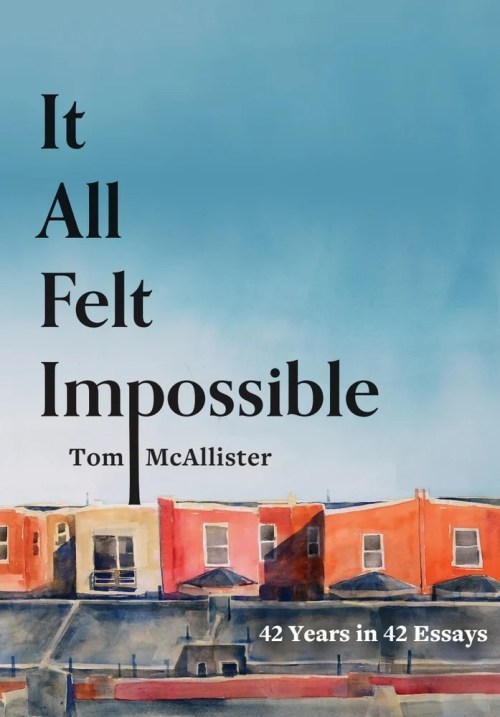
NONFICTION
It All Felt Impossible
by Tom McAllister
Rose Metal Press
Published May 14, 2025


