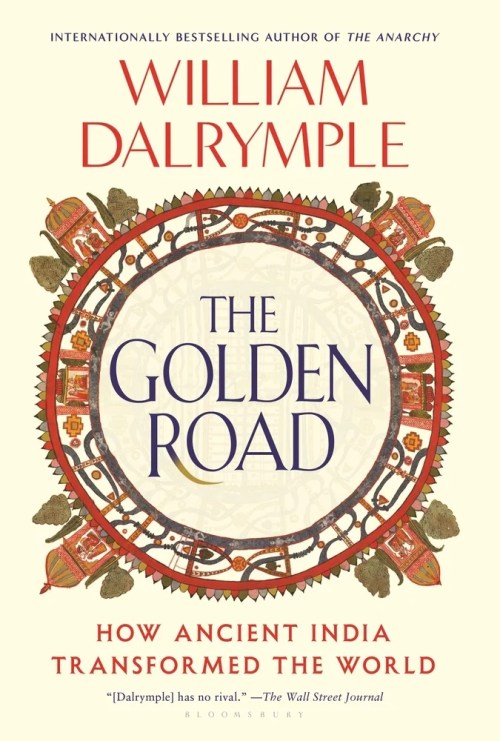
In his new book, The Golden Road, William Dalrymple turns his gaze to the spread of Indian influence across the ancient world. This is, in many ways, a culmination of his lifelong engagement with the subcontinent’s cultural and spiritual histories and Dalrymple charts the journey of ideas—Buddhism, Hinduism, architecture, cosmology—from the Indian heartland to lands far beyond its shores. I came to The Golden Road through the popular podcast Empire (hosted by Dalrymple and Anita Anand), and this book, through densely researched pages, brings to life the vibrant network of global trade and exchange of ideas that transformed much of Southeast Asia as well as ancient Rome and the Middle East.
There is much to admire in The Golden Road. It shines in its treatment of China—especially the extraordinary chapter centered on Empress Wu Zetian and the monk Xuanzang. Here, Dalrymple is at his best: balancing scholarship with storytelling, and illuminating a moment of unlikely cultural and political synthesis with clarity and grace. Buddhist fables had to be fabricated to legitimize a woman ruling over a Confucian court, and it is fascinating to read Dalrymple’s quotes on the myth-making collaboration between Indian and Chinese monks to conjure divinity:
The prophecy of the Devi is that she should rule over the land in the body of a woman . . . I will send the Devi with rods of gold to punish any arrogant and recalcitrant men that refuse her. (146)
Dalrymple renders Empress Wu Zetian as a crafty and merciless ruler, profoundly invested in Buddhism as a vehicle for legitimacy and philosophical reform, and this section is rich in nuance and vivid detail. He demonstrates how India’s civilizational reach wasn’t limited to its immediate maritime neighbors, but extended deep into the Chinese court and monastic tradition, leaving traces that would shape Chinese religious life for centuries.
Unfortunately, for all the depth Dalrymple brings to other parts of Southeast Asia—Cambodia and Indonesia in particular—his treatment of ancient Indian influence in Malaysia is strikingly cursory. This omission is particularly glaring given the Malaysian peninsula’s key historical role in oceanic trade. The Bujang Valley in Kedah, for example, is among the earliest and richest archaeological zones in Southeast Asia with evidence of Indian cultural presence. With ruins dating as far back as the fourth century CE—temples, Shiva lingams, inscriptions, and Buddhist relics—Malaysia stands as a critical link in the long history of commercial and cultural exchange. And yet Dalrymple barely skims the surface, with Kedah mentioned in three continuous pages, and spottily otherwise. The reader is left with only passing references to this region, despite its significance to the very thesis of this book: that Indian civilization flowed eastward not through conquest, but through cultural magnetism.
Dalrymple’s oversight here is not simply one of space but of interpretive weight. In neglecting Malaysia’s complex historical entanglements with Indian religious and political systems, he reinforces a problematic bias long embedded in colonial historiography and one propagated by Malayo-Islamic chauvinism—namely, that the grandeur of Indian influence is left erased, and at best a footnote. This erasure continues on the streets of Malaysia even now: in April 2025, members of the groups Pekida and Gabungan Hak Bela Insan held a protest against an academic conference at the Universiti Sains Malaysia, claiming that the spotlight on the ruins of what are said to be Hindu temples in Bujang Valley would undermine Malay-Muslim identity.
If The Golden Road aims to tell the full story of Indian civilization’s outward arc, then Malaysia’s omission is more than just a missed opportunity; it is a structural flaw. One wishes that the same careful attention lavished on China and Cambodia could have been turned southward, to the humid coasts of the Malay Peninsula, where Indian religion and trade helped shape a cultural crossroads that still echoes today.
Despite this, there is no denying that The Golden Road is a major achievement and Dalrymple’s ability to animate entire worlds from fragments of ancient texts is exemplary. His writing is engaging and falters rarely, as in this description of Buddhist cave murals:

These court women wear little but spinels and chrysoberyl cat’s eyes; they hold nothing but empurpled ebony flywhisks of burnished gold; gleaming rubies the colour of peacocks’ blood flash against their dark skin. (italics mine, 30)
Here, the white male gaze unreels purple prose about exotic dusky women—of course peacocks, like all birds and other vertebrates, also have red blood—and seems jarring. But such passages are rare, and Dalrymple’s vision of India as a civilizational fountainhead whose ideas flowed across oceans and centuries remains a compelling corrective to insular nationalist histories. The Golden Road is an important book.
NONFICTION
The Golden Road: How Ancient India Transformed the World
By William Dalrymple
Bloomsbury Publishing
Published April 29, 2025