


I met Arianna Rebolini in 2019 through a spreadsheet, facilitated by a neighborhood parent group, of pregnant people with July due dates. We got to know each other haphazardly, in the way of those thrown together by coincidence and in the context of first-time parenthood. I was delighted to discover she was also a writer, though our early conversations were more about feeding, daycare costs, and sleep training. I was impressed by her job as Books Editor at BuzzFeed, though it seemed to be causing her distress for reasons I would only piece together over time and confirm much later.
At some point, she mentioned her hospitalization for suicidality, but this was another thing I wouldn’t understand until later: how recent it was for her as a new mother, and how she was still, when we met, trying to define for herself the idea of recovery.
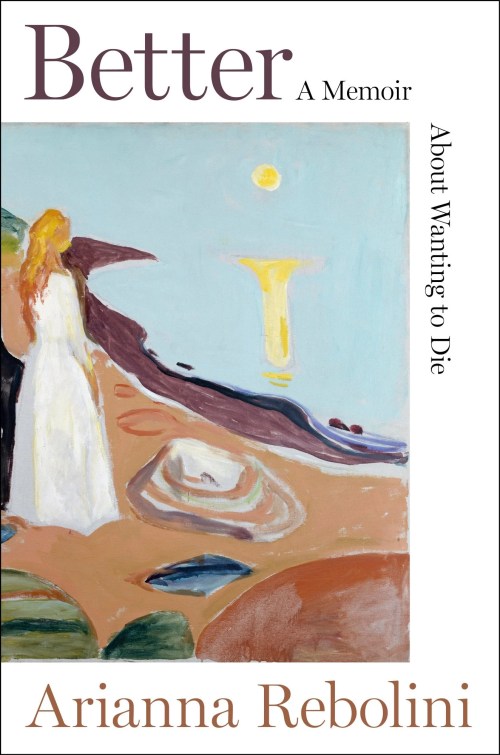
Better: A Memoir About Wanting to Die traces that journey. The book is both an act of defiant self-expression—an insistence on vulnerability over shame—and an academic exploration that asks seriously: “What is making us want to die?”
I spoke with Arianna in March over video call, and our conversation has been edited for length.

Shayne Terry
I remember first talking to you about this project in 2019, but it changed over time. Tell me about the book’s conception and evolution.
Arianna Rebolini
I started writing it basically as soon as I got out of the hospital in June 2017. You’ll relate to this as a writer, but you feel this urgency with your projects. I had an agent and within six months of getting out of the hospital, I was like, proposal, done, let’s sell this book.
For the next year or two, I went through three versions of the proposal. I was just so eager to get the story out in whatever way my agent thought would be most marketable, but neither of us knew what it was supposed to be. It wasn’t right, it wasn’t the right time, and I am so grateful it didn’t happen then. That agent and I parted ways, but I’m so glad that she wasn’t like, “If you think this is ready, let’s go,” because that book would have been so much different—and so much worse. I needed more space from the “inciting incident” to know what I was trying to say.
It was disheartening when my agent and I separated. It feels like a breakup. And for a while I thought maybe this book just wasn’t meant to be. While I was pregnant, I didn’t really write, and then those first postpartum months….
It was really when the pandemic hit and everything blew up, and my mental health plummeted like so many people’s, that it became clear to me: this book is actually something.
It started with the question, “How am I going to get better?” And it was going to be a lot neater. Then, when everything went to shit, I realized it was really about the fact that better doesn’t really exist, not in the way we want it to, and it just made a lot more sense that way.
Shayne Terry
So you started off thinking it would be a narrative about being sick and getting better.
Arianna Rebolini
I went into it thinking it would be a book about wanting to get better and getting better and researching it in real time. Originally, I was like, imagine I get pregnant at the end, and that’s the end of the book—that’s how you know I’m better. But early on, it became so clear that that way of thinking was flawed.
Shayne Terry
You end up poking holes in the linear recovery narrative, this idea that if you can only achieve X and Y, or if you can conduct this project of recovery perfectly, then one day you’ll be “better.” Maybe, you suggest, you’ll never stop wanting to die, and maybe that’s okay. Perhaps one can dispense with the need to be fully “healed,” whatever that means, and live with the desire to die.
Arianna Rebolini
Once I realized that I actually don’t think being fully better is really possible, at least not in the clean way I wanted it, then I decided the book would be about how “better” is complicated.
We hold ourselves back in so many ways, waiting for this moment of being okay. We have these expectations of how happy and how good and how productive our lives should be, but I know for myself that having this idea of what “better” would look like, it just wasn’t helping me. It kind of feels like I’m saying you have to settle and that’s a sad thing, but that’s not what I’m saying. Yeah, lower your expectations, and that’s actually great and freeing. I actually think settling gets a bad rap.
Shayne Terry
Throughout the book, you frequently quote your own journals, text messages, online chats. When writing memoir, there’s a craft choice that must be made early on between relying on memory alone or researching the personal archive. Why did you choose the latter?
Arianna Rebolini
It was for really practical reasons. First of all, because of the distance the book covers. To really tap into how I felt at my worst…it’s hard to write that when you’re feeling okay, and then also it’s really hard to write at all when you’re feeling low. I didn’t know if I could tap into that emotion and write it well, but I wrote it in my journal, so I could just take it from there.
Also, my anxiety is so obsessive about getting something wrong. I feel like being on the internet during peak cancel culture—I was always afraid I would say something wrong and my career and my life would be over and that, still, is in me. I needed to make sure that the book was as accurate as possible.
Shayne Terry
To the extent that you actually start with a correction to a previously published essay, which, you discovered while writing the book, contained a faulty memory of your own suicide attempt.
Arianna Rebolini
That was so trippy. I genuinely felt panic. Because I was like, now that I know the truth, I need to write it the way it really happened. But then I was worried—what if someone reads this and says, “Wait a minute, you wrote this differently in an essay…” As if someone is that obsessed with my work and so dedicated to ending my career.
Shayne Terry
The impulse to correct the record is one thing, but also layering in all these pieces from all these different texts of the past self just makes for a really realistic portrayal of what it is to be a person. Putting that discovery on the page is a way of acknowledging that memory is weird, which is one of the things the book is about: the different versions of the self and the fallibility of memory.
Arianna Rebolini
Especially if you are a person who journals a lot, you are shaping the way you remember things—you’re writing new memories.
I wrote about finding my friend Melissa ready to kill herself at a college party. I sent her the chapter and was like, “Are you okay with this?” And she was like, “Yes, but that’s actually not how I remember that night.” I would have sworn—I could see it—that she had been fumbling with a disposable razor. And she was like, “I wasn’t. I had whiskey, and my plan was this.” She suggested that maybe I’d remembered a story of when she was little and accidentally broke a razor, and maybe my mind merged those. Maybe? How does the mind work? I swore I could see it.
Shayne Terry
The book uses as touchstones other writers who have experienced suicidality—Sylvia Plath, Virginia Woolf, Édouard Levé, Donald Antrim—as well as suicidologists, psychologists, and philosophers who write about suicide. Tell me about the process of building the book’s bibliography—the research outside the personal archive.
Arianna Rebolini
Going back to that first book that I thought was ready to go, that was just fully Plath, Woolf, David Foster Wallace. It was literary analysis.
Shayne Terry
That’s the book you told me about in 2019.
Arianna Rebolini
Absolutely. It didn’t really grow until I realized in 2021 that it would be about society and the real-world effects. But it’s funny because even when I sold it in 2022, even when I was broadening to philosophy, I still had this idea that I didn’t want to mess with the integrity of this heady text. I’m an English major.
Rachel Kambury, my editor, during our talks before she bought it, wanted to know if I’d be open to making it a little more modern, bringing in scientific research. And she was right.
Once I started, it was a snowball. I would read one book and look at their footnotes and then read those books. It became about sociologists, people who study suicide and depression, and especially the data—who kills themselves, the demographics, and the stuff that is so relevant right now about how the real world can make people suicidal. It’s not just something that lives in your brain.
Shayne Terry
Because one of the book’s arguments is that sometimes the desire to die is not irrational, that things like for-profit healthcare and poverty can make people rationally want to kill themselves. Can you talk about coming to that realization—what changed for you once you realized that?
Arianna Rebolini
That is definitely something I came to understand while writing this book. It’s a touchy thing to talk about. I absolutely was a person who subscribed to this idea, like, “This is an illness. If I kill myself, it’s because the illness won. It wasn’t me.” And I never want to say that’s bullshit, because I know that helps a lot of people and I know that it’s not completely bullshit; it’s complicated.
I came to a better understanding of myself once I started acknowledging that, yes, maybe my depression makes it so that I can’t stop focusing on the bad things that are happening in my life, but those bad things that are happening in my life are real and are valid reasons to not want to be alive anymore. If someone is like, “I can’t afford to eat” or “I’m being targeted because I’m trans,” all these things that make living awful, it’s disingenuous to say, “It’s mental illness that you want to die. You need to heal that. You need to fix your brain.” It’s a tricky thing to get into, because there is truth to the mental illness aspect, but we’re not helping anyone by limiting it to that.
Thankfully, these were things I was coming to terms with while other people were saying it too. It is a really researched book, partly because I doubt my thinking all the time, and that makes me a more rigorous reader and I’m glad for that, but at a certain point, I was like, “Is it weird that I actually think it’s maybe not crazy to say we want to die because none of us can afford to live?” And then I saw, this writer wrote about it, this person tweeted about it. I’m not alone in thinking this. And to be able to include that in the book was helpful for me.
Shayne Terry
You had this idea at the beginning that you had to be better in order to have a kid, and then you realize during the book that you don’t feel better but you still want to have a kid. You have this beautiful line: “A mother is a mother whether or not she wants to die.” It’s really powerful to realize that one can want to die and can still be all the things they want to be in this life.

Arianna Rebolini
It’s a weird thing to hold. It’s a scary thing to say. I actually wanted to ask you about this: writing about your child knowing they might read it….What is [my son] Theo going to think? My mom was my mom and also she wanted to die? I wasn’t enough?
I know he has no doubt how much I love him because I know how I mother him and I’m raising him in a way that, I hope, him finding that out wouldn’t undo all that. But it is just an uncomfortable thing to sit in. You didn’t name your kid in your book. Was that something you always knew you were going to do?
Shayne Terry
My book had so little of my kid in it, to the point that when I sent it to my agent, she was like, “Where’s the baby in this postpartum book?” But I recently wrote an essay that was about my decision to have a child and the various things that influenced that decision, and my husband was concerned about me publishing it. He was worried that our kid would read it one day and feel unwanted. I spent a couple of months sitting with that feedback and I did choose to make some edits, but ultimately I feel the same way you do—my kid knows how much I love him, and anyone reading the essay in good faith will understand that, however I got here, I’m glad I have a kid now.
This reminds me of that time in maybe 2022 when you tweeted something along the lines of, “this part of parenthood sucks,” and you were attacked online. I remember your responses to those attacks and you insisting: “Saying this part of parenthood is shitty doesn’t mean I don’t love my child.” I admire how you engaged with it, and it was helpful for me because I was having a really hard time with the toddler years. You gave me permission to say, “I don’t like this part, and that doesn’t make me a terrible mom.”
Arianna Rebolini
That was a wild experience. That’s the worst I’ve ever been targeted on social media. When I receive bad faith criticism, the way I don’t obsess over it is to engage with it earnestly. I had people being like, “If you don’t want your child, I have friends who would love to take him off your hands.” And I was like, “Why would I not want my child?” Actually engaging made it less scary for me, though now I’m curious how I will handle the response to the book. I don’t know if my energy is well spent with people who are not coming in good faith.
I did think a lot about Theo’s presence in the book. There are a lot of people who think it’s immoral to have a baby if you are depressed or mentally ill. I don’t know if it’s worth even engaging at that point.
Shayne Terry
If people who are depressed were not allowed to have children, there would be very few children in the world. And sometimes having a child literally makes you depressed.
Arianna Rebolini
Exactly.
Shayne Terry
There are memoirs that cover a defined time period, so it’s easy to pinpoint a beginning and an end, and there are memoirs where the story keeps going and it’s harder to find an endpoint. You are still living this story. How did you think about the time period the book would cover and the point in time from which the narrator version of you would narrate?
Arianna Rebolini
That was probably the hardest part of putting the book together—how do I structure this? I was juggling the research, the timeline of the book, then I had Theo. Originally, the present tense throughline was going to be me taking my leave from work and then deciding to quit, and deciding to quit would be the end. But it just didn’t make sense anymore, as time passed.
It also didn’t make sense to me to have the timeline of the narrative hinge on life events. So much of the book is about the fact that there is no real narrative climax—that’s just not how life works. How can I figure out the end point of a period of my life when the whole point is that this thing doesn’t really end? It became more about where I was in my argument about suicide and my analysis of the world, and what note did it make sense to end on? For me, it made sense to broaden it.
I end on a conversation with Theo. I wrote the last scene of the book the day after we had the conversation, and I sent it off. It made sense because it wasn’t like something happened with Theo or something happened in my life. It was a perfect encapsulation of how I feel about what it means to be better and how it’s a continual process.
Shayne Terry
How do you feel about the word “better” these days?
Arianna Rebolini
The work continues. I’m still in therapy, I’m still figuring things out, I’m still figuring out how I want the world to work. I’m getting better in that I’m learning better ways of managing myself in the world and managing as a parent, but it’s not a straight line.
NONFICTION
Better: A Memoir About Wanting to Die
By Arianna Rebolini
Harper Collins
Published April 29, 2025


