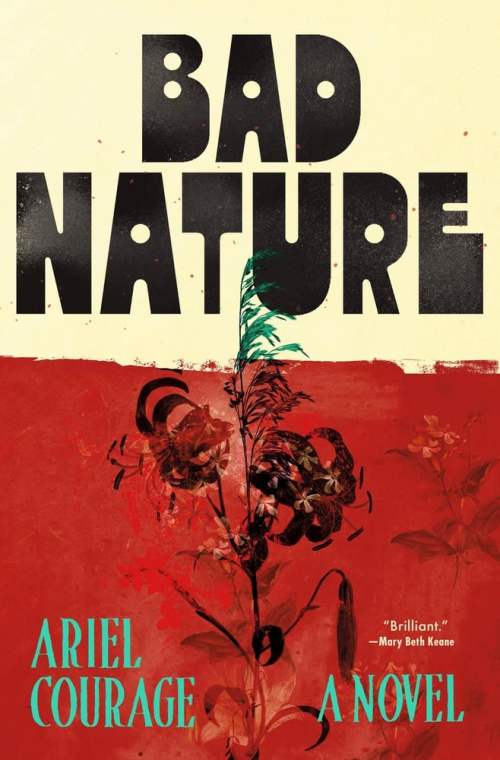
Ariel Courage’s debut, Bad Nature, supplies a snappy-enough premise: After receiving a terminal prognosis from one of her (many) New York City doctors, Hester, a once-highly-optimized corporate lawyer, resolves to kill her father—but not before setting off on a circuitous road trip across the United States.
“Oklahoma was a blur of similar-looking roads through similar-looking landscapes leading to similar-looking motels,” Hester narrates. “Everywhere I looked, I saw faint reminders of my destination, which made me feel I was accomplishing something despite my obvious drift, my slantwise approach.” Ironically, I read this passage while driving cross country myself (albeit West to East) and if anything, Hester understates this blur: the interstate system’s propagandistic billboards, its uncannily similar gas stations, its “very hunched trees.”
Understatement, though, is Bad Nature’s dominant language. A startling coolness runs throughout the whole of Hester’s narration. She sees and she narrates, whether it’s old boyfriends or the unfolding climate crisis, yet she remains largely unmoved. Courage shows remarkable control for a first-time novelist, only occasionally allowing the full extent of Hester’s pain to bleed through:
I didn’t enjoy being aggrieved exactly, but neither did I like words like healing and trauma and survivor. Blah blah blah, Daddy hurt me, boo-hoo, who cares. I’d rather pluck his eyeballs out with a fork and eat them jellied on toast than endure five minutes of therapy.
This is what, I gather, BookTok would call an “unlikable female protagonist.” Never mind the fact we are obviously meant to like Hester—even as we find her behavior bizarre and objectionable. The unlikable protagonist, as I best understand it, is a term meant to contain its opposite. We can’t help but delight in Hester’s rage or find unlikely recognition in the denial of her pain. Why else would we read a novel wherein a corporate lawyer fantasizes about eating her father’s eyeballs? Moments like these seem almost focus-group tested to elicit yasses and snaps from a certain reader.
So while we may bristle at the clumsy terminology, there’s no denying Hester represents a character type: disaffected, urban-dwelling, and anything but content. “The anger was TV static, too diffuse to be separated from my personality. It didn’t exhaust or distract; it invigorated and verved, routine and harmless like coffee,” Courage writes of Hester, and also, accurately, of Hester’s prototypes. She might as well be describing the narrators of Ottessa Moshfegh’s My Year of Rest and Relaxation or Mona Awad’s Bunny or even their male predecessor Patrick Bateman. Eventually, we won’t lack in criticism addressing more deeply the proliferation of disaffected women throughout American literature (late 2010s–present). For now, the cultural explanations for these trends feel obvious, banal.1 I’m far more interested in how Courage transgresses this emergent archetype—not the rules of polite society.
As part of this effort—and over the course of Hester’s road trip—we are introduced to John, a hitchhiker and degrowther who “dabbles” in acts of ecotage across the United States. John emerges as a foil for Hester. He is ungroomed, a devout Christian with little room for moral equivocation. Stuck in the car, the two quibble like a married couple. They make for an unlikely Bonnie and Clyde, both willing to commit acts of lawlessness. But whereas John’s wrongdoing happens in service of a higher law, Hester’s planned murder pairs with an increasing sense of nihilism as she surveys an American landscape descending into climate crisis.
The novel’s tentpole is a sharply written, extended back-and-forth between John and Hester about his “ecorexic” diet and the possibility of ethical consumption in the United States:
“Everything has a cost, a consequence. Everything,” John says.
“How about murder?”
. . .
“Depends. Let’s say it’s by gun. You have the production of the weapon, the fact that manufacturers work with or yield byproducts like asbestos, lead, arsenic, mercury, nitroglycerin . . . that can get into creeks and soil or the air if incinerated. . . . And then there’s the corpse. A rotting body produces methane and other gases. The nitrogen will be so potent at first, it’ll kill surrounding plant life but after a year, it’ll nourish the soil, make it fertile for trees or grass, which pull carbon, although if the grass is mown or the trees are cut, those benefits are moot. . . . Too many unknowns to say.”
. . .
“So would killing a CEO be justifiable to you?”
“You can’t go around killing people for being jerks. Don’t think you need me to tell you that.”
In a sense, Hester and John are not altogether different. Both have faced the apparent impossibility of a truly moral life and turned away—Hester from society’s moral strictures, and John into a greater set of moral strictures but away from society. In one pivotal moment, John stresses that Hester is perpetuating an unjust logic when what she needs to do is act on a different set of terms. It makes for an apt description of his own approach to the climate crisis and also an echo of what Jenny Odell’s How to Do Nothing refers to as the “third space”—the stomping ground of American refuseniks like Bartleby and Thoreau. “Voluntate, studio, disciplina—it is through these things that we find and inhabit the third space, and more important, how we stay there. In a situation that would have us write yes or no (on its terms),” Odell writes of the third space, “it takes work, and will, to keep answering something else.”

Bad Nature may be a first novel, but it has the will to provide two such answers. In the process, it makes for a cool-headed meditation on American refusal. Courage throws a Moshfeghian disaffected narrator into a rental car with Bartleby and sets the two out West. At one point John falls asleep under an atlas, “all fifty United States keeping him warm. Looking at it, I felt oddly bad for America,” Hester says. “For being, like any idea or object, unable to resist those who tried to define it.”
- A list literally off the top of my head: Donald Trump, #MeToo-era feminism, Instagram filters, spiritual malaise. ↩︎
FICTION
Bad Nature
By Ariel Courage
Henry Holt and Co.
Published April 1, 2025