


The greatest trick the writer ever pulled was to keep a reader engaged for a full novel after killing a character on the first page–or in the case of Ron Currie’s new novel, The Savage, Noble Death of Babs Dionne, in the title. There are plenty of examples of this trick in literary fiction, from Alice Sebold’s The Lovely Bones to Celeste Ng’s Everything I Never Told You to Paul Murray’s Skippy Dies. We know the “what,” but the story is about the “how” and the “why.” Of course this is a common convention in genre fiction murder mysteries, as well: A dead body shows up, and the whole story tries to figure out whodunit.
Currie’s novel is both: A gritty modern noir thriller with the heart and soul of literary fiction. Evidence of this, and one of myriad reasons this is ultimately a successful and hugely entertaining read, is that he pulls the “character death” trick twice in two different ways. There’s the eponymous character in the title, yes. But second, in the first line of the novel, we learn Babs’s daughter Sis is dead, too.
But let’s start with Babs: Imagine if Tony Soprano resided in a small, broken-down town in rural Maine, was even more ferocious, and surrounded himself with a coterie of hard-drinking, chain-smoking broads: You’d have Babs Dionne. Babs’s life of violence began when she was just 14. She exacted her revenge for a brutal rape at the hands of a crooked cop by stabbing him in the back with a knife.
Nearly 50 years later in the summer of 2016, Babs is one of the last of her kind: A resident of the town’s Little Canada neighborhood who still prizes her Franco-American heritage. Babs heads a local drug-dealing syndicate, of which her two daughters Sis and Lori (and her son, before he died fighting overseas) are her two lieutenants. Sis, though, has disappeared. And Lori, an Afghanistan combat veteran and current opioid addict, makes it her mission to try to find her. We first meet Lori as she’s dying of an overdose in a sleezy bar bathroom – but luckily, she’s resuscitated (“Welcome back, asshole,” the medic tells her). She decides she needs to make some changes.
The novel really gets going when a brutal but debonair Canadian guy simply named The Man – a villain who has stepped into this novel directly from a Cormac McCarthy creation – starts sniffing around Babs’s operation. We’re clued in that a drug war may be afoot.
So we keep quickly turning the pages to find out what happened to Sis, but also what’s going to happen to Babs. Both of these savage, noble deaths are the architecture of a plot that moves along faster than a Mainer can crack a lobster claw.
A dirty cop, a whisky-swilling preacher, a wife-beating drunk, and several other low-life characters round out the cast. It’s a violent page-turner of the highest order, but like the novels of Liz Moore and some of Jess Walter’s early work, this is crime fiction elevated to high art. To wit: There’s a reference to David Foster Wallace’s famous and controversial “psychotically depressed” person explanation for suicide, a long and immensely affecting section about 9/11, and even a blurb from Richard Russo.

Plot, character, and place are the true tent poles of this novel. Though we’ve spent most of our time here on the plot and characters, the setting is just as crucial to this story. Do a little research into Waterville, Maine, this story’s locale and Currie’s hometown, and you’ll find Little Canada is a real place (and there are several similar Little Canadas throughout New England, holding fast to Franco-American traditions) with similar drug and poverty issues as those portrayed in the novel. In his author’s note, Currie says, “I wrote this story because of a deep personal connection to the place and people in it.” It shows.
The Savage, Nobel Death of Babs Dionne is Ron Currie’s fifth book and first since 2017’s The One-Eyed Man. Not only is it his best novel, but also this book represents a career resurrection of sorts for him. This novel shows the stick-to-itiveness of a writer who gathered his wits after a long publishing hiatus, and wrote something really amazing. He’s truly found his voice here – there’s a snappiness to this dialogue and a care for his characters that form the cornerstone of any satisfying novel. As a huge fan of his first four books, anyway, I’m delighted both that Currie is back, and that he’s clearly now at the top of his game.
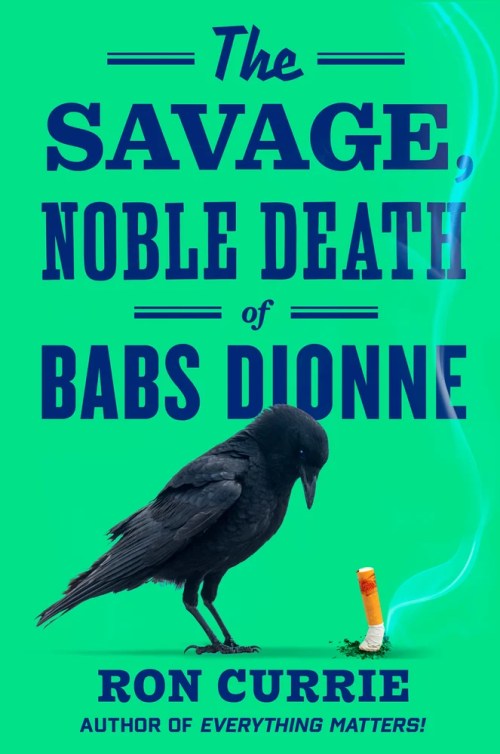
FICTION
The Savage, Noble Death of Babs Dionne
By Ron Currie
G.P. Putnam’s Sons
Published March 25, 2025


