


Roxane Gay will speak about The Portable Feminist Reader at Chicago’s Athenaeum Center on Wednesday, March 26 at 7:30 p.m., in conversation with Sasha-Ann Simons, the host of WBEZ’s Reset. More information and tickets are available at https://www.wbez.org/event/wbez-presents-an-evening-with-roxane-gay-sasha-ann-simons (use code “BOOKCLUB” for 20% off tickets).

The first time I realized that identifying as a feminist could be divisive was freshman year of high school, when a so-called friend in choir rehearsal called me a “feminazi.”
He thought this quite funny, as did the other boys who laughed with him. I’m not sure they understood then what “feminist” or “Nazi” truly meant; almost three decades later, many people still cannot agree on the definition of these terms. What sticks with me is the fact that he conflated fascism and my desire for women to have equal rights. Something about women having rights, the idea that we might demand the same respect and civil liberties he enjoyed, was frightening to him, and he felt the need to dismiss me with a crass insult. I think he knew there was no risk in insulting me. Another man using similar tactics was recently elected to the highest political office in the United States.
Which is all to say: what is the role of feminism in the present moment given, well, everything?
In her introduction to The Portable Feminist Reader—a new mandatory read for feminists, allies and students everywhere—editor Roxane Gay notes that recent political and legal setbacks, the overturning of Roe v. Wade foremost among them, are “a stark reminder that women’s bodies, movements, and choices are contingent on the whims of men in power. We have made progress but we are not yet free.” Referencing her New York Times bestselling essay collection, Gay frames her “Bad Feminist Reader” as a starting point, intended to spark conversations and critical thought around historical and contemporary feminist perspectives.
This dense volume is not the sort of text you read in one sitting. Over the course of 60+ personal essays, short stories, academic articles, poems and manifestos, The Portable Feminist Reader makes a successful case that feminism is both essential and not without its flaws, specifically the many ways in which women of color were excluded from “mainstream” feminism for centuries. The inclusion of so many diverse writers in this collection, effectively adding them to the feminist canon (the collection is published under the Penguin Classics banner), is both a powerful choice and a step towards improving a canon that has historically marginalized and excluded these voices.
Some of the feminists within these pages will be familiar to most readers: Audre Lorde, bell hooks, Susan B. Anthony, Gloria Steinem, Alexander Chee, Ida B. Wells (especially for those of us in Chicago). But Gay ensures all readers are oriented throughout by providing concise and informative headnotes prior to each text, so its place in history and the context in which it was originally published are clear. For example, prior to the book’s opening article, “Demarginalizing the Intersection of Race and Sex” by Kimberlé Crenshaw, Gay reminds us that with this piece Crenshaw coined the term intersectionality, a word now universally used in feminist discourse.
Another early piece from that same year, 1989, was a groundbreaking essay on white privilege written by feminist and anti-racism activist Peggy McIntosh. Her words seem prescient now, as the U.S. government attempts to shut down “unnecessary” equity and diversity efforts nationwide: “I did not see myself [a white woman] as a racist because I was taught to recognize racism only in individual acts of madnesss by members of my group, never in invisible systems conferring unsought racial dominance on my group from birth.”

Some of Gay’s selections for this volume are unexpected in form and just as impactful as scholarly texts. In a section on sexual politics and agency, Franny Choi’s 2014 poem “To the Man Who Shouted ‘I Like Pork Fried Rice’ at Me on the Street” explores the intersections of racism, misogyny and street harassment, combining body horror and takeout stereotypes in an attack on people who prefer women to be “more digestible. / more bite-sized. more thank you.” Patricia Lockwood’s 2013 poem “Rape Joke” questions succinctly and brutally whether a joke about rape can ever be funny, and all of the ways in which victims of sexual violence are blamed for their assaults, or convince themselves into believing they did something to deserve it. Charlotte Perkins Gilman’s widely anthologized 1892 short story “The Yellow Wall-Paper” (which I encountered in high school shortly after the “feminazi” slur) turns to fiction to explore the damage done to women such as herself, who were prescribed confinement-based “rest cures” in response to their untreated postpartum depression. Women’s maternal and postpartum needs are widely misunderstood and mistreated to this day; last year the Commonwealth Fund released a study revealing the U.S. has the highest rate of maternal deaths among high-income nations.
There are hopeful reflections, too, among these pages. In analyzing and advocating for cultural and legal reforms to protect Native women from violence and abuse—specifically the ways in which the U.S. justice system prevents Native communities from punishing the mostly white male perpetrators who harm Native women—Muscogee Nation citizen Sarah Deer reminds us in “Sovereignty of the Soul” that her own tribe’s rape laws in 1824 centered indigenous women in adjudicating sexual violence committed against them: “if any person or persons should undertake to force a woman and did it by force, it shall be left to [that] woman what punishment she should [be] satisfied with, to whip or pay what she say[,] it be law.” In short, they believed women.
The Portable Feminist Reader provides essential intersectional perspectives that not only support women—they serve as a direct repudiation of the sexist, racist, xenophobic currents sweeping across the U.S. All women are not yet free, but Gay reminds us that feminists have the collective power to create a more inclusive and equitable future. The work continues.
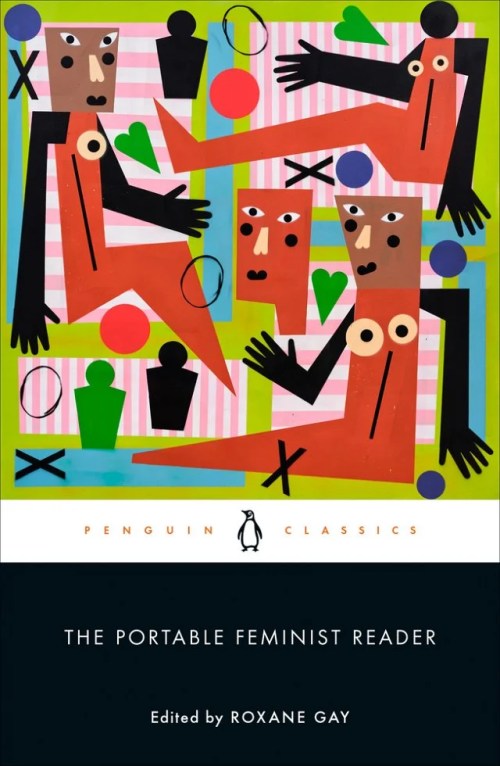
The Portable Feminist Reader
Edited by Roxane Gay
Penguin Classics
Published March 25, 2025


