


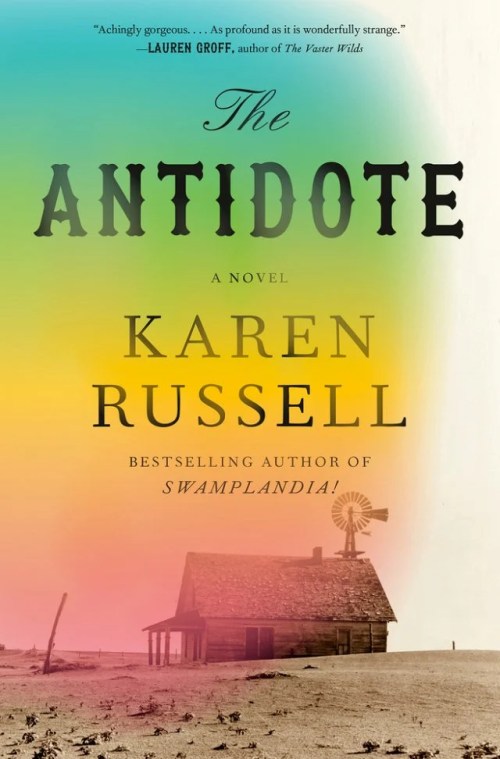
In her first novel since 2012’s Pulitzer Prize nominated Swamplandia!, Karen Russell demonstrates that her capacity for detailed, incisive long form fiction is far from diminished. The Antidote is a thought-provoking piece of speculative historical fiction, transforming aspects of American history into folklore while still examining the many wrongs of said history. Utilizing numerous point of view characters, including a prairie witch, a resettlement photographer, a farmer, a preteen girl, and a scarecrow, Russell captures how tenuous the truth is and how our capacity to forget history is what leads to ugliness and injustice in our world. On the flip side, the few drawbacks of The Antidote also regard this plurality of both voices and ideas, as well as the question of taking on too much in a single narrative.
The Antidote takes place in 1930s Nebraska, amidst a terrifying Dust Bowl wreaking havoc on hundreds of rural communities. One of these communities is Uz, a small agrarian town, where a prairie witch who calls herself “The Antidote” does business. Prairie witches serve as a kind of memory ‘vault,‘ taking in the weight of people’s memories, good or bad, in exchange for a feeling of lightness and hope. When The Antidote loses her memory deposits in a dust storm on Black Sunday, she fears for her safety yet cannot leave the dying town of Uz, as she awaits her long-lost son stolen from her in infancy.
Amidst The Antidote’s poor fortune, we are introduced to Harp Oletsky, a Polish-American farmer whose crop is the only one unaffected by Black Sunday. He and his niece Asphodel live in relative seclusion as Harp tries to make sense of his good luck, while Asphodel keeps her basketball team afloat and takes on an apprenticeship with the prairie witch herself.
Meanwhile, the dark undercurrent of local politics sets in. A serial killer supposedly behind bars, but with a very thin case holding the suspect steady. A history of Native American resettlement and land destruction as the undercurrent of present environmental disaster. A home for unwed mothers leading to lasting trauma. The novel takes on much of the early 20th century in its scope, to both dazzling and disorienting results.
Russell’s prose is as sharp as ever. Her capacity for detailed imagery while maintaining an easy, readable pace must be commended. Conceptually, her imagination stands head and shoulders above her peers, which is no surprise to any Karen Russell reader. The concept of desperate Nebraskans rushing to The Antidote to collect their memory deposits as a metaphor for the depression-era run on the banks is just one example.
However, the book is not without its weak points. Cleo Allfrey, the resettlement photographer, is an interesting character with a unique speculative element, but she is introduced at a later point in the story than the other characters and as a result, it is difficult to get invested in her narrative. A major uncovering of backstory occurs towards the end of the novel, leading to Harp Oletsky making not one but two speeches at the novel’s climax, which are ultimately long-winded and slow the pace of the novel just as tension ramps up. While the messaging in these speeches is commendable, and ties in directly to Russell’s extensive historical notes at the end of the book, they feel somewhat shoehorned in when so much of the storytelling prior is expertly plotted. The novel ultimately feels long towards the end, and while the resolution of The Antidote’s personal journey is more than satisfying, the other characters do not receive this same type of resolution. One wonders if several of the interwoven narratives might have shone brighter in novels of their own.
Such is the drawback of an ambitious novel. On the whole, The Antidote shines due to its concept and thoughtful prose, and different readers may connect differently to its bevy of characters. No matter one’s opinion of the plotting and inclusion of historical messaging, it cannot be denied that this book is wholly unique and represents one of the modern greats continuing to challenge herself.
FICTION

By Karen Russell
Knopf
Published March 11, 2025


