


The story of Death Takes Me by Cristina Rivera Garza, translated from Spanish by Robin Myers and Sarah Booker, examines the intrusion of crime into the lives of witnesses and detectives. A wave of men are being discovered, dead and castrated, their corpses accompanied by mysterious poetic allusions and all the marks of a serial killer to-be. The Detective, at a loss, starts enlisting the services of a local professor and writer, Cristina, who found the first body.
The violence of the crimes starts a wave of impact that hits the professor, the Detective, her partner, and everyone else in its wake. The murderer appears to be a woman, castrating men, leaving behind poetry using ‘women’s objects,’ such as nail polish or lipstick. This troubles the professor and the detective both.
It presents a linguistic conundrum with real-world consequences. The word victim in Spanish is feminine—the articles about the crimes can find no “suitable grammatical way to masculinize the victim.” The crime spree leads to a new “collective paranoia” in society, an ironic twist on our own society’s gendered violence, where men feel a need to protect their genitals in public, where old men would later reminisce of “better times…when a man was safe.” Women, in turn, “would gradually get used to provoking disproportionate suspicion.” When the protagonist women try to think about this killer, they feel an uncomfortable identification. (“Do I want to find you, murderer?” The professor asks. “Will I want to see my face in yours?”)
The novel begins with an epigraph that suggests that only once a person with a penis is castrated can a truly equal relationship begin—only with that change, that humbling of masculinity, can he see the other, start to wonder what the other is thinking. Perhaps that is the same: the need to force difference. The inversion of gendered violence, too, opens a door. Will things change if men can see their own bodies as victim? Would women be willing to see the face of their own violence if it meant change? Within the book, the editor who publishes the murderer’s book says that a “faceless text” is a riddle, and the reader must decide if they “want to construct that face and implicate yourself…in that enigma.”
Are readers willing to work to construct that face, to find the murderer and face the implications? Garcia plays with genre and metafiction in a way that will attract many readers, but confuse others. An essay, for example, examines the way that poet Alejandra Pizarnik (who the murderer is obsessed with) tried to explore prose poetry in order to bring the externality of prose into the interiority of poetry, cutting across the form’s limits. Perhaps here, Garza’s goal is to have us let the book wash over us, to not figure it out in its entirety, but let it impact us as it is, in some mixture of interior and other.

But it’s hard to say precisely what Garza wants from us. Many readers enjoy a good literary mystery, turning pages back and forth and trying to piece together clues, but the battle to figure out who is speaking in a given chapter, or who they’re referencing, can unnecessarily confuse more interesting questions such as unreliable narrators or themes of gender inversion. (That very well may be part of the point: in a coda, Garza quotes Pizarnik saying, “Who’s speaking? Who the hell is speaking?”) Fascinating riddles and questions are unfortunately hidden behind what may be one too many experiments in this newest outing by Garza.
FICTION
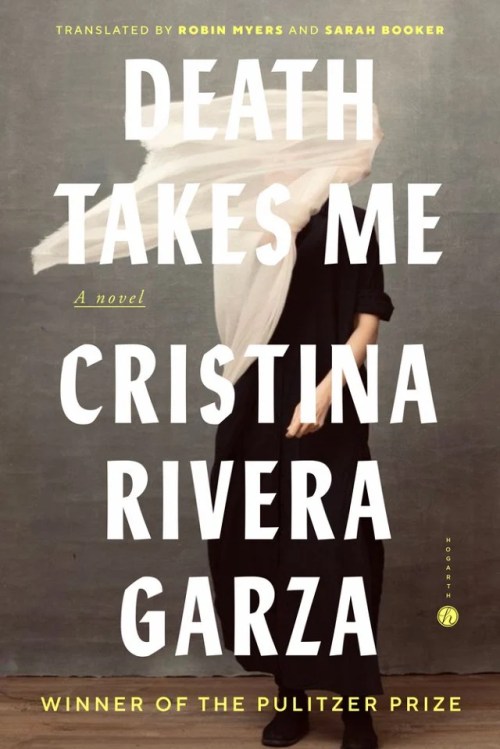
Death Takes Me
By Cristina Rivera Garza
Translated by Robin Myers and Sarah Booker
Hogarth
Published February 25, 2025


