


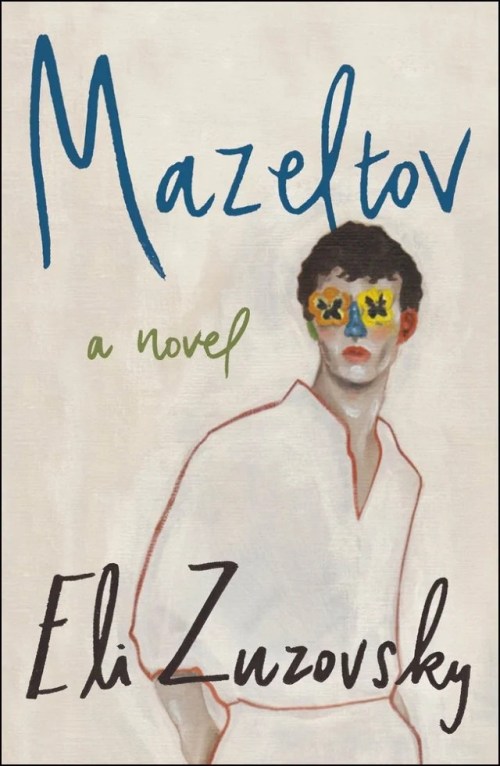
In Eli Zuzovsky’s debut novel, Mazeltov, the morning news is forecasting “both a rainstorm and a war,” and the bathroom mirror is proclaiming that “ADAM WEIZMANN IS AFRAID OF TITSSSSS.” It’s Tel Aviv, circa 2009, and Adam—an isolated, precocious, aspirant thespian who’s also, yes, closeted—is traipsing towards his temple-ordained manhood, visible on the horizon thanks to a bar mitzvah looming in the near future.
But don’t get too comfortable with conventions in what is, among other things, a queer coming-of-age. In Zuzovsky’s ambitious, time-hopping novel, Adam’s bar mitzvah is simultaneously in the far future, in the here-and-now, and in the distant recesses of the past. We experience that bar mitzvah through Adam’s eyes, from his family’s perspective, and through the lens of a Palestinian poet. Time blurs in the hazy fog of a war-torn Middle East; the narrative swirls around our protagonist in a fitful polyphony. “Tonight”—which is also tomorrow, which is also yesterday—”was meant to be [Adam’s] party, but the world had other plans.”
Those plans are elusive thanks to the crowded, kaleidoscopic nature of Zuzovsky’s debut, an atypical conceit for a first-time novelist due to the difficulty it presents in sustaining a coherent narrative. Such an approach, replete with so many points of view, runs the risk of becoming overly reliant on caricatures—that is, rapid-fire characterizations are necessary to get on with the story, and so the author might resort to stereotypes.
Mazeltov, with a startling number of narrators populating its compact 180 pages, isn’t immune to such tendencies–Adam’s best friend (if not his only friend) Abbie in particular. She possesses a platonic, manic-pixie quality, a disposition mitigated slightly by a difficult mother, and by her crippling anxiety. Abbie’s not without her pathos, but her personality seldom extends far beyond her unwavering love for Adam. She has, evidently, come to terms with his sexuality, but it doesn’t stop her from pining, the futility of which her mom cruelly highlights: “you are desperately in love with a boy who’ll never love you back.”
A similar propensity is present in Adam’s ostentatious theater instructor, Vee, someone who drags on a cigarette while quoting Oscar Wilde. She’s a minor character, but I was initially concerned to find that a couple more substantial characters might possess a caricatured bent as well. Namely Adam’s hyper-neurotic mother, Sarah, who’s more interested in playing host for her son’s bar mitzvah party than she is in an impending war: “Why on earth did they bring the lilacs, god,” her chapter opens, “now the centerpieces look like someone sacked some Lithuanian ghetto.”
I am, however, pleased to say that my intuitions regarding Sarah were wrong, or at least decidedly incomplete, as Adam’s mother’s manic exterior belies the boundless love she clearly has for her son. Despite her disastrous, navel-gazing bar mitzvah speech: “I didn’t plan to gain nine kilos. I didn’t plan to leave your father.” And despite her repulsive politics: “monogamous homosexuals” and “liberal Arabs” are “part of that postmodern mythology she despises.” Sarah sees and accepts Adam for exactly who he is, even if it contradicts her own backwards views: “I’d be there for you [Adam], always have been, always will be, always, always, even if you rape and murder, which I really hope you don’t.” Not to mention, and not for nothing, she’s also actually, physically present.
This isn’t the case with Adam’s father, Yishai, who was, per his own internal admission, unprepared for fatherhood: “[Your mom] wanted you more than anything. Today I can admit I didn’t.” He isn’t even attending Adam’s bar mitzvah—a brief interlude interrupts the festivities to follow Yishai on a solitary hike, seemingly taking place concurrent to Adam’s big day. The chapter’s titled “Tikkun,” Hebrew for “repair” or “improvement,” and it serves as an elongated confessional: “I’ve drunk myself out of two separate law firms…I’ve woken up in hospitals wearing nothing but my boxers.” It might all be moving if it weren’t so self-pitying, and if Yishai were communicating with his son and not just speaking the words to himself.
Yishai does evoke a certain sympathy due to his obvious unsuitability for parenthood, and thanks to the flashes of compassion he displays with young Adam. Even his wife admits he’s a “lovely man,” and Adam’s grandmother (Yishai’s mother) regrets that she “never really found the time or language to address” Yishai’s “illness.” A late-novel revelation unveils the depth of his psychic wound, but it’s Yishai’s spirituality that seems to foretell his disintegration. He found religion later in life, and there’s a desperation—if not a kind of mania—in his attempts to “embrace the brokenness” of life, meanwhile he fails to embrace his own son.
Nestled in Zuzovsky’s novel is something of an indictment of religiosity, serving here as a last-ditch haven for Yishai before he reaches a breaking point. There’s also the fact that Tel Aviv’s religious sect has ostracized Adam’s grandma, a “Shiksa” (gentile woman), who despite having “tried so hard to join the Chosen Folk” knows she “does not belong [in Tel Aviv].” To be clear, Mémé, as she’s known, isn’t sure she wants to belong anyway, thinking Adam’s rabbi a “motherfucking piece of crap” for telling her grandson that “according to the scriptures, sexual inverts were to be stoned to death.”
In addition to Mémé, and Adam’s parents, and of course Adam himself, there are other narrators I’ve failed to mention altogether: there’s the bar mitzvah DJ; there’s Adam’s cousin Ben, a member of the Israel Defense Forces (IDF); and then there’s the queer, Palestinian poet Ben chats up, Khalil, who’s working Adam’s party as a caterer. I suppose I’m acknowledging the obvious when I say there’s a political dimension to a Palestinian poet’s presence at a Tel Aviv bar mitzvah, especially when he’s in conversation with an IDF soldier, and make no mistake: both in terms of its content and in terms of its broader context, this is a deeply political novel.

These politics are often peripheral–exactly where the “liberal” sect wants to keep them–but we hear rumblings about the DJ’s previous gig being “called off” because “Gaza has been heating up.” And while Sarah makes last-minute party preparations she “smells the stench of bonfire and mud,” which she deems “the harbinger of military operations.” It’s only through Khalil that this violence is concretized. His loved ones in the West Bank are at the mercy of Israel’s “brutal, bureaucratic omnipotence.” Israel’s Civil Administration has the ability to save lives, like the heart surgery they permitted Khalil’s great aunt. It also has the ability to ruin them, like the demolition order they signed on his friend Ayad’s house.
When we meet Khalil, the narrative—like Khalil’s home—fractures, as does the novel’s form. Prose gives way to verse, before giving way to a dizzying blend of the two. What follows deserves to be read without prior knowledge. The exact plot machinations strain believability but, nevertheless, it’s bold and ambitious in a way most purportedly “political” fiction never is. A lot of contemporary literature is set against the “backdrop” of some devastating sociopolitical moment, and that’s exactly where the issue stays: in the background.
In Zuzovsky’s novel the politics are front and center, which is not to say this is any kind of activist screed. Mazeltov is a deeply felt queer coming-of-age that could be happening anywhere, but that is, importantly, happening in Israel. And Israel is—in 2009; in 2025—at war. Everyone, our protagonist included, is implicated in that war. Because while an older version of Adam may have “some aspiration of changing the system from within,” he comes to the inevitable realization that it’s “programmed to perpetuate itself.” He can “no longer pretend the whole thing [doesn’t] make him sick.”
FICTION
Mazeltov
by Eli Zuzovsky
Henry Holt and Co.
Published February 11, 2025


