


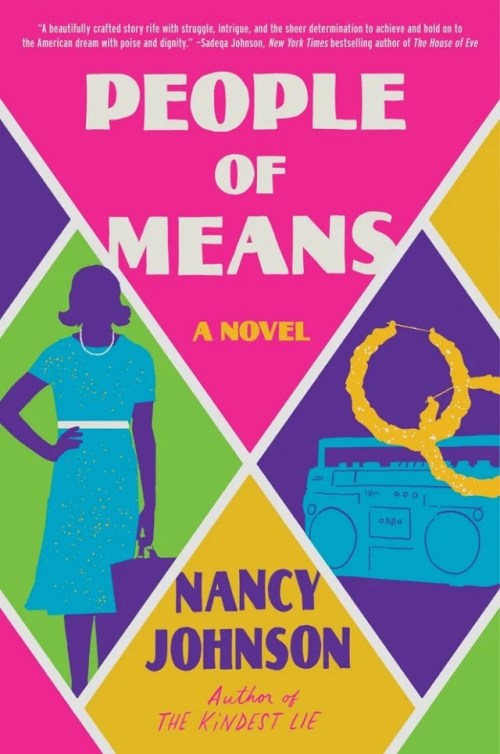
In Nancy Johnson’s new novel, People of Means, it’s 1959, and a mathematics-obsessed Freda Gilroy moves from Chicago to Nashville to enroll at Fisk University, continuing her family’s tradition of Black excellence at their alma mater. Her first year brings her first confrontations with segregated bathrooms and “in-your-face racism”—something from which she was shielded growing up in a Black high society family in Chicago. Her parents tell her not to get mixed up in the student protests, but she does—and finds herself torn between two men. One is an activist who tugs her toward racial justice activism; the other is a soon-to-be doctor who prefers uplifting Black communities through education.
Nearly three decades later, Freda’s daughter Tulip is stuck in a similar dilemma. After five years in corporate public relations, she knows spin when she sees it. When the Rodney King verdict sparks riots in Los Angeles, the violence leaves her constantly on edge. Journalists editorialize the protesters to stoke rage and fear among white people. Her colleagues at her firm say King deserved what happened to him. When she hears about a group of organizers meeting at the Ida B. Wells Homes—then a public housing project falling apart from city neglect—she goes, despite her friends and family telling her it’s a waste of time.
Nancy Johnson’s first novel, The Kindest Lie, came to life amid the lie that electing our first Black president made the United States a post-racial democracy. With People of Means, her characters are concerned with the costs of organizing for social change. What draws people to march for change, and what keeps them standing on the sidelines trying to protect what they have?
“I was thinking about resistance and activism and these consequential times in our racial and social change history,” she said. “These periods are different, yet we are going through the same thing over and over again. When we look at where we are in America—new presidential administration, new Congress—marginalized groups now are grappling with how to resist. Looking back at how our ancestors did generations back can be instructive for how we respond today.”
In our conversation, she discusses why different generations respond to social change and how Black excellence can’t save Black people from white supremacy.
This interview has been edited and condensed for clarity.

Reema Saleh
It’s such a shock for Freda when she moves from Chicago to Nashville and sees more in-your-face racism, but also segregation is so striking in Chicago, and she can’t have been entirely shielded from it. Confronting that for the first time is very isolating for her.
Nancy Johnson
Freda was born and raised in Chicago. Her father is a medical doctor. She is used to the white milkman coming by and having very cordial conversations with her mother and her, so it feels like it’s a much more civil way of being. Then she travels to Nashville and is hit in the face with many of those indignities and just the stark reality of the separation of Black and white people. She sees that when she first goes to the state fair for the first time, she encounters the colored and white bathrooms and water fountains. It’s a big shock to her system. She sees it on her train travel, what that’s like in segregated train cars when you’re in the South, and how that changes when you move into the North. But there is also a scene in the book where she reflects on growing up and having seen her mother be manhandled on a street corner by a white man. She has experienced racism at home, but it’s just more in your face for her in the South.
It’s a very isolating experience for Freda. It’s almost as if she doesn’t talk about it, she can erase it from her mind. And that’s why—when she stumbles upon a sit-in at a five-and-dime lunch counter—she is so put off by her Black and white classmates who are part of that organized sit-in. She thinks that if we don’t stir up trouble, everything will be okay. She even says, can’t they make a cheese sandwich at home? Why do we have to create problems like this for ourselves? Because we are the best and the brightest, and we’re going to be successful in this country, so why are you creating a disturbance here? And that’s also the voice of her parents in her head, telling her that this is the way you make change, not by organizing.
Reema Saleh
It feels like with Freda’s storyline, there is a lot of this idea that Black excellence will not save them, even though it’s something her family has worked at for generations. It was interesting to see Freda be drawn between these two love interests and what they both represent in her story.
Nancy Johnson
I wanted to explore this idea of Black excellence and how it can hang over us and put pressure on us. In one way, it’s the ideal that you’re trying to live up to. Every parent wants the next generation of children to do better than they did. Being excellent and being educated is part of it. There is this whole idea of respectability politics and the misnomer that being excellent will save us as Black people, and it really won’t. It won’t inoculate us from racial prejudice.
Freda is pulled between two very different men—Darius, a saxophone player and civil rights activist, and Gerald, this very focused young man trying to become a medical doctor. They have very different ideas about how to respond to this period, which they all find themselves in during the late 50s and early 60s. I think Freda is trying to decide what she is going to do, which choice she will make about whether to get involved or not, and if so, how much. And the two men who are pursuing her are pulling her in very different directions. It amplifies the choices she has to make.
Reema Saleh
It seems like, for Tulip, the way that she works in resistance is through shaping media as a PR person. She does all the things to make a racial justice rally happen for public housing residents in Chicago, but almost like later that night, it gets twisted into being a riot. It made me think back to 2020 and how people talked about protests then.
Nancy Johnson
I was definitely thinking about the murder of George Floyd in 2020. That was one of the inspirations for this story—how it sparked people from every race, background, age, and ethnicity to get involved in activism. But then, it seemed to all go away. You know what I mean? It was a reactive moment for people, and that enthusiasm for change dissipated. That was also something I wanted to look at. You know, is the change real, or is it just performative?
A few months after George Floyd’s death, Representative John Lewis died. I watched a documentary about his life and had no idea he got involved in activism as a college student. Here he was, 19 years old, on a campus organizing these sit-ins that launched what became the civil rights movement. And I kept thinking, what is it like to be a young person coming of age then? You’re thinking about your class schedule, what you’ll do over the weekend, and the friends you’ll make on campus, but then you’re also launching the movement at the same time. I just wanted to interrogate that. What was that like? What were the risks that young people took to make that happen?
I was born in the 1970s, and I went with my parents quite often to those Rainbow PUSH meetings every Saturday. That was a big part of my upbringing, and I was so young that I didn’t really understand it fully, but I knew the importance of social change and being involved in activism and your progress as a people. My parents met in a taxicab, leaving one of those civil rights meetings in the late 60s. On the weekends, we’d sit around a record player listening to speeches of Dr. Martin Luther King Jr. That was a big part of how I grew up.
Reema Saleh
It feels like Tulip has a lot of similarities to you in the sense that you both inhabit the communications and public relations world. I’m curious: how much of yourself do you see in these characters?
Nancy Johnson
I definitely see myself in both of them, particularly with Tulip being the more contemporary of the two characters. I’m a former television journalist, so I understand the power of the press to amplify issues and stories. I often think about how vocal I can be in expressing my feelings about the things around me. And will there be negative repercussions of using my voice for change?
I was a student at Northwestern University when those officers were acquitted for the beating of Rodney King. That’s another reason that I had Tulip going through this. Tulip was a young professional working at the time. I had grown up with parents steeped in activism, but I still had to decide—do I want to go out there and march? What’s my real reason for doing it if I do it? And I eventually did, and I was out there holding up my sign, chanting, “No justice, no peace,” and I felt like I was a part of something larger than myself, trying to bring about change in the country in any way that I could by lifting my voice.
Reema Saleh
When Tulip starts working with organizers from Ida B. Wells, she is still an outsider, and getting people to tell their stories to the media is like a big ask, you know?
Nancy Johnson
I always love writing about people on the outside of things. I did that with my first book, writing about a poor young white boy in this dying Indiana factory town who felt ostracized as a kid and didn’t really fit into his white world or with the world of the Black boys he was friendly with, so I’m always thinking about that. That’s where Tulip is. She is on the outside because of her socioeconomic status and because she is not from the Ida B. Wells community. And I think they are rightfully skeptical. Who is this woman coming in here, trying to tell us what we should be doing? So, I think she must also come to terms with herself to interrogate her motives and what she is trying to do and listen.
Reema Saleh
Half of this novel takes place in Chicago, and the other half takes place in Nashville, and both bring up a lot of historical events and pieces from each city. What were you doing to research the novel?
Nancy Johnson
I interviewed several alumni from Fisk University to get a sense of the time. What was it like to be there while people came from the North to the South for the first time? What was that culture shock like to go into the Jim Crow South and see the separate restroom signs and separate water fountain signs? I wanted to understand what it was like to be a student in the dormitory with a house mother, all the rules you were subjected to, what you had to wear, and being independent for the first time on a college campus.
I had always heard of the Pullman Porters, but I had their involvement in the civil rights movement. The Pullman Porters are based in Chicago, too. I didn’t have any idea about everything they had done, but it was the late Nikki Giovanni, the author and poet, who I interviewed while doing research. I got that nugget of information from her. She also told me about the role that Nat King Cole played—a lot of hidden history in there, and when I interviewed her, I kept saying, “Oh, my God, I’m going to look up everything you’re telling me. She said he was like, “Girl, you’re not going to find this in the history books.”
Reema Saleh
Does it always feel like things oscillate back and forth between things seeming like they’re going to change and then not? Where do you see those parallels between then and now?
Nancy Johnson
It feels like we take a few steps forward and a few steps back. I mean, right now, when you look at some of the executive orders from the current administration and their attempt to roll back some of that civil rights progress made when Freda was a student in the 1960s. Some of what’s been couched as DEI looks like there is an attempt to roll back some of the civil rights protections people have. I see the trajectory, and it’s scary. It’s a lot, but I think when people read People of Means, it will feel like it’s in conversation with where we are today because there are so many parallels with what’s happening in the 50s and 60s, in the early 90s, and today.
There are moments in time when marginalized people are responding to oppression. And each time, people have conflicts about how to engage and respond. For example, in the 50s and 60s, some people were from different socioeconomic brackets. You also had the age split—some older folks said, “Let’s take it slower.” Let’s rely on our legacy organizations like the NAACP and the Urban League to bring about change. Let’s also concentrate on being excellent and doing our best academically and professionally. That’s how we rise as a people. And then, some of the younger people say, “No, we’re not going to wait for change to come to us. We’re going to make our voices heard.” It was a push to challenge some of those systems of authority and some of the institutions of that time.
I’ve seen all kinds of conversations on social media right now about how we can organize an effective movement today. Can we get everybody on the same page? In retrospect, it felt like everybody was when you saw them marching in the news and history books. How do we do that today? It’s not the same type of leadership that we had back then, where a few central figures and organizations helped people mobilize for change.

Reema Saleh
With your career, you made a big shift from telling nonfiction stories about people to fictional ones. Why did you make it?
Nancy Johnson
I worked as a television news reporter for over a decade and loved it until I didn’t. I always wanted to tell the stories that I thought were worth telling and were important. But then the pager would go off, and there would be a triple homicide two counties over, and the photographer and I had to pack up and leave that feature story that we were really invested in to cover breaking news. But I earned my storytelling chops there in news, so moving into public relations and corporate communications was a natural transition. But there was always this part of me that wanted to tell the story of my imagination, the things that I care about that keep me up at night, and that’s why I decided to start writing fiction as well.
I chose to write fiction because I want to address these issues of race, class, resistance, family dynamics, the power of legacy, and the pursuit of the American dream. I don’t want anyone to feel preached to or that I’m giving them tips for how to address racism in America or classism in America. But I’ve found that fiction can be much more powerful because people can connect with the themes and concepts more through character and story.
After I wrote my first novel, The Kindest Lie, I did a book club discussion with a group of white women. One woman told me that she and her father had never had a civil conversation about race in America. She said she planned to buy him a copy and read it with him, and hopefully, they would have a real conversation. I still remember that from years ago, and it touched me so deeply and made me realize that my work has a real-life impact on people’s lives and how they think and approach the world. If I could get those two people together in a room to talk about things that they never could before, that’s progress for me.
Reema Saleh
I feel like after 2020, many of the books on race that became bestsellers were like Robin DiAngelo’s White Fragility or Ibram X. Kendi’s How to Be an Antiracist—nonfiction, which people pick up with a specific purpose in mind. I was talking to my sister the other day and joked about it being the SMART-goalification of anti-racism.
Nancy Johnson
I was into it. I’m not going to lie. They have their moment, but fiction can be long-lasting for sparking conversation. People are not going to get as defensive because I saw with some of the nonfiction books about race in 2020 that some people showed a lot of defensiveness. “Are you trying to call me a racist? What are you trying to say about me? I wasn’t around during slavery; I’m not responsible for what my ancestors did.” I think that with fiction, they can see what the characters are experiencing in a less threatening way, but it will be equally thought-provoking and spark conversations. Fiction has a great way of building empathy, helping us understand people who are not like us, and walking in the shoes of someone who doesn’t look like you or doesn’t have your life experience and background. That’s a powerful thing. I know fiction does it for me, too, so I think it does that for most people who read it.
Reema Saleh
So, you called it “People of Means” for a reason. And actually, what was that reason?
Nancy Johnson
I love titles that work on multiple levels. My first novel was The Kindest Lie, which was about some of the small lies and the things that we tell ourselves to get by in life and protect each other and the people we love. And then I kept thinking, but on a macro-level, America has been lying to itself and its people—propagating that it’s kinder as a nation than it really is when you look at some of the abuses that America has visited upon people.
People of Means as a title also works on a couple of levels. I’m highlighting an upper-middle-class Black mother and daughter, so they are people of means because they have a certain amount of wealth and privilege, even though they’re Black in America. But at the same time, I wanted to expand that definition, and saying a person of means also means that you have the inner fortitude, the grit, and the determination to make life better for yourself, your family, and your community, and you don’t have to have money to do that. You need to have the will to make a difference.
FICTION
By Nancy Johnson
William Morrow
February 11, 2025


