


What to do about the novel? As a form, an artistic object, even an idea. Much ink and angst has been spilled; we’re told we’re in, to borrow the subtitle of one recent award-winning, thought-disrupting work of criticism, a “post-fictional age.” Are we? This seems unlikely. The issue, though, has something to it (indeed the book in question raises some good points), as there does seem to be something going on with the contemporary novel (a distinct matter, thank god, from the contemporary marketplace). A more common, if otherwise problematic, term for this phenomenon is “autofiction,” likewise much discussed (and much disliked by authors). But more fundamentally, all this is so much parenthetical palaver leading away from the real heart of the matter, which is the same as it ever was—what is it that makes a work of art? What makes it distinctive, what reaches us, compels us, from deep within that je ne sais quoi? In her startling, breakneck, wildly insouciant debut, Sonya Walger raises these questions before leaving them profoundly unanswered—and leaving Lion, simply, as an excellent novel.
Told in the first person over a series of relatively short chapters, Lion encounters the story of the narrator’s father, and the history of his interpersonal life. As the publicity materials make clear, this is an “autobiographical novel,” in the vein perhaps of Adler and Ernaux, and indeed there are any number of parallels between our narrator and Sonya Walger, the quite well-known actress-turned-novelist. That Lion represents Walger’s first published work of fiction speaks to the singular importance of sheer talent in art; her novel is of far more impressive stuff than many lauded books of recent vintage. From the first words, Walger announces her work as a risk-adept, ferocious one, and her self as not here to play nice:
But how hard to be the one who stayed! The one who packed the raisins but not the nuts, who wiped the lipstick off the piano teacher’s mug, tissue-wrapped the Christmas ornaments, washed the sheets, staunched the blood, ignored the lies and the slammed doors, peeled the stickers off the walls, fought for sunscreen and table manners, made beds, combed out the lice, stapled the hems and later sewed them, kissed the friends, befriended the lovers, returned the books, loaned the car, the house, the denim jacket with the Liberty lining, combed out the lice, listened to the story tape jammed in the car stereo, held back the hair bent over the loo, paid the school fees, paid the tennis coach, paid the airfare, combed out the lice, pushed the swings, paired the socks, allowed the cigarettes, forbade unkindness, packed the trunk, renewed the passports, taught the second tongue, recited the alphabet, churned the ice cream, bought the bras, the Walkman, the wedding dress, learned the names and never forgot them, shared the crossword, the towel, the chewed gum. The one who did not stray, who was always where I left her, who never spoke a word against him, who signed birthday cards in his name, lied in his name, raised a human in his name.
And here I write a book about the one who left.
She tells me this is a betrayal. She tells me she did her best.
I tell her she did, that for better or worse, this book is not about her. No one can be two parents. I tell her my writing is not a measure of her failure, or of anyone’s failure. It is a book about love.
My mother tells me she will never read this.
I will write it anyway.
I would not be here without her.
There are few openings from this century as refreshing as that, especially in American fiction. Inaugurating and complicating the book’s central tensions around storytelling, the narrational premise established in this raucous beginning likewise is key to the book’s composition and architecture alike; Lion traces our narrator’s father from his meeting her mother through to his death, across a dizzying array of divorces and children and hobbies and jobs and continents. Walger is in complete command throughout, relying on playful narrational techniques such as first-person free indirect, Cohnian autonomous monologue, and immersive memory to render both those aspects of his life that overlapped with her own and those that did not. She also skillfully interweaves her own, non-paternal existence, albeit one that moves in a constant shadow of her larger-than-life father. That Walger’s narrator is also English, also an actress, and also a mother is at once at the heart of the novelistic-ness problem (such that it exists) and largely irrelevant. Lion is a finely crafted piece of literary art, another term for which is a novel, regardless of how much the “real” Walger provided the research for the plot events.
It is when the fictionality of the events runs into the narrational artifice, in fact, that Lion is at its most effective, nowhere quite as much as the chapter in which our narrator is born, coming in sideways, ready to narrate:
One night the pains begin. She wails in the bathtub. Her mother wipes her brow. My father is out. No one knows where. My grandparents drive their trembling aching daughter to the hospital. She clenches her hands. Where is her husband? The nurses, the doctor, the grandparents, everyone is asking. Dug down inside her, deep as a baby’s crown, is the terror that he is with another woman. It makes her sweat with pain. Deeper than a baby’s fist is the thought of him with another woman, a woman with vowels from the north, whom she chanced to overhear on a phone, who may be in England now, now as she is splitting open alone in a clinic, holding this secret, ripped open with the terror of her world tearing apart. She bites down. And the baby will not come. The baby will not come into a world that has no father in it nor emerge from a mother who is so alone. The baby will stay locked in place because this is not a family yet. The doctor turns to forceps because this baby will not come and must be dragged into this fatherless world. And then my father runs into the hospital, tearing down corridors, slams into my mother’s room, and she is weeping and he clasps her hand and buries his face in her hair and she will never ever know because she will never ever ask and my grandparents turn their faces away and now, now I am ready for my life to begin.

In many ways Lion, like (in varying ways) Rachel Cusk’s Parade or Lucy Ives’s Life Is Everywhere, is a consummate novel of our current “moment,” staring into and then smashing to pieces, as it does, the ornate mirror constructed out of that cracked and cloudy glass, criticism. “Autofiction” is a term of near-unbelievable controversy. (As a supposed novelist myself, I suppose I could weigh in, but I usually stick to third.) I teach a freshman composition course on autofiction, specifically through the work of Cusk (who does not consider her writing to fall within the aegis of that slippery term). The concept is a limiting and limited one, no doubt, although useful for distilling larger ideas for entry-level courses. What Lion makes manifest is what so much commentary misses: autofiction, to the extent that it exists, is more or less the practice of sticking a label on that which has been evident at least since Plato took umbrage with art’s tendency to trick everyone into thinking it was reality, and that things made by humans have traces of human life in them, regardless of how “true” or “false” they purport to be.
No doubt, autofiction can be used to belittle the work of some writers against others; in my class we talk about Cusk’s reception as opposed to that of, say, Knausgaard. (I’ve not yet read other reviews of Lion, but one can imagine its susceptibility to similar affronts.) But all this discourse, be it the broader criticism of reviews and essays or the serious scholarship of monographs, obscures the point, one which Lion recalls forcefully to mind: a work of art is less about the input than the output; that is to say, worrying about how “true” a novel is, or how “false” a memoir, or how much the form itself may be harder than ever to pin down, is all secondary (or should be) to how good it is. How well is the story told, regardless of the extent to which it was actually lived? (This is a more colloquial way of framing the question as one less of narrative than narration, a central theme of my classes.) Sonya Walger, it is readily apparent, has drawn on her life quite a bit in crafting her novel, more so than most. I, as a reader and critic, struggle to care; as a “theorist” of the novel, maybe I care, a bit, as a data point. I believe this to be broadly true of readership writ large, that silent mass which makes up the other side of the human potential of art.
Lion is a successful novel because its author is a skilled, daring, intuitive artist. Walger commands narrational mode in inventive and surprising ways, she writes with a style and verve that excites and propels, she commands the speed and tempo of her narrative with precision and grace. That’s the point; it always has been and, let us hope, always will be. A novel is a rare, complicated, demanding thing. As an art form it challenges and it illuminates, at its best in equal measure. And if works such as Lion portend any evidence of the future, the novel, happily, isn’t going anywhere.
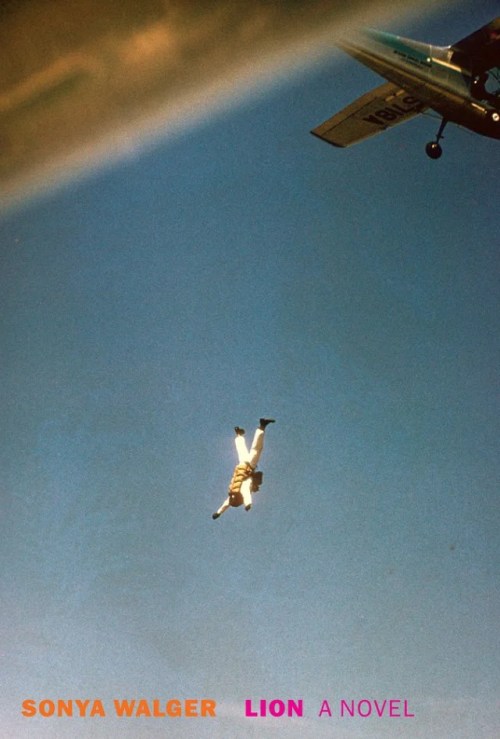
FICTION
Lion
By Sonya Walger
New York Review Books
Published February 4, 2025


