


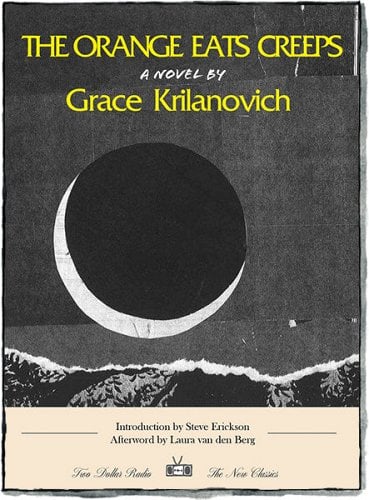
Grace Krilanovich’s The Orange Eats Creeps is an existential phantasmagoria running rampant with stream-of-consciousness storytelling. Forms melt in-and-out of space, and time is a fluctuating construct. Where James Joyce explored Dublin, and William Burroughs New York City, Krilanovich’s novel is located in the Pacific Northwest of the 1990s. Gas stations, forests, underground rock venues, wasteland beaches, and bus stations detail the setting. “Setting” may be a strong word—these places are anti-spaces where forms melt in and out of each other, and blurry people grind against each other to find fulfillment in the societal wilderness. Orange is not an easy read.
The novel was originally published in 2010 and named a Best Book of 2010 by Amazon, NPR, and Shelf Unbound. This January’s re-release is part of The New Classics series through Two Dollar Radio, celebrating recent works that have already made a strong cultural impact. The book comes with a contextualizing introduction from novelist Steve Erickson, and a new afterword by writer Laura van den Berg.
The unnamed teenage protagonist believes she is experiencing a form of drug-induced ESP—extrasensory perception, psychic powers. She describes herself as a “vampire hobo junkie,” wandering jobless to find blood to suck, drugs to consume, and people to vamp or be vamped by. As the protagonist notes early on, this lifestyle makes her “free in the most sinister way.” There is a reminiscence here of period-adjacent vampire films like The Lost Boys and Near Dark, but Orange carries a greater grittiness and neurotic introspection. In such neurotic introspection, it becomes increasingly difficult to tell as the text progresses what is real in the moment and what is a phantom of the protagonist’s memories. Herein is a cosmogony of meth, the Donner Party, deformed kittens, sex, coffee, disembodied voices, birds, 7-Elevens, ghosts, diners, rock concerts, mites, Safeways, and schizophrenics. “We live in a past we don’t understand,” the protagonist observes.
It is hard to determine if Orange has a plot, or if what is presented is even chronological. The protagonist seeks her foster sister Kim, carrying on this vague quest throughout the text. For about the first half of the novel, the protagonist spends much of her time with a gang of fellow hobo vampire junkies. At one point, this gang disappears unnoticed from the story, only for the protagonist to suddenly find them again at a 7-Eleven. It’s possible to pick out a turning-point climax near the end of the novel, but its reality and enduring growth for the protagonist is foreseeably unclear.
Some have called Orange a new kind of novel. For this reviewer’s part, the influence of Kathy Acker, William S. Burroughs, and that foundational master of the daydreaming unconscious, Joyce, is evident. This is stated not to diminish the violent strength of Orange, but to emphasize the tradition the novel takes part in, as all novels must—excepting those staggering inconceivables that come along perhaps twice a century. Orange is, in any case, a standout work of the 2010s, and likely to go down as an important work of the decade. The question remains whether it will be acknowledged as a great work of literature in general, or be penned off in the space of genre fiction—a division that remains shaky and debated in our own times.
The work is nearly more poetry than prose. The cascade of events and imagery invites the reader to let it all wash over them, rather than attempt an exhaustive interpretation. “Don’t think hard, think deep!” the protagonist reminds themselves. The reader would do as well—to sink deeply into the work, into whichever fragmented piece they are currently reading. Orange is a world of fragments, pieces that can perhaps never be put together into an understandable whole, but only felt strongly moment-by-moment.
FICTION

by Grace Krilanovich
Two Dollar Radio
Published January 21st, 2025


