Close your eyes and imagine an ancient manuscript. What picture comes to mind? If you received a Western education, like I did, you might picture a tiny and yellowing book of illuminations, made by hunchbacked monks in the European Middle Ages. Or perhaps you imagine crackling scrolls of papyrus, lost and mourned forever at the library of Alexandria. There is another manuscript tradition, just as old, just as storied, just as central to our collective human heritage: the South Asian palm leaf manuscript tradition.
The practice of writing on preserved palm leaves dates back to at least the third century BC, when Hannibal was marching on Rome and the Qin Dynasty was rising in China. The leaves of the ola tree (among other types of palm) were prepared through a several-step process involving gentle boiling, sun drying, and wood smoking. Once the palm was prepared, a scribe would take a metal stylus and inscribe letters in a curved script upon the cut materials. Ink was then rubbed into the carved depressions to make the text legible. Such a manuscript could last hundreds of years, if preserved and treated properly. Then, after its time had come, monks or other scholars would recopy the texts onto a different manuscript, ensuring the texts could survive for several centuries more.
I learned all this when I was in high school, on a family trip to South India. My dad took us to an old library in Chennai, where some of the manuscripts of his beloved Tamil epics were stored. There, at the Swaminatha Iyer library, I held a palm leaf manuscript for the first time in my young and clumsy hands. I felt a deep pride swell within me, mixed with an intense curiosity. The intervening decades have not dimmed my fascination.
Growing up as a brown kid in the West, it can be easy to internalize the message that your culture is not as civilized, as storied, or as all-around important as Western culture. My family took pains to ensure I knew our history, maybe as an antidote to that sort of colonizers’ shame. But there’s a difference between being told your history and holding it between your hands. When I run my fingers up and down such tiny inscriptions, and I breathe in the brilliance our people have shown for centuries: I feel my place in time, and I stand tall.
Last summer, when I was looking for an excuse to get into the Newberry Library’s reading room, I asked if they had any palm leaf manuscripts in their collection. I’m always looking to see another one, and it never hurts to ask, right? To my delight, they did have one such manuscript in their collection, and as a newly minted Newberry Library patron, I was allowed to see it. It took maybe fifteen minutes for me to request the item, head to the reading room, and, finally, have it delivered to my table. I was told to be careful. That was it.
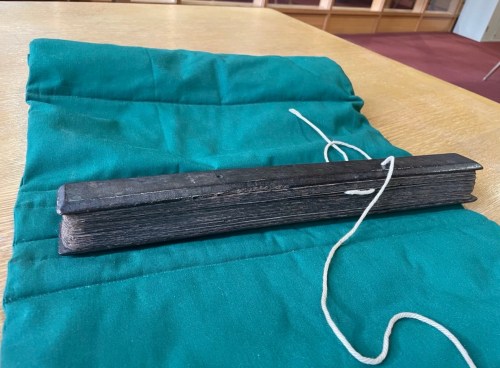
I thought that there should be more ceremony around the whole thing, to be honest. Gloves and a mask, maybe, or someone to hover over my shoulder to make sure I didn’t damage the manuscript. It was brittle; flakes of dried palm leaf came off if I pulled the cord through the leaves too roughly. The manuscript only had one cord serving as its binding, although there was clearly a hole in the leaves where a second cord should be. It must have gotten lost over decades and centuries. I didn’t know for sure, but I imagined the manuscript had to be hundreds of years old, at least. It was almost certainly older than the building it sat in, possibly older than the city it was living in, too. Shouldn’t it require more reverence?
In a moment, those concerns faded away, replaced by undiluted awe. I ran my fingers up and down the leaves. I breathed in deep, hoping for a whiff of a time long past. I took a thousand photos and I spam-texted my family. The manuscript, like many palm leaf manuscripts, was about forearm length, horizontally, and about one inch tall. It was a cinnamon brown color; each page was as thick as an index card. The edges were rounded and rough; beneath the text, you could see the lines of the original palm leaf.
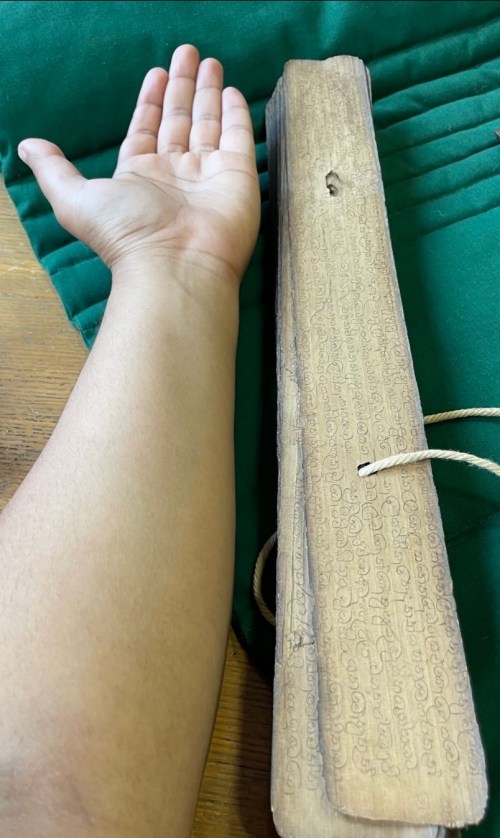
There was only so much I could get from aggressively staring at the book, because the truth was that I couldn’t read it. I can only read English with ease, and oddly enough, this ancient South Asian manuscript hadn’t been inscribed in English. So I went up to the librarians’ desk to learn more.
Bouncing on my toes with enthusiasm, I asked the librarian at the reading room desk how old the manuscript was, what language it was in, and how it had ended up here, of all places. What did it say? I asked. There was a sad small silence, and then the librarian said, “We don’t know.”
I couldn’t live with that answer. I felt a compulsion, a deep need to know the story of this manuscript, this little brown fragment of South Asia. When I left the Newberry that day, I started looking through old news articles. WBEZ reported that in 2008, the McCormick Theological Seminary in Hyde Park donated almost 5,000 books and manuscripts to the Newberry Library. This manuscript was part of that collection. At the McCormick Seminary, “the books were sitting in a locked room, and some had never been studied.” The staff at the Newberry Library have spent the years since then cataloguing the donation book by book, unearthing everything from first-edition Calvin sermons to thirteenth-century Bibles. But the work is ongoing, and, as Newberry Curator Dr. Jill Gage told me, palm leaf manuscripts are “not a specialty of anyone currently on staff.”
So, the Newberry was only able to speak to the manuscript’s twenty-first-century history. McCormick Theological Seminary did not respond to my request for information about how they’d ended up with the manuscript in the first place. The Newberry did reassure me that they had been told the Seminary had acquired each piece in that 5,000-item collection “in good faith from their rightful owners.” I’d feel better if I knew the details of acquisition, especially given the context of imperial history, but at least it was clear that all contemporary intentions had been good. Good, but not detailed. So this part of the trail went cold. If I couldn’t trace the story of the manuscript’s journey, I thought, then perhaps I could instead decipher the story within its leaves. I needed to find someone who could read it.
The Newberry’s catalog information for the manuscript is a study in uncertainty. Author: Unknown. Creation Date: 1—? Language: Probably Pali. I decided to take “probably Pali” as my jumping-off point. I knew nothing about the Pali language, and I found it deeply confusing that the manuscript’s infofile also said it was written in “possibly Sinhala script.” I’d only known of Sinhala as a contemporary, spoken language. So, as any good millennial does when confronted with a baffling question, I turned to Reddit. The good people of r/language explained to me that the ancient Indo-Aryan language of Pali had never had its own script. It was a spoken language, only; when written, its phonetic sounds had to be transcribed in the scripts of different languages. It was technically possible for this manuscript to be both “probably Pali” and “possibly Sinhala”; many Pali-language texts had been transcribed in the Sinhala script.
I’d need someone then who could not only read Sinhala script, but also understand the Pali language—or so I thought. I reached out to the Pali Text Society, founded in 1881 to “foster and promote the study of Pali texts.” The society is based in Oxford (Britain, not Mississippi), so I sent them a series of photographs of the manuscript. My atrocious photography skills and iPhone 12 (mini) were not the best suited to the task of photographing a long, skinny, and faded manuscript’s leaves, individually and with sufficient legibility, but I managed well enough.
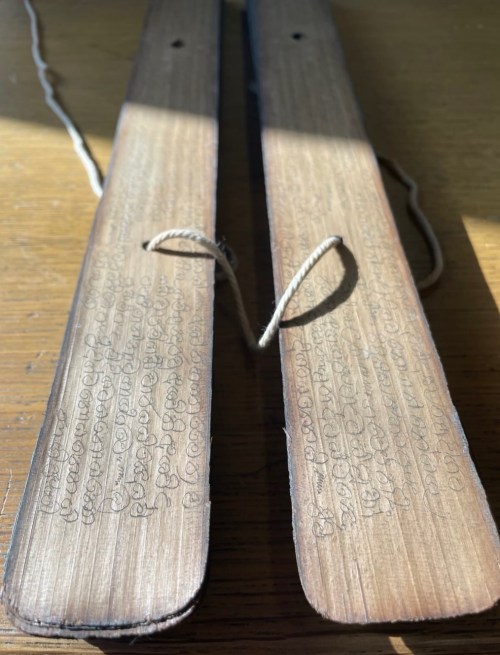
It took a few weeks before the Pali Text Society was able to answer my questions, but once I heard the answers, I definitely understood why. The Society’s office administrator had reached out to a German colleague, who had in turn reached out to a Sri Lankan colleague. My poor, shoddy photography was circumnavigating the digital globe. Together, the British, German, and Sri Lankan scholars came to the conclusion that this manuscript was not a Pali manuscript. Instead, they said, “It is our belief that the text is in Sanskrit with a Sinhala commentary.”
Cross “probably Pali” off the list. “Possibly Sinhala,” however, was looking more and more like a winner. To find an expert in Sinhala and Sanskrit, I needed to once again look to scholars far outside Chicago, and America. (Apparently, only one American university, Cornell, offers instruction in Sinhala at all.) I reached out to Dr. Rohana Seneviratne at the University of Peradeniya in Peradeniya, Sri Lanka. Seneviratne pushed back on the idea that this manuscript was a Sanskrit text.
“This is NOT a Sanskrit work but, more certainly, a Sinhala work containing Sanskrit verses/phrases here and there,” said Seneviratne. His colleague, Dr. Jambugahapitiye Dhammaloka, added that the manuscript was “definitely a translation (gloss) of a Sanskrit text which is in verse form. The author provides the Sanskrit verse first, and then glosses it word by word or phrase by phrase.” (A gloss is essentially a highly notated type of translation.) The professor also pointed out that there appeared to be some grammatical errors in the Sanskrit; he hypothesized that perhaps the scribe who transcribed the manuscript hadn’t been perfectly fluent in the language.

Both professors agreed that the pages of the manuscript appeared to be out of order. I hadn’t been able to send over a scan of the entire manuscript, so they were attempting to answer my questions based on the content of just a few pages. Seneviratne spotted quotes in the text from Varāhamihira’s Bṛhat Saṃhitā, a well-known sixth-century Sanskrit encyclopedia by a famed astrologer. Dhammaloka noted that the manuscript discussed the rice-feeding ceremony (annaprasana), a traditional ritual performed after a baby is born. He also saw references to the namakarana, or naming ceremony for newborns, in the manuscript. The text’s main subject appears to be the traditional rites and rituals performed for newborn babies in ancient South India and Sri Lanka.
These rites haven’t changed much over the centuries. I had a namakarana and an annaprasana right after I popped out of the womb. These pages, and the practices they speak of, are both ancient and alive.

But exactly how ancient the manuscript is remains a mystery to me. “The codicological features . . . do not allow me to decide how old this manuscript could be,” said Seneviratne, but “apparently, this is not older than a couple of centuries at the most.” A colleague of Dr. Dhammaloka’s thought the shape of the lettering might indicate a type of script that was used in the eighteenth and nineteenth centuries . . . but it also might not. After haranguing scholars on three different continents, that’s the best sense I could get of the manuscript’s age, and it’s hardly a precise one.
I remain unsatisfied. I want to know more because I’m consumed by curiosity, sure. I’d like to know exactly how old this manuscript is, exactly how it came to be here, the name of the scribe that wrote it, the room he was sitting in, and what he had for lunch while he was inscribing the very first folio. (And if the scribe was a she, I’d extra like to know!) But it’s more than that.
I wish this manuscript was celebrated and known, as beloved by the city and as precious to the community as it has become to me. I think it could play an important role in ensuring the public knows how global and diverse the history of the book has been. As it so happens, though, I’m the only member of the public to have viewed the manuscript since the Newberry began keeping electronic checkout records in 2018. It’s a bit of a chicken-and-egg situation.
Will Hansen, the Vice President for Collections at the Newberry, shared a bit with me about how the library sees its role in researching manuscripts: “In general, the charge for the library and its catalogers is to glean enough information about each item to create a catalog record that will assist researchers . . . so that they can generate new knowledge about the items upon viewing.” He added, “Particularly with rare or unique items such as manuscripts, in many cases we are dealing with incomplete knowledge. . . . We are necessarily dependent on researchers with more specialized knowledge than library staff might have.”
The public isn’t going to flock to view a complete nonentity of a manuscript. But the manuscript’s history can’t be filled in without the work of more readers and researchers. One solution would be to digitize the manuscript so that its pages can be read and translated by those with expertise in Sinhala, since there are so few such experts in the United States. The Newberry’s librarians expressed openness to this suggestion in our last conversation. I’m hopeful the process will move forward. I’m hopeful this manuscript will be read, translated, and celebrated. Spending time with its palm leaves has given me a profound sense of connection. As its secrets are unraveled, I hope more Chicagoans will come to feel its pull.