


Erika Krouse’s latest story collection Save Me, Stranger begins in a Siberian village, the coldest place on Earth, and takes one through Anchorage, Bangkok, Tokyo, and the desert town of Santa Rosa, New Mexico. Not only do the places in these stories keep a hold over you for what they carry—their culture and history—but also how they interact with the characters, shaping their fears and living, sometimes offering a safe haven, and other times chasing them out. When Krouse grounds you in the compelling and deeply fraught world she creates, you want to know about the people inside that world—a girl who falls in love with the son of her father’s murderers, a daughter who finds her father’s secret in a massage parlor, two friends diagnosed with cancer, with months to live, alarmingly saved from their deaths through unexpected acts of service.
In this haunting collection, the voice of a first-person narrator is so unashamedly real and complex, surprisingly confessional, and bravely intimate, that the gap between reader and character closes with each page. Even then, Krouse succeeds in leaving one in a state of suspension, relief, and hopefulness. In particular, Krouse writes about survival with such tenacity; inviting us to the radical act of paying attention and stretching our hands in the deep to pull one back to life. This is a book to be read at all times, especially now, when the world would have us choose between who deserves to be saved and who to leave behind.
Tryphena Yeboah
There’s an intimacy to your writing of place that lingers long after one is done reading the stories. From the coldest town on earth where trees explode and everything breaks, to family trips in Bangkok, and a haunted Bed & Breakfast in Colorado where a ghost saves the life of a woman on the run, these places come alive in such vivid ways and shape how the stories are told. It is as though the setting becomes a character too, with real traits, attitudes, and history that significantly inform how characters engage with their world. Can you talk about your approach to building these worlds, how much of your own experiences inspired some of these places, and what you find to be a key aspect of making a place tangible in a reader’s mind?
Erika Krouse
I’ve researched some of those settings over decades, especially Oymyakon, the coldest town on earth. I also lived in many of the places: I hid from a stalker in the haunted Colorado B&B I wrote about, I was the teenager driving an ice cream truck through Omaha ganglands, I went to middle school and high school in Tokyo, got lost as a kid in Bangkok, etc. However, I’m not naturally good at writing settings, and I have to work harder to evoke them. I do think of settings as characters, but not separate ones—more like subplot characters, extensions of the protagonist’s psyche and specific state of mind. Like, one person’s Topeka can never be another person’s Topeka. But you have to get it right—you can’t have banana trees and surfing in Topeka or someone’s going to email you.
Setting’s ridiculously hard. The better you know a place, the harder it is to write about because it feels like it’s ordinary, so what is there to say about it? And the less you know a place, the harder it is to write about because you’re afraid of getting it wrong. I think it maybe helps to remember that setting is emotion. I’m thinking of the spiteful, furious house in Toni Morrison’s Beloved, “another kettleful of chickpeas smoking in a heap on the floor; soda crackers crumbled and strewn in a line next to the doorsill.” Or one of the protagonists in Denis Johnson’s Jesus’ Son, hitchhiking after a fight with his girlfriend “with the wind crying through my earring.” When people say “setting is a character,” they mean that it’s always changing, and full of complicated feelings.
Tryphena Yeboah
The humor in your writing is absolutely fantastic; it is subtle but sharp, aptly timed, and so effective at punctuating certain highly charged moments, and when one least expects it. In “Eat my Moose,” with Bonnie’s brain tumor and chemo treatment, Colum notes her foresight to never marry, and Bonnie responds, “now I’m too bald to wear the veil.” Or, when they consider working as euthanizers, Bonnie states, “dying people are everywhere. We could start with our support group. Word of mouth is everything,” and to which Colum replies, “Corpses don’t make referrals.” There were several times I caught myself chuckling, and then almost felt bad for doing so. These are often unsettling and serious moments, yet somehow, you make room for the contrast of a funny remark or observation. Why do you think humor works in these moments and would you say you carry this perspective beyond your writing?
Erika Krouse
I think humor is our best defense against despair, especially when it’s forbidden humor. Did you know that sarcasm and irony are punishable in North Korea? I think there’s rebellion and subversiveness in humor, and the truer the joke, the more it lingers and helps us cope. Because life is ludicrous! I also sometimes use a joke as a kind of avatar to tap into a reader’s true thoughts about a story and making them feel heard and included, even if the protagonist doesn’t necessarily feel the same way, or understand the joke. But for me, just cracking jokes isn’t that interesting; I love it when a writer finds the humor in something deeper like grief or loss or the absurdity of the human condition.
Beyond writing, I tend to use humor as a defense mechanism, like most people. I crack jokes in the worst situations: at funerals, when someone’s yelling at me, to the police, in the gynecologist’s stirrups, etc. Just like there’s humor in the most serious situations, there’s also a sinister edge to humor. You’re saying, See, we’re all laughing, don’t hurt me!
Tryphena Yeboah
There’s a strong sense of mystery and thriller in “Fear Me as You Fear God,” “North of Dodge,” and “Eat my Moose.” The stories have characters with a depth of emotional complexity as they navigate intense situations, often for their survival. The stakes are incredibly high, and what I find unique about these stories are the characters—their voice, what drives them, the internal conflicts within them and their shattering sense of self. I’m curious if your experience in private investigation played any role in thinking about plot twist, suspense, hidden-in-plain-sight-details, and character motives, as well as depicting a world of crime, domestic abuse, and violence.
Erika Krouse
I think my P.I. work helped me understand that every situation is complex, and that the complexity never ends—it’s turtles all the way down. P.I. novels often get this wrong; they dispose of characters after they reveal a key piece of evidence or establish themselves as a type (an “it’s none of my business” witness or angry ex-girlfriend or whatever). But people are endlessly complicated, and the more they tell you, the more important their information becomes. Writers tend to have the kinds of faces/demeanors that make people open up, perhaps because writers are generally interested in people. We ask questions and make eye contact. But yeah, it happens all the time: check-out clerks, people in line, people on airplanes and buses. During my last mammogram, the tech described her mother’s recent death by breast cancer and then said, “Good gravy, why am I telling you this?” It definitely gives you more to write about.
I think my on-the-job training as a private investigator did also teach me to look at things most people avoid, like crime, suffering, and violence. It’s hard to look at pain, but if you can manage it, you learn much more about life. The job taught me how to observe more closely and to get better at understanding people. It’s becoming a lost art, noticing and listening to people. People are mostly looking at their little rectangles.
Tryphena Yeboah
You’ve written a memoir, two short story collections, and a novel. I also discovered that you started out with poetry before experimenting with long form, which is exactly how I started my writing journey, too! I’ve long been interested in the relationship that exists in writing across multiple genres—the distance between them, how one borrows from the other, and the possibilities when the lines cross over. How is your writing enriched and challenged when you write in multiple genres? Do you find that your sensibilities and relationship with language evolves as you switch between the long and short forms, fiction and nonfiction?
Erika Krouse
Ah, you’re a poetry victim, too! What hooked you? All the money?

I never set out to write in different genres, but I’m allergic to doing the same thing twice. Being comfortable makes me uncomfortable (and yes, that’s the definition of hell right there). So I never really know what I’m doing; I’m always winging it and failing. I grew up in a difficult situation with tons of rejection and failure, so I’ve made friends with it—unless it’s a mammoth failure, one that costs me years. But the smaller failures are just part of the writing process, I think. I’m only interested in writing something that’s a mystery to me, which often means there’s some kind of genre/style shift that I’m going to screw up a lot until I figure it out.
Regarding the different genres and their demands, nonfiction feels easier to write for me (you already know what happened) but harder to edit, because if you mess up the tiniest fact, the whole story loses credibility. Fiction bears the upfront burden of endless choices and the demands of imagination, especially when you’re crafting your plot structure. Books have to carry all that weight and tension to sustain the whole long story, so language often falls away from focus. Short stories and essays are inherently more experimental and free, making them denser on the sentence level, yet easier for a reader to abandon because the stakes are often lower. Regardless of genre, when I finish any story, I feel mystified about how to write the next one. It’s like I’ve never done it before. I know I’ve written things—I remember!—but the next story feels impossible, like trying to build a rocket using only Christmas tinsel and a fork. And someone just cut off my hands.
Tryphena Yeboah
You have just described so clearly the season I find myself in, and it feels strangely comforting to know I’m not alone.
Survival and longing wield such an urgency in this collection. You bring the characters close to the edge, to the end of themselves, and they’re yanked back just as quickly as they were thrown in. In “The Standing Man,” Satō leans forward, ready to throw himself in front of an express train, but a hand drags him back; in “The Blue Hole” pregnant Katie goes down a sinkhole, drowning, until Stacey pulls her up by the hair, and once out in the open air, she finally admits, “I wanted to live.” It is quite remarkable how you explore the inner wrestling and deadly resolve of a character, and the timely intervention of an act of kindness, of saving. These moments made me think first about second chances, but also about risks and surprises—did you encounter either in the writing of these stories?
Erika Krouse
I think writing itself is a risk. You’re risking your life—your days and years. It takes so long to write and publish anything, and without a reader, writing is just squiggles on paper. There are no guarantees in this business, so I think it’s pretty badass to fling yourself out there. The bravest people I know are writers. I’ve also seen people save each other, and I’ve participated in that kind of saving before, on both ends. I wonder what we owe each other, and to what extent. Do we owe each other our sacrifices? Second chances? Because I’ve written characters who deserve neither. How much sacrifice is too much? Too little? What should we risk for each other? For ourselves? I’ve answered your question with six questions, which means that I don’t know the answer, even after writing a book called Save Me, Stranger. But I think the questions are sometimes the point of writing. Stories often function as questions, so readers can find and experience their own answers.
I guess one story had a surprising progression. I couldn’t quite get it to work; I revised and revised, and it always fell a little flat. I decided to open a blank document and just pull out the parts that worked and cut the rest, kind of like the original was an organ donor. I ended up extricating just one scene, a name, the setting, a sentence I liked, and a character attribute. That was it! I hadn’t realized how much of my carefully-crafted story was so negligible. The new story I wrote from those scraps had a different perspective, relationship, title, story structure, situation, genre, conflict, dilemma, and plot—basically, everything. This time, it worked! I think from now on I’m going to try the same exercise with every story.
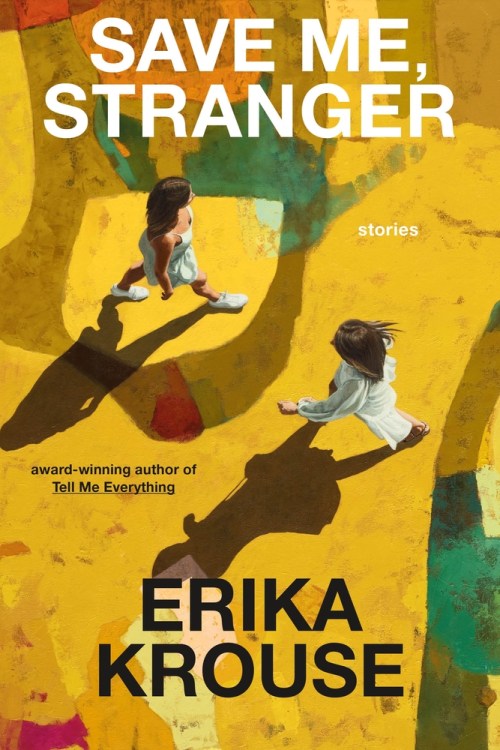
FICTION
Save Me, Stranger
by Erika Krouse
Flatiron Books
Published January 21st, 2025

