


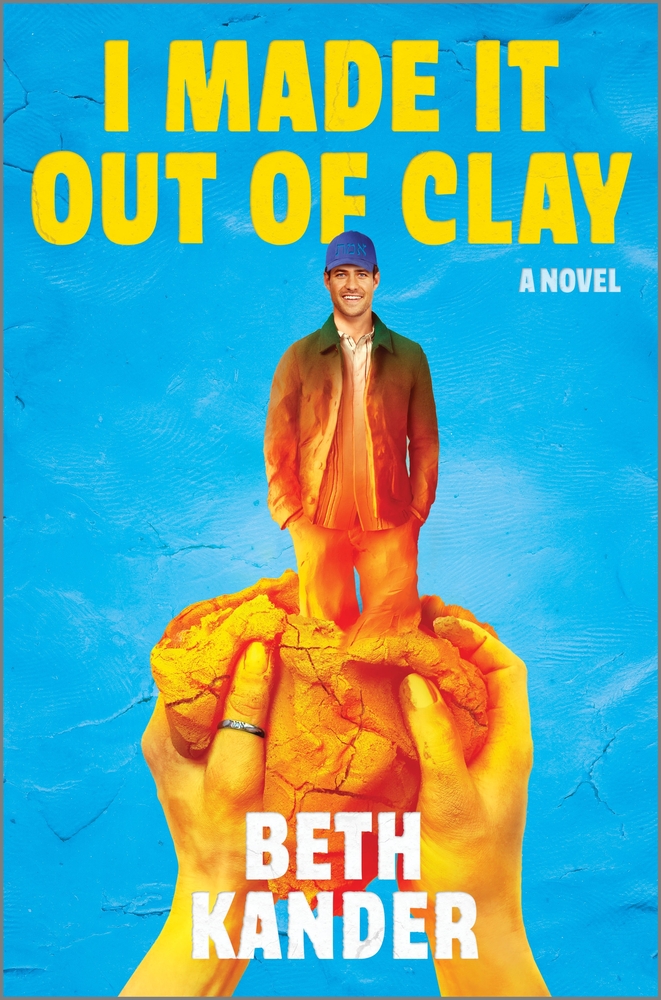
The golem is a folkloric creature made of earth and brought to life by a Jewish person in need of protection or companionship. Beth Kander invokes this legendary being in her adult debut, I Made It Out of Clay, a story about a woman whose grief pushes her to create what she feels is missing from her life.
Eve Goodman is a copywriter for a Chicago ad agency that is on the verge of losing their biggest account. If that happens, the list of newly unemployed people may well include her. Not only is her job on the line, but at the end of the week in which the story is set, Eve’s younger sister, Rosie, will be marrying the love of her life—a feat Eve is nowhere near achieving—and the day after the Hanukkah-themed nuptials, Eve turns forty. Her father passed away a year prior to when this story begins, and her grandmother, a Holocaust survivor, passed away some years before that. Eve’s mother is in constant motion in a clear effort to keep her own grief at bay, and Rosie is a TikTok fitness celebrity with a booming following. Since her immediate family seems more interested in moving on than working through their sadness, Eve usually keeps her cell phone turned off to avoid unwanted conversations about things that simply don’t matter as much to her as the people she’s lost.
After aspirationally including a plus-one in her wedding RSVP, Eve decides to ask her neighbor from across the hall, whom she calls “Hot Josh,” if he will be her date, but he turns her down. Humiliated and drunk off her face, Eve stumbles back to her own apartment with big emotions swirling through her. Not only is she plagued by grief and loneliness, but fear, too, with the news of bomb threats made to her family’s synagogue and a recent encounter with a neo-Nazi fresh in her mind. When Eve was thirteen years old, her bubbe had told her the story of how she almost succeeded in making a golem just before she and her family were stolen away from their home. Years later, her life crumbling around her, it is Eve whose back is against the wall. The morning after Josh rejects her wedding invite, Eve wakes up having built a life-sized, living man out of clay leftover from her apartment building’s construction.
Despite how central grief is to the narrative, I Made It Out of Clay feels like a cousin to the Hallmark holiday film in that it leans more toward heartwarming than harrowing. Eve inherited an appreciation of Christmas from her father, a devout Jew who insisted that all the best Christmas songs were written by Jewish musicians; this sets the tone for a happy balance between Jewish and Gentile holiday cheer. The scenes recounting wedding and holiday festivities are immersive, lending a light buzz to the reading experience that makes you wish you were there with a drink in your hand—that is, until a situation or two comes up that makes you glad you’re not there. The emotional moments between Eve and her family are touching (yes, I teared up during the wedding toast), as are her memories of her grandmother. Surprisingly, more of her grandmother’s personality shines through than her father’s despite his more recent death and the anecdotes Eve shares about him.
Much like those beloved holiday films, this story has certain roadblocks in place that only exist as part of the formula. From the remembered conversation between Eve and her bubbe, we learn that bringing a golem to life requires writing Alef-mem-tav—the Hebrew word for “truth”—on its forehead, and that erasing the alef turns the word into “death” and puts the golem to sleep. So it’s strange when, a couple of chapters later, Eve is worried about leaving the golem alone in her apartment and decides to bring it to work with her. Decommissioning the golem doesn’t occur to Eve; the golem coming out into the world with her is treated as the only option. The issue in instances like this is not that a character doesn’t do the thing we know they could do—it’s that they don’t even consider or acknowledge the possibility, which makes them feel slightly less human. Ditto Eve’s tendency to cut people off in conversation or ignore messages just as something critical is about to be revealed, or to form judgements out of thin air to justify behaviors that disrupt her relationships, and hence the course of events. These elements expose the author’s agenda in a way similar to the holiday rom-com that doesn’t want to scare you away by surprising you too much. What ultimately happens is what you want and expect to happen.
Kander also over-explains in places, a habit that could understandably be the result of having written numerous books for younger readers. A lesser example of this comes when Eve takes her golem to a restaurant with Wi-Fi so that she can get some work done, but hides the truth of the situation from her friend Sasha. Kander writes, “If I say that I’m out to lunch with a man I made from leftover basement renovation supplies, Sasha is going to think I’m out to lunch in another way—namely, the gone-completely-batshit-insane way.” The phrase “out to lunch,” though perhaps no longer commonly used, is something Kander’s adult readers will likely understand without need of the em dash and what follows. One could argue that the aside is a way of injecting some of Eve’s personality into the story, but when it happens repeatedly, it can feel as if the author doesn’t trust you to keep up when you might already be familiar with what they are telling you.
Eve’s best friends are a gay man and a biracial, Black, Jewish woman. On the one hand, it’s great that these details aren’t underlined in the same way they might be in a literary novel since probing the depths of racial and even religious discrimination are not the point of I Made it Out of Clay and doing so would probably ring hollow. On the other hand, Sasha’s Blackness is practically erased from the story altogether, despite opportunities to plug it in organically using details already present in the story.
For instance, Eve learns about the bomb threats to the synagogue in a conversation with her mother. When Eve asks why they don’t simply increase police presence there, Eve’s mother replies that doing so would likely make some members of their congregation feel even less safe. Though it’s wonderful that her mother is shown to be cognizant and empathetic of the situation’s nuances, this would have been a perfect conversation to have with Sasha. But unlike Eve, who encounters a neo-Nazi and is rightfully shaken, the worst thing to happen to Sasha (that we know of) is a mugging which, though troubling, could happen to anyone. Admittedly, conversations about race don’t always happen even between close friends who occupy different corners of that construct. But that, too—an acknowledgement by Eve that she and Sasha never discuss these things—would have been a refreshing way to handle race in a story whose genre rarely touches on the subject.

The golem is Eve’s ideal man in most ways: he is protective, proactive, and pro-feminine pleasure. He’s also hot (despite being cobbled together while she was shitfaced) and unexplainably fleshy, though often covered in a light film of dust. He acquires language slowly, but gains other knowledge rather quickly. While the rules aren’t completely clear, they don’t need to be when the fantastical element of a story is primarily there to make sure the protagonist learns an important lesson, and Eve does: that we have more power than we think to create the lives we want.
I Made It Out of Clay looks at grief and loneliness through a romantic holiday lens. Like the golem within its pages, it is a story designed to lessen some of the harshness of life. A comforting read for literal and figurative winters, I Made It Out of Clay will inject some coziness into your holiday season while gently nudging you toward emotions that may need your attention.
FICTION
I Made It Out of Clay
Beth Kander
Mira Books
Published December 10, 2024


