


The morning after the 2016 presidential election, I walked my wife to work along the tree-framed median that splits east-west traffic down Commonwealth Avenue, looking with great suspicion upon those able to fix their vision firmly on what was before them. We were toeing the miserable months. A winter in Boston lasts half the year. You can’t imagine clawing out it. False springs taunt you. Then, finally, June arrives, but not until you’ve been changed.
Now, something more profound and everlasting slouched our way.
A small group of protesters had gathered on the steps of the gold-domed capitol building. At the Granary Burying Ground, someone had tied black balloons to the obelisks and headstones of John Hancock and Samuel Adams, of Paul Revere and Robert Treat Paine. You felt the judgment of those long buried: how were you able to so thoroughly make a mess of what we’d bequeathed you?
I kissed my wife at the door to her work, a distracted kiss for both of us, then headed down the street to a café, where everyone appeared to be in a fragile state. At my table I unrolled the draft of a chapter I’d brought with me. Soon, I was lost in it, the heavy world falling away.
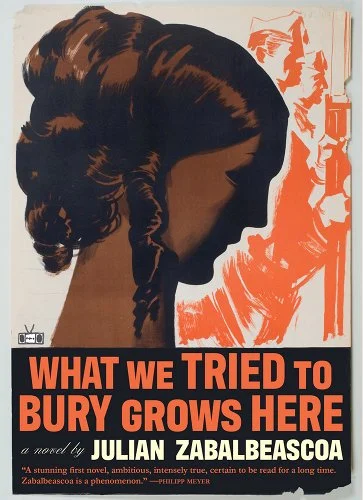
The chapter was from my novel-in-progress that would become What We Tried to Bury Grows Here. It took place during the Spanish Civil War, in the city of Bilbao, the last front for the Basque Army who had amassed there to defend Spanish democracy against the military-led and fascist-backed Nationalists. Gernika had been bombed months earlier, razed in the first carpet bombing of its kind in history. Bombed by Nazi Germany’s Luftwaffe Condor Legion, with assistance from the fascist Italy’s Aviazione Legionaria, the destruction of the village was a birthday present to Hitler. Now, in the story, in Bilbao, thousands of shells are dropped daily upon the city, leveling buildings, tearing craters into the earth, killing many, including the displaced, those who had fled the bombing of Gernika. The story focused on a writer of leftwing pamphlets as she struggled to protect her two children not only against the ever-grinding demolition but also the threat of fifth columnists, those supporters of the National Movement crouching among the population for the arrival of fascist troops so that they may finally reveal themselves and join the fight against the democratically-elected Spanish government.
Working on this story felt like vital work. From a distance it might have seemed a selfish act. The world was teetering on the precipice. Who was I helping by sitting at that table and trying to summon feelings from words? I was under no illusion that what I was doing would right the course of events—should any writer feel that way, chances are they’re either in the manic grip of some lofty delusion or penning propaganda, or both—but writing, returning again and again to bombed-out Bilbao and its population who, despite it all, continued to resist was vital for my own grounding and well-being. The art and craft of writing, this daily practice, kept me present and engaged, kept me from going through that day and the many dark ones that followed it numbed and acquiescent, pliant material for those I had voted against.
On Jon Stewart’s former podcast, Russia-born journalist Julia Ioffe explained to Stewart why no number of body bags returning home from Ukraine would motivate Russians to reach for their pitchforks and storm the Kremlin. Bombarded, she said, as they are by mis- and disinformation, a fatalism by design takes root. The people conclude that since nothing depends upon them, since the folks at the top don’t listen to them, and since they can no longer determine what is or is not real, they may as well give up. She concluded with this joke, “A bunch of Russian peasants are standing in a giant sea of liquid sewage, and it comes up to right under everybody’s noses, and everybody is standing there with the top of their heads sticking out, and one guy sticks his [head further out], looks around, and is like, ‘Hey, we’re all standing here in shit! Why are we doing this? Let’s go! Let’s get organized! Let’s improve our lives! Why are we just standing here in shit?’ And somebody stands [further] up and says, ‘Shh. Stop making waves.’”
The agenda of authoritarians is to meet little to no resistance as they impose their will upon the rest of us, amass more power, and pillage the national coffers. It is not impossible but far more difficult to do this against a population daily in pursuit of what makes them feel alive.
In the weeks and months and years to come, we will be bombarded by stories meant to dispirit us, devastate us, persuade us of our powerlessness, stories that will break our hearts, make us fearful of the prospects before us, attempt to gaslight us, to infuriate us, to distract us with outrage while our institutions are chipped away at, and ultimately encourage us to retreat from the world. If we succumb to these, there’s a far greater chance that much that we currently fear shall come to pass.

We will be in desperate need of other stories then. Of other storytellers. Of all that breeds hope. For “hopefulness,” the musician Nick Cave wrote, “is not a neutral position. It is adversarial. It is the warrior emotion that can lay waste to cynicism…[that] keeps the Devil down in the hole.” This is the sort of shatterproof hope that those who fought to preserve Spain’s government during the Spanish Civil War possessed to the very end, regardless of their dwindling odds. Despite being outmatched out the gate by the fascists, they never stopped fighting for tomorrow. What the fascists in Spain were after was capitulation, for people with a positive vision of the future to lay down their arms and submit. They didn’t. No matter each new loss they suffered, they refused to allow the fascists to snuff the light within them. In so doing, they showed the rest of the free and unfree world that such a fight against seemingly implacable forces was possible, even within the conditions of loss.
We find ourselves now within similar conditions. Or acutely aware, at last, that we’d always been in them.
We can retreat, we can despair, we can capitulate. But we can be fairly certain then how this will end. Or, as a triumphant act of resistance against the demoralizing headlines and those penning them, we can remain vitally alive, tenaciously engaged with the world, take note of all pooling around us, and never stop making waves.
FICTION
What We Tried to Bury Grows Here
By Julian Zabalbeascoa
Two Dollar Radio
Published November 12, 2024


