


Who is Johnny Carson? The name still rings with familiarity today, even to younger generations that cannot match the name with a face. He was the third host of NBC’s The Tonight Show, the longest running at thirty years, and arguably the most influential of all time. A profile and study of Carson is invaluable in the modern age of influencers, which Carson not-so-jokingly predicted in his final on-air monologue, May 22nd, 1992: “It may stun you: When we started this show October 1, 1962, the total population of the Earth was 3,100,000,000 people. This summer, it is 5,500,000,000 people. Which is a net increase of 2,400,000,000 people. […] A more amazing statistic is that half of those 2,400,000,000 people will soon have their own late night TV show [emphasis added].” With websites like TikTok, Twitch, and Youtube, they may as well.
One of the first questions the reflecting reader may have reading Carson the Magnificent is: what makes it unique? Carson biographies have been written since the 1970s, covering various periods of the life of the “king of late night.” There are two primary elements that make this biography different: the authors and the book’s structure. The original author of the project was the Chicago-native Bill Zehme. Zehme wrote articles for Esquire, Rolling Stone, Playboy, and Vanity Fair, as well as several book-length biographies. Zehme began his study on Carson in 2005—this book, a project nineteen years in the making. After Zehme’s passing, it would be up to another Chicagoan, Mike Thomas, to bring the pieces together and complete the work.
Zehme’s style might be described as ‘romantic biography.’ Not romantic in the sense of focusing on the love lives of his subjects, but aesthetically, where the subjectivity of the person in focus is emphasized. This creates the effect of narrating the world more closely from the subject’s perspective. In one of his previous biographies, on the life of entertainer Andy Kaufman, Zehme shares a quote from film director Federico Fellini that frames the concept: “Everyone lives in his own fantasy world, but most people don’t understand that. No one perceives the real world. Each person simply calls his private, personal fantasies the Truth.” Reflecting this, Zehme opens the first chapters of his Carson biography in the style of comedic monologue, every sentence carrying some connotation of wink.
The book’s structure is a curious unfolding, courageously non-chronological except in a rather loose sense where the end—Johnny’s retirement—isn’t only at the end, but at the beginning and elsewhere. Loose topics reflecting aspects of Johnny’s career organize the biography’s seven parts and epilogue. The beginning parts almost present too glowing a portrait of Carson, though the lights dim as the text continues. These parts progress as an unpeeling into deeper layers—and deeper darknesses—of the host’s personality. The aforementioned “monologue narrative”, describing Carson’s life while suppressing an admiring grin, gives way more to plain speech as the history delves into darker topics. Readers may also sense this as the transition from Zehme’s style to Thomas’.
The brightness of Carson’s portrait at the beginning also helps introduce the show host to newer generations who may never have seen an episode of the old Tonight Show. These early chapters give a sense of what it was like to tune in during the 1960s, 70s, and 80s to see the comforting face of Carson night after night. It might be hard now, in our divided culture, to imagine a single cultural figure so consistently and broadly popular—and to understand the impact that’d have. As Zehme describes, “Johnny Carson was always there, reliable and steadfast […] His was the last face flickering on to the brain before so many billions of slumbers. Quite literally, he launched the dreams of generations, as no golden Hollywood dream merchant might have fathomed…”
After the portrait of Carson is established and we are given the script of a sample show (including helpful footnotes on the 1960s cultural scene), the biography goes back to Carson’s early life, family, early broadcasting history, and how he became host of The Tonight Show. The third part of the book, “A Tight Suitcase”, breaks the chronology to make an examination of Carson’s interest in magic throughout his life and career, and the comparison of that interest to being a great television host. The film director and fellow magician Orson Welles makes an observation that resonates through many public accounts of Carson, as well as a secret to the host’s success: “He’s the only invisible talk host.”

The book continues with Carson’s experience in World War II, shaky alliances with associates on The Tonight Show, the ups and downs of his four marriages, the beginning of declines in views for the program, and concluding with the closing years of Johnny’s tenure. Still, the book never quite broaches the deeper layers of his troubles—the difficult relationship with his mother, his intense mood swings, and various legal battles with NBC—which, admittedly, can be found elsewhere. Carson the Magnificent is ultimately best as an introduction to the generations that never knew Carson, and are looking to get a feel for the glamor and impact of the most influential late show host of all time.
NONFICTION
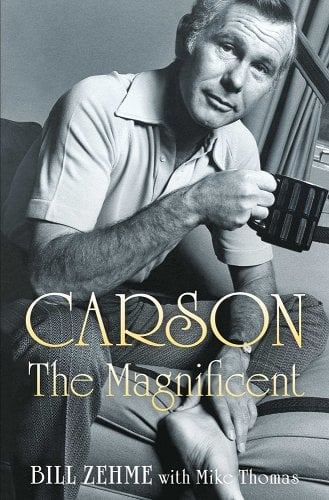
Carson the Magnificent
by Bill Zehme, with Mike Thomas
Simon & Schuster
Published November 5th, 2024


