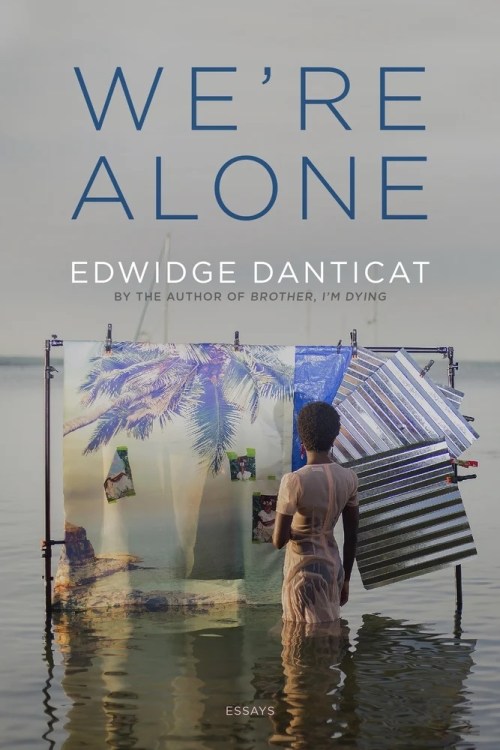
Anytime Edwidge Danticat has a book being released it’s a cause for celebration. She is perhaps best known for her debut, Breath Eyes Memory, which was chosen by Oprah’s Book Club, or her short story collection Everything Inside, a National Book Critics Circle Award winner. Danticat hasn’t released a new book since 2019 and I haven’t read much of her nonfiction so I was eager to immerse myself in her thinking. We’re Alone, released September 3, is a collection of essays, some previously published elsewhere (like the New Yorker, for which she’s a contributor) and others brand new. The book is short, divided into two parts and containing eight essays that cover a wealth of topics.
Each essay is able to stand alone. Together, however, many of them not only provide insight into Danticat’s mind but also provide additional context for the themes Danticat likes to explore in her fiction: Haitian history, postcolonialism, mother-daughter relationships, grief and displacement. Much of my exposure to Danticat is through her novels and short stories, where motherhood is a dominant presence; it was nice to see that thread carry through in this collection. Another connecting thread through much of part one is the influence of Danticat’s literary heroes, or, as she refers to them, “the literary loves of my lives.” In her essays “Children of the Sea” and “They Are Waiting in the Hills” Danticat cites her literary influences. I am grateful that Danticat singled out Paule Marshall, an author I’ve long believed should be more well known in the twenty-first century. That being said I’m ashamed to admit even I, an avowed fan, didn’t realize she had passed away a week after Toni Morrison. Danticat writes movingly of her relationship with both Morrison and Marshall, noting that even while both were living she was constantly taking notes and writing elegies: “I sometimes worried as the years went on that one day I might have to share these stories about them while I was weighed down with sadness.” She also indicates where they directly influenced her work, which will thrill any bookworm and cause them to race to reread both her books and those of the aforementioned authors. But aside from published authors Danticat also reveres the “kitchen poets,” oral storytellers. I would read an entire book of her informal book reviews and meditations on her life in reading.
Danticat describes her lifelong love of reading and emphasizes the importance of art and literature for both individuals and our society. The book is short, which might deceive a reader into thinking they can fly through it. This is a book you can quickly read in a day but it’s also one to savor, taking the time to read and reread each essay. It provides a glimpse into what it must be like to take one of Danticat’s classes at Barnard. I was constantly circling the names of writers, historical figures and notable individuals who were new to me, then looking them up while reading. I know each re-engagement with the collection’s many citations will enrich my reading experience.
While many of the essays in part one have a literary focus, the ones in part two offer a look at lesser-known Haitian history, politics and lives of individuals, those who are remarkable in their ordinariness. The essays often also reference Haitian proverbs that Danticat smoothly weaves into the narrative. In her prelude, Danticat explains the significance of her clever title—it is meant to convey the intimacy between an author and a reader, what one might whisper to another when everyone has gone: “We’re alone can also be a promise writers make to their readers, a reminder of this singular intimacy between us.” It manages to center feelings of connectedness and privacy.
It is rare that I want a book to be longer but in this case I’m greedy and think it needed one or two more essays to make a stronger and more cohesive collection. Even with the gift of hindsight I think these essays could have been held a little longer to see what other topics Danticat may have wanted to plumb. For example Danticat is currently a professor at Barnard and I would be curious to explore her point of view on student protests this past year and the increasing punitive and violent crackdown on people’s right to protest. Some readers might find the discussions within the book lacking a new perspective. As it is, the final essay, “Writing the Self and Others,” ends abruptly and it’s not always easy to follow the thread of commonality in the essays.

Nonetheless, those who appreciate gaining a better understanding of how a brilliant author’s mind works, even if some of the interjections aren’t particularly noteworthy, will relish the chance to better understand one of our greatest living authors. How lucky are we to learn alongside and be privy to some of the most intimate thoughts and musings of Edwidge Danticat.
NONFICTION
We’re Alone
By Edwidge Danticat
Graywolf Press
Published September 3, 2024