


A World War I soldier grows increasingly morose as PTSD overtakes him. A large, pointy-eared dog walks the streets of Paris with one dead eye. A female botanist rattles off the identifying characteristics of nonexistent plants: for instance, the foamy narcissus is incapable of playing a role in its ecosystem.
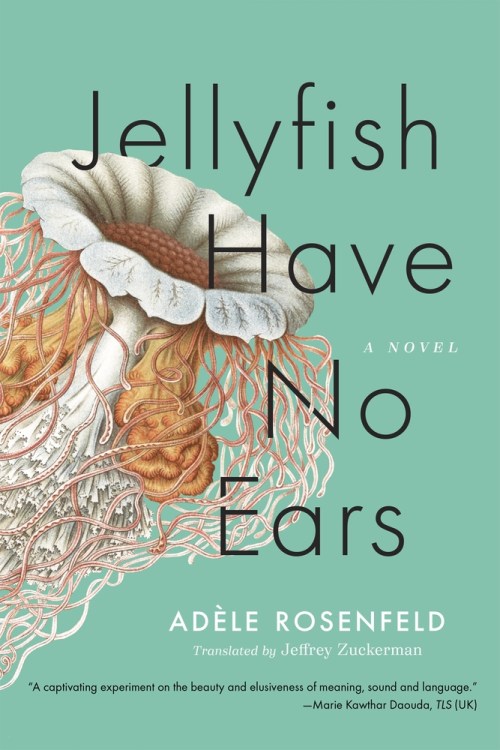
In Adèle Rosenfeld’s spectacular debut novel, Jellyfish Have No Ears, imaginatively translated from the French by Jeffrey Zuckerman, these three seemingly disparate figures form the protagonist’s, Louise’s, closest companions. But, like the foamy narcissus, they’re not entirely real. The soldier, the dog, and the botanist are projections of Louise’s psychic state as her brain heightens her visual sense in response to her decreased auditory sense. They are mirages—“miraginary,” even. They exist in the gaps between reality and illusion, human and nonhuman, living and dead, present and past. And in a novel that interrogates how the line between seeming opposites forms identities and communities, these three figures embody Louise’s discovery that imagination is the most powerful sense, and connector, of all.
Born partially deaf, yet having built a life as a hearing person, twenty-five-year-old Louise feels orphaned between the hearing and the deaf communities. When an audiology test confirms that her hearing (l’ouïe) is nearly gone, she must grapple with who her hearing has made her and will make her; and she must reexamine where she fits.
Although she attended a hearing school and has perfect French grammar, she’s not hearing enough for frictionless insertion into French society, which expects her to find a partner, a job, and a social life—in other words: a place in its socioeconomic structure. At a job interview for a local government position, a woman with a nasal voice talks to Louise with her back turned or her face obscured behind a computer. Louise, therefore unable to read the interviewer’s lips, can only piece together words like summer (or was it paper?) and guess what the appropriate response should be. This is ultimately where Zuckerman’s craft shines, as he translated not just content, but phonemes to evoke Louise’s lipreading.
The interviewer begins yipping in a frequency Louise can’t hear. Once Louise categorizes the woman’s responses as indistinguishable canine sounds, the miraginary dog makes his first appearance by biting Louise’s calf. Half-seeing, half-blind, and potentially three different breeds, the dog is a manifestation of Louise’s feeling that her in-betweenness will be interpreted as unproductively, painfully other than human. Indeed, a later visit to the Museum of Natural History unleashes her fear that she, too, is monstrous. Then, she learns that jellyfish don’t have ears; they “hear” through organs oriented to sight and balance. Upon further exploration of the comparative anatomy exhibit, Louise concludes, “I was, at best, a hybrid mixture of jellyfish, fish, and oyster.”
Both comforted and estranged by such encounters with nonhumans, Louise continues the search for her place. She’s not hearing enough for easy insertion into French society, no; but she’s also not deaf enough for Deaf culture. At a French Sign Language course, she experiences the reversed lack of expressive capacity she encounters in the hearing world: “The creativity of sign language, the integration of body and of physical space were a contrast to the constraints of the French language… We felt suddenly conscious of our stony faces, our bodies weighed down by years of orality. We were so awed that, in unison, we bemoaned the misery of mouths and voice exercises, the weight of sentences.”
Despite being poised to leave “the continent of the hearing” for “the islands of the deaf,” Louise doesn’t find social acceptance within the Deaf community. Her sign language teacher tells her that they occupy different worlds, “him the one of the capital-D Deaf people who signed, and I that of lowercase-d deaf—oral—people who talked. He saw me as a turncoat.” Louise explains that she didn’t choose one community over another: she will soon be totally deaf. She finds herself in “no-man’s land.”
This short novel—absorptive from the beginning—gains momentum as Louise’s hearing further degenerates and she faces a time-sensitive choice. She must decide whether to get a cochlear implant before her hearing completely disappears. Her hearing (and non-miraginary) best friend, boyfriend, mother, and medical team have their opinions, certainly, but it is Louise who must confront what an implant would mean for her already fractured sense of belonging. Will she, excluded from Deaf culture, settle permanently on her own “island of the deaf”? Or will she, using a cochlear implant as an oar, paddle towards “the continent of the hearing”?

Paralyzed by this life-changing decision and cast about by further hearing loss, Louise gets more and more depressed. She tunes out her hearing community—sometimes even turning off her hearing aid while they’re speaking—and catches only snippets of their advice (“Forget how you hear, what’s real is what you’ll hear with an implant!” “Does this society really need to be heard?”). And so, Louise turns inward, able to communicate only with the figures produced by her imagination. The traumatized miraginary soldier who appears early in the novel is now weepy and withdrawn, the embodiment of a losing battle she wages against herself. Who has she been as a deaf woman, she wonders? Who will an implant turn her into? Will it land her in a world she can’t recognize, a life that isn’t hers? Hearing is much more than a sense, afterall; hearing is a connection between the world outside one’s head and the world within it.
Louise realizes that, regardless of whether she gets a cochlear implant, she doesn’t want to lose her way of engaging with the world. In a twist that will make comparative literature students laugh with delight, Louise learns that language is always already full of holes and that subjective interpretation plays an underrated role in speech acts of all kinds. Louise, the embodiment of hearing-as-listening, learns to embrace duality: “I was hearing. I was deaf. More hearing than deaf, because I could fill language’s holes. But is hearing having access to language? Yes and no. Because hearing wasn’t listening.”
From hearing to listening, Jellyfish Have No Ears is ultimately a powerful, necessary meditation on the connections formed through silence. “Silence,” Louise considers, “was a place to be in language. Silence set free words and images held captive by language.” Sometimes, the hardest community to form is in this place where fears are spoken, asking to be listened to and accepted for what they are. Sometimes, the hardest community to form is with oneself.
FICTION
Jellyfish Have No Ears
by Adèle Rosenfeld
Graywolf Press
Published August 6th, 2024


