


2017 was a big year for reactionary, far-right extremist politics. Incensed by Charlottesville officials moving to take down a statue of Confederate general Robert E. Lee, hundreds of far-right protesters took to the streets, chanting, “You will not replace us!“ and “Jews will not replace us!“ by torchlight. A few years later, the same ideology followed a white supremacist when he shot and killed 10 Black people in Buffalo, New York, having published a 180-page manifesto claiming minorities and people of color were replacing white people. Narratives like these have underpinned mass shootings in Pittsburgh, El Paso, Jacksonville, and Christchurch, New Zealand, capturing that same panic of “white genocide” and demanding to start a war that could save the Western world.
But it’s also appealing to wider audiences in the United States and Europe, especially on far-right internet forums and message boards. Conservative television personalities like Tucker Carlson brought them to primetime while right-wing politicians have echoed some of the same talking points. A 2022 poll found that one in three Americans now believe in a version of replacement theory—that influential people are trying to replace “native-born” white Americans with immigrants to win elections—something that may have been exacerbated by the last few years of heated immigration rhetoric.
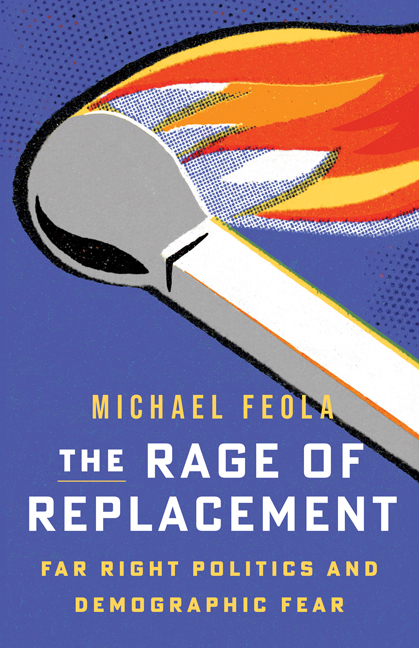
Once firmly in conspiracy territory, the “Great Replacement” and the apocalyptic images it conjures up have become much more mainstream in the past decade. But what fears and anxieties do replacement theory fuel? What do far-right extremists today believe they’ve lost to non-white, non-Christian immigrants? And what are the costs of its spread? Those are the big questions that Michael Feola, a political theorist and professor at Lafayette College, explores in The Rage of Replacement: Far Right Politics and Demographic Fear.
First coined in 2011, the “Great Replacement” is a fringe conspiracy theory that quickly left the margins. Far-right extremists and white nationalists use replacement theory to characterize white majorities in the United States as being intentionally and systematically replaced and outnumbered by an influx of non-white, non-Christian immigrants. That “replacing” (which is done by a vaguely defined “global elite”) can take multiple forms—like increasing immigration from non-Western countries or demographic changes that saw fewer people identify as white in the past decade. Others fear that declining birth rates among white populations have made them no longer the majority in this country—and with less power.
The book traces its origins from ethnonationalism writing in France to its growth through far-right forums and conservative media ecosystems. For Feola, its defining emotion is rage, stemming from entitlement—a feeling that immigrants are usurping a birthright once promised to white Americans. He describes this rage as rooted in the belief that the white race “no longer has a legible future” and its power taken from “its rightful heirs and given to undeserving others.”
Each chapter is devoted to unpacking what elements fuel this rage and how replacement devotees weaponize it to achieve political goals, from political violence to altering culture through language to controlling reproductive politics. Paralyzed by a fear of displacement, its adherents struggle to think of a future for whiteness and instead fixate on an imagined ethnostate, driven by a desire to recapture a supposedly stolen, mythic past where whiteness held power.
Perhaps its most fascinating section comes near the end, examining reproductive politics stemming from reactionary, far-right extremists. As replacement conspiracists panic over declining birth rates, they treat declining birth rates as something jeopardizing the future of a white nation. Feola visits the creation of white nationalist dating sites, the “tradwife” influencer movement, and other efforts to capture their ideal of the all-white family through curbing women’s sexual autonomy.
It’s an academic text, and because of that, the writing can be dense with jargon at times. It’s a primer to the resentment and white grievance that fuels replacement theory but focuses less on the individual events and figures that built up the movement in favor of an overarching review. But wading through it has value in understanding this political moment.
As former President Donald Trump vies for a second term in office, he also repeats replacement narratives, accusing Democrats of plotting to reduce white people’s political power by allowing more immigration. The same is true of conservative media commentators and politicians. As replacement narratives keep penetrating the mainstream, The Rage of Replacement offers an incisive social and political analysis of how we got here.
NONFICTION

The Rage of Replacement: Far Right Politics and Demographic Fear
By Michael Feola
University of Minnesota Press
Published on July 30, 2024


