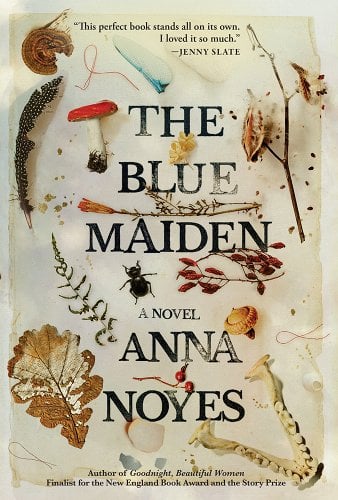
What I expected to find upon opening Anna Noyes’ debut novel, The Blue Maiden, was a story of sisters, a story of myths and traditions, a story brimming with nature and mystery. While all this is here within the pages, I found so much more brewing beneath the surface: how we understand one another, what we know to be true versus what we wish to be true, and, perhaps most importantly, what it means to be a woman who has been told what to believe her whole life.
The story begins in the year 1675 in Sweden on Berggrund Island. We reside in this moment only briefly to witness the accusations and trials of the island’s women, thirty-two in total. It takes seemingly less than hours for the women to be found guilty of witchcraft – specifically, having associations with Beggrund’s sister island, Blockula, otherwise known as the Blue Maiden. Blockula is known to be the home of the devil, where only those with evil intentions can tread: the home of witches. The convicted women are taken to the woods and killed, later to be burned. Of the thirty-two who began on the island, only five remain.
We then fast forward to the year 1825, on the same island where the stories of the women are passed down through generations, none more so than the story of the witch in the window, rumored to wake sleeping children to the sound of their fingernails raking down a windowpane. Young sisters Bea and Ulrika are the daughters of the island’s priest, and they are subject to his religion in full, though they prefer the soft-hearted man their father occasionally becomes when he isn’t preaching. Bea, the younger of the two, is determined to learn what their deceased mother, who died giving birth to Bea, was like. Ulrika is far less interested. As eldest daughters often do, she claims maturity and wisdom, as well as a solid memory of her mother that Bea lacks. The girls break into their mother’s old and yet-untouched room and discover a stone and a red book, inscribed with the medicinal and botanical writings of many generations of women. These findings act as fuel for discovering who their mother was, and who they are to become.
As Ulrika and Bea get older, their personalities begin to diverge in distinct ways. Ulrika, ever older and wiser, takes care of feeding the household and dives into her mother’s red book, befriending their mother’s confidant and partner in botanical passion, Bruna. Preferring to spend time on her own and quickly becoming an outcast, Ulrika learns the language of plants and flowers, even at the cost of social status. Bea, on the other hand, longs for the companionship of others, and finds her way into the group of children on her island, slowly resenting Ulrika for not needing her sister’s companionship.
When the girls come of age, a foreign visitor is invited at their father’s behest, who, it is made quickly clear, is in search of a wife. That search lands on late-teen Bea, who leaves Beggrund and begins her new life with her husband, August. All is well until August begins to pull away following the birth of their son. Ulrika suddenly comes to join the young family (much to the dismay of Bea), and the witch who used to visit her window at night returns.
Noyes is constantly poking at what we take to be true versus believable as Bea grows up. Shortly after finding the stone in her mother’s old room, she reflects: “In truth, she knew from the moment she saw the white, winding beaches of the Blue Maiden that the stone belonged there, but she didn’t want to be rid of it. The Devil was in her ear.” Yet on the page just before, Bea’s relationship with the Devil is altogether different: “No, she has not believed in God enough to love or fear him – or the Devil either. … Curses are real, and the witch outside the window, and Blockula, its lone house and its labyrinth, all of it.” If the Devil is simultaneously not real but in her ear, who is Bea really hearing? Even though Bea does not believe in the Devil, can his whispers still be true? If the curse of Blockula is true, can Bea choose not to believe it? This pattern of truth and belief waltz throughout the story, asking the reader to decide if they can coexist in disagreement, and if one can ever be truly right at all.
What I found to inform and propel the story forward was experiencing the events through Bea’s perspective, rather than Ulrika’s. Though the novel is narrated in third person, the lens through which we watch the island events unfold is primarily the biases and emotions of Bea. I think the literary world at present is abundant with stories of eldest daughters and what it means to carry that load, and I find that the perspective of the youngest daughter is often neglected. Through Bea, we see her come to find her own truth within the space of being “second.”

Despite the underlying emotions entwined in the pages from Bea, I found Ulrika to be a compelling character and at times wished that her feelings were left less in the dark. I found myself pushing against Bea’s view and wanting to experience more of Ulrika in a balanced way, as I felt at the beginning of the novel when the girls were young. Ulrika’s view is certainly clouded through the rain of Bea’s, and while this may be formative and crucial to the novel, I felt there was more to be desired from Ulrika.
The greatest strength of Noyes’ The Blue Maiden is the unspoken battle that the girls, specifically Bea, face in understanding the difference between truth and belief. Their lives are infiltrated with religion, a constant in their father’s priesthood and the devout nature of the island. While the stories of God are told as truth, the stories of Blockula and the evils it holds are reduced to myths, to stories one tells their children to make them behave at night. Noyes challenges us to think about why that is – why do some stories become known as true while others are dismissed as myth? How do we determine what is true for ourselves when it may not be true for others? Within the walls of witchcraft, piety, and the determination to not forget the past, The Blue Maiden takes us to a haunting and hypnotizing island and dares us to explore.
FICTION
The Blue Maiden
By Anna Noyes
Grove Press
Published May 14, 2024