Early in Andrea Hairston’s novel Archangels of Funk, the protagonist dances to Parliament’s 1976 single “Doctor Funkenstein,” in which the eponymous doctor invites his audience — co-conspirators or test subjects? — to party. Later, I returned to this passage with the strange feeling that I’d become one of Andrea Hairston’s test subjects myself.
How exactly to define Hairston’s latest novel? It’s not exactly science fiction, or steampunk, or cyberpunk. It’s closer to solarpunk (Hairston is an avowed fan of Ursula K. LeGuin’s The Dispossessed, one of the foundational texts of the subgenre). It’s speculative Afrofuturism, certainly, but subtly conservative, shot through with nostalgia for that brief period in the 60s when MLK, Malcolm X, James Brown, and George Clinton all coexisted in a kind of hopeful harmony. It’s a postapocalyptic vision bursting with optimism and joie de vivre. It’s a novel as well as a love letter to pan-African culture. I can only describe this wild and unconventional book as funk punk.
A prologue in the form of an advertisement foreshadows the central event of the novel — the Next World Festival (an “Outdoor, Sci-Fi Carnival Jam… Celebrating Yesterday and Improvising Tomorrow Today!”), meant to unite several loosely affiliated communities that are working together to survive in the wake of a devastating flood. The gangs representing each community have formed a defense alliance, a sort of Mad Max-style NATO, to support a tenuous agricultural economy and ensure their mutual protection against violent marauders and bandits. Our heroine, Cinnamon Jones, is a benevolent tinkerer who honors her grandparents’ dying wishes by organizing and hosting the Festival every year. But with only a few days to go before the event, ominous signs of increasing bandit activity have everyone, including Cinnamon, on edge.
Cinnamon also serves as the coalition’s food distributor and bike messenger. She loads her wagon with provisions, her two attack dogs, Bruja and Spook, and a trio of protective “circus bots” — sentry drones cobbled together from bike chains, broken glass, and other discarded treasures, each imbued with an AI avatar based on one of Cinnamon’s dead relatives — and pedals off in the direction of a nearby community that is waiting for its regular food delivery. But in order to reach the community living in an abandoned shopping mall called the Ghost Mall, she must pass through “no people’s land,” a dangerous network of wooded trails in rural Massachusetts littered with electric fences, burned-out cars, and stealthy marauders bearing automatic weapons. Cinnamon narrowly escapes the marauders, thanks to a pair of friendly, Falstaffian security guards and her reclusive partner, the mysterious “hoodoo” sorcerer and nature spirit, Baron Taiwo.
The day before the Festival, figures from Cinnamon’s past reappear, spreading suspicion within the Ghost Mall and dredging up unwanted memories. A former academic and acquaintance named Fred infiltrates the community with an unloaded gun and tries to coerce Cinnamon into giving up the Ghost Mall’s valuable solar panels and generator. Bruja and the circus bots scare Fred off, only to find another newcomer in their midst, Cinnamon’s estranged ex-girlfriend Tatyana. To her friends’ surprise, Cinnamon absconds with Tatyana to a hideaway in a dilapidated, former theater on the Mill River and confronts Tatyana over her betrayal. She admits to stealing Cinnamon’s most prized invention, a world-changing AI program dubbed the “Seven Generations Algorithm,” and asks Cinnamon to join her and perfect the algorithm to “overwrite the colonialist origin code” for the benefit of society.
Cinnamon sends her away, wracked by regret and self-doubt, but receives a shot of inspiration when the ghosts of her dead grandparents and great aunt materialize in the old theater and present her with a Festival costume based on the elusive water spirits that populate the wooded streams and rivers nearby. Every character in the novel, big and small, convenes at an outdoor amphitheater to put on the Next World Festival, a kaleidoscopic, psychedelic performance (“The Mothership blasted funk-tastic beats and descended from the treetops. Rigging groaned but didn’t think of giving out. Funkadelic lights whirred”) that draws a huge, adoring crowd. But when Fred and Tatyana sneak in, Cinnamon and her friends must work together to save the circus bots and, in the process, learn to practice restorative forgiveness in order to set things right again.
The book overflows with music, from the way that characters talk to their tendency to beatbox and break into impromptu raps. Hairston delights in making references to a panoply of musical genres ranging from spoken word poetry and African polyrhythms to “astral bop.”
Cinnamon yelled, “Here come the Archangels of Funk.”
Game-Boy, griot-in-training, turned this into a rap:
Yeah! Mega-attitude! Astro-spunk!
See, here come the Archangels of Funk
Ancient but they be tomorrow too
Dr. What, Dr. How, Dr. True

At their most effective, these moments function as charming bits of characterization and worldbuilding. However, the melodies in Hairston’s head don’t always translate to the page. Her mischievous cast of characters beckon readers closer, but they sometimes danced to songs I couldn’t hear.
Dialogue is frequently interspersed with gestures and physical movements that slow down the pacing and produce daunting blocks of text. A lot happens on every page. Sentences follow a staccato rhythm that generates fragments and unfinished thoughts. (“‘Evil need a straight line,’ Cinnamon said. ‘Good don’t get lost in the twists and turns. That’s elder wisdom from Japan.’”) For this reason, the chapters written from the point of view of Cinnamon’s dogs are the most fluent and legible. Without the option of dialogue, Hairston — an accomplished playwright — is relegated to conveying the basics of the action without indulging her characters’ penchant for extemporaneous commentary.
Hairston leaves much of the physical environment to the imagination of her readers, a strategy that reminded me of Octavia Butler and even Ray Bradbury. In this way, I could see how Archangels of Funk might be understood as “antirealist,” a narrative approach that Hairston developed in the 90s as a playwright for the progressive Chrysalis Theater in Massachusetts. Like with Butler and Bradbury, it is easy to get swept away by the author’s passion for worldbuilding. I was frequently impressed, and a bit overwhelmed, by the joyful complexity of Hairston’s world. Such complexity can be a double-edged sword. The ideal reader of Archangels will welcome both the chaos and the creativity and gladly come along for the ride.
There’s a lot to enjoy in this epic, psychedelic odyssey through Andrea Hairston’s imagination (or “ImagiNation,” as she calls it). But before joining the party, you will need to follow the lead of Cinnamon Jones and open your mind to the funky, syncopated beat.
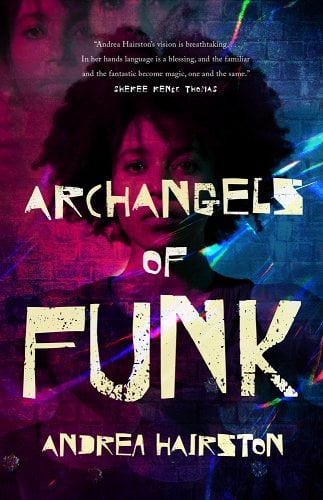
FICTION
Archangels of Funk
By Andrea Hairston
Tordotcom
Published May 7, 2024