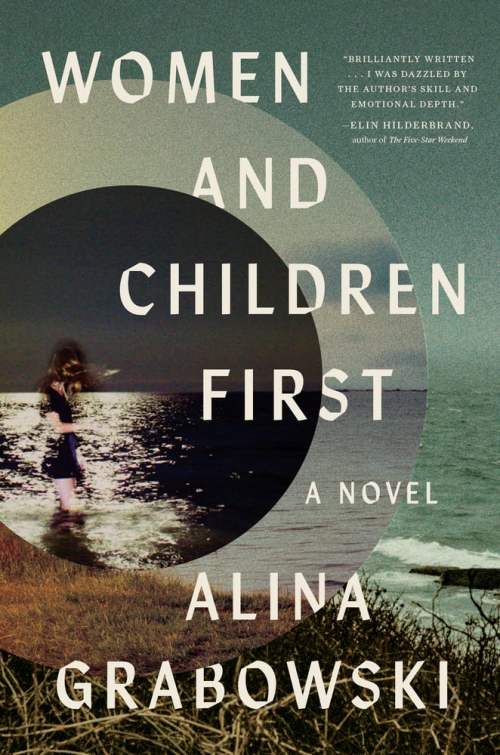
In Alina Grabowski’s debut novel Women and Children First, Lucy Atkinson dies under suspicious circumstances at a house party thrown by her high school classmates in an empty, half-finished suburban home in the fictional Nashquitten, Massachusetts. Nashquitten is a small, tight-knit coastal town, and this tragedy has a ripple effect through the community. Lucy’s friends, classmates, teachers, counselors, and family members are shaken, and the novel follows these women and girls in the aftermath as they grapple with grief in the midst of growing up.
The novel is divided into two parts defined by Lucy’s death: “Pre” and “Post.” Each part contains five chapters, and each chapter is narrated by a different woman or girl from Nashquitten. The connections between narrators are often loose at first, but throughout the section the links to the previous point-of-view character, to others in the town, and to Lucy gradually materialize. Even with this large cast, the voice in each chapter is distinct as we become fully immersed in the character’s world. Jane, the first narrator, is a high school student who works at the supermarket, helps her chronically ill mother, and believes her relationship with her teacher and SAT tutor is a love affair. Home visiting her mother in the hospital for cancer treatment, Natalie’s phone pings with incessant demands from her boss, an innovative genius who is also an unfeeling asshole, and she wonders what the point of her job and life is in the second chapter. Finally, Brynn narrates the closing chapter, as she grieves the loss of her daughter, considers the destruction of her marriages, and struggles to follow societal rules and exist in a world, in this town, now defined by an immeasurable loss.
Even though a slight majority of the narrators are adult women in the town, the novel consistently centers girlhood. This is in large part due to the novel’s focus on Lucy’s death and the mysterious circumstances surrounding the tragedy. Lucy was diagnosed with epilepsy earlier in high school, and in the weeks before the party, a video of Lucy having a seizure is shared among her classmates. The night of the party, Lucy’s relationships are unsteady as she holds the resulting embarrassment, shame, and anger. In the four chapters voiced by high school students, including Jane, these girls are all connected to Lucy, whether it’s through their lifelong friendship, in passing at the small local high school, or directly at the house party where Lucy died. The women who narrate the other chapters are similarly connected to Lucy and her death to varying degrees. While Brynn is her mother, Natalie, for example, sees Lucy for a moment when she is brought into the hospital.
But this centering of girlhood is also the product of the way Grabowski approaches her younger characters as fully realized, with a broad spectrum of experiences and emotions. This respect for girlhood is reminiscent of Dizzy Tate’s Brutes and Emily Temple’s The Lightness. Similar to these works, Women and Children First gives weight to the feelings, desires, and fears of its teenage characters. Even when the older women in this novel consider the teenagers or reflect on their own experience during adolescence, it is with deep empathy. This does not mean that the novel glosses over youthful shortcomings entirely, however. After a seventeen-year-old coworker notices she is upset and offers to hang out, another narrator Mona thinks: “What an age! To be so convinced of your allure and so ignorant of its consequences.” The gravity of these consequences are ever-present for all of Grabowski’s characters, with Lucy’s tragic death, of course, but also the abusive teachers and the adults who choose to overlook instead of intervene.
Grabowski’s achievement in creating ten compelling narrators is not only satisfying but moving. The novel deftly retreads scenes from these different perspectives, illuminating misinterpretations or unpacking missed emotions. The result is a prismatic community novel, where slight shifts complicate the narrative, further entwine its characters, and cast new light on key moments. These shifts keep the reader from growing complacent and myopic in a single character’s story. The structure instead forces a broader perspective that is typically only available at a distance, whether it’s from a remove or in reflection. In the novel’s final chapter, Brynn retreats, destructive and desperate in her grief. Brynn clings to Lucy’s best friend Sophia, another narrator, and she also spends time alone lingering on the choices that defined her relationship with Lucy. In the month leading up to Lucy’s death, and perhaps even before, Brynn’s relationship with her daughter was strained. During her heavy contemplation, Brynn offers herself and her mothering some grace: “It’s difficult to see what’s shaping a kid when you’re in the process of raising her, in the same way that you don’t sense the design of the place when you’re standing in it.” With her chorus of connected narrators, Grabowski offers readers this perspective.
Brynn’s comparison to sensing the design of a place is apt here, as well. Women and Children depicts common experiences of teenage girls; yet, like the best fiction, the novel does so by telling deeply local, specific stories. Nashquitten is a fictional town on the south shore of Boston, but the descriptions ring true. There is a well-worn townie bar that sits mostly deserted, everyone other than the regulars flocking to the new, trendy gastropub nearby. There are long stretches of beach that are claimed by the locals but overrun by visitors in the summer months. Economics depend on these beach town tourists, and there is evidence of more ambition than money in the teen’s college dreams, the school’s budgeting plans, and many of the houses in town. The half-finished suburban family home in an empty subdevelopment where the kids drag kegs and liquor for the party where Lucy dies is the most haunting. An idyllic suburban dream unrealized, and the cost of this wanting and failing is clear.

This wanting and failing is a recurring common theme throughout the novel, as each character grieves and lives with desires that culminate, often repeatedly, in disappointment. While back home, Natalie runs into Mona, her close friend throughout childhood and high school. Mona’s family paid for Natalie to go to camps when the girls were growing up, an expense her own parents couldn’t afford. The girls had the same dream college, but only Natalie got in and attended, and their lives since grew further apart. Now, Natalie earns an impressive salary and works for a startup in San Francisco while Mona lives in the house her parents bought her, working at a fish market alongside teeangers. Mona tells Natalie this isn’t her only plan; she is awaiting graduate school decisions so that she can become a writer. Natalie’s response to Mona is kind, but she is less accepting when she considers the woman before her and the girl she knew. “The issue isn’t my perception of Mona but Mona’s perception of herself. Sure, you can claim to be whoever you want to be, as long as no one holds you to your history.” Grabowski’s Women and Children First teases out this issue of perception and identity in a small, overlapping community. The result is a gripping, moving novel of a group of women who connect through a senseless tragedy, converge in their insular town, and grapple with who they can become when someone else will always hold their history.
FICTION
Women and Children First
By Alina Grabowski
Zando – SJP Lit
Published May 7, 2024