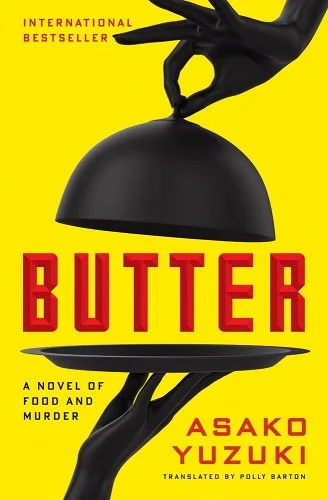
On the heels of recent food novels The Thick and the Lean and Land of Milk and Honey comes Asako Yuzuki’s Butter, a novel not quite speculative but just outside our Western frame of reference. Part true crime novel, part love letter to fine dining, and part takedown of capitalistic structures in modern-day Japan, Butter is a compelling and intensely readable take on what it means to enjoy life, and all the contributing forces that make that decision complicated.
The novel centers Rika, a young journalist born and raised in Tokyo. She develops an interest in the upcoming retrial of a notorious serial killer, Manako Kajii. Kajii is a woman in her mid-thirties, dubbed “fatso” for her voluptuous figure, and indicted for killing several male romantic companions with the use of her sumptuous cooking. Kajii is uncommunicative, and Rika obtains exclusive information by exchanging letters about the nature of good food. Beginning with the concept of butter over margarine, then exploring the joys of homemade recipes in varying circumstances, Kajii’s wisdom turns to culinary requests of the curious Rika, and these requests have her questioning not only the body and identity, but what it means to be a woman in contemporary society.
On a prose level, the translation of this book from the Japanese strikes a fine balance. At the line level, the work is not as dense as the aforementioned Land of Milk and Honey, but in intermittent moments of food writing, especially when it comes to the titular subject, Butter captures the simple, gustatory pleasures of good food, and how taste calls upon all other senses to make its impact. For instance, when Kajii instructs Rika to eat butter ramen immediately after having sex, the experience is impossible not to compare and contrast. “The hot broth and hot noodles were more assertive, more forceful than Makoto’s warmth and smell.” At the same time, dialogue in this novel is simple and easy to follow, even bordering on aggressively straightforward, with characters processing thoughts and feelings out loud with ease. They discuss gender expectations and corporate life with exposition to spare, sacrificing realism for clarity at times.
The fulcrum of the novel, of course, is Kajii herself. Rika, being young and eager to transform herself, stands in for the easily manipulated reader. Despite her journalistic standpoint, Rika cannot help but grow attached to Kajii, and becomes sensitive to her flights of rage and her cult of femininity. Kajii’s appeal stems from a rejection of modern life, of an increasingly corporatized world where women eschew marriage and homemaking in favor of careers. Kajii firmly believes that “the ultimate happiness for women is to find their soulmate, raise his children, and make delicious food,” and Rika listens, even though she has no inherent interest in any of these things. When juxtaposed with a world of convenience cooking and solitary life, Kajii’s world feels appealing to both Rika and the reader. However, Yuzuki takes a nuanced approach by bringing into question the role of patriarchy in this imagined domestic utopia. Kajii ignores, and even loathes, other women for their perceived hatred of her lifestyle. Rika recognizes the double standard of how cooking is compartmentalized as a woman’s task, when both sexes face similar loneliness in their capitalist society. And of course, with good food and pleasurable eating comes weight gain, and this burden too is unfairly placed on women.
Much attention is placed on Kajii’s stature, but when we are given a number to picture her size, she is simply “over seventy kilos” (about 154 pounds) To a Western audience, this comes as a shock, but the attention to thinness that Japanese culture enforces is frequently referenced, and critiqued, in Butter. Nevertheless, for readers sensitive to this topic, it feels repetitive. Rika gains weight as she learns to cook for herself, and when people in her life ask rude questions about her weight, she is hardly 120 pounds. While Yuzuki does not glorify the emphasis on thinness in her home country, it takes up a large portion of the narrative.
Additionally, with much of the novel invested in Rika’s culinary journey, the question of Kajii’s guilt takes a secondary role in the novel, dominating the latter half as Rika and her childhood friend Reiko investigate Kajii’s past. At this point, however, the investigative nature of the novel feels almost dull as we leave the magnetism of Kajii herself and Rika interrogates various family and friends. While it is satisfying to see the layers pulled away from this compelling figure, the novel takes its time to get there, leading to the book feeling like two separate entities. At well over 400 pages, the novel begins to feel its length, and the ending skitters to a halt. Instead of choosing in-depth character study over a propulsive crime novel, Butter attempts to split the difference, with mixed results.

Nevertheless, Butter is a fascinating look at contemporary Japanese society told by one of its everywomen. Rika’s blandness directly contrasts Kajii’s fiery nature, and scenes juxtaposing the two are utterly satisfying to read. For this, and the food scenes in and of themselves, the novel is well worth its page length and consideration.
FICTION
Butter
By Asako Yuzuki
Translated by Polly Barton
Ecco Press
Published April 16, 2024