


When we’re young, there’s a specific intensity to reading. We stay up past our bedtimes, flashlight under the covers, the world we’re reading about more real to us than our own. It can be difficult to tap into this sense of immersion when we’re older, but this is the experience of reading Chloe Benjamin’s new novel, Under Story. It’s a book that will imprint on you; its story more like a memory.
Under Story follows a grief-stricken mycologist, Laurel, who journeys to McMurdo—a research station on the frozen frontier of Antarctica—to escape a recent tragedy. Miles from McMurdo, a mysterious dome of light known as the Arc has appeared, confounding scientists. Laurel is drawn to Antarctica because of the continent’s foreignness, how it offers her no reminders of the places or people she’s left behind, but when she sees the Arc, she wonders if she’s been drawn there for another reason.
Under Story is an astonishing book. It’s both transportive and grounding, particularly in its study of a marriage and its exploration of the beauty and interconnectedness of our natural world. I talked to Benjamin about her in-depth research process, her own favorite novels from childhood, and how she gave herself permission to tell big stories.

Rowan Beaird
This is such an incredibly rich book, and I can imagine numerous different points of inspiration: mycology, time travel, physics, Antarctica. Where did this story begin for you?
Chloe Benjamin
The original spark of inspiration came in early 2020. I heard about a real experiment in Antarctica by ANITA, which is this neutrino detector, and they had found that they were detecting neutrinos behaving very strangely. They were moving in the opposite direction that the scientists expected. There were a few different possible explanations thrown out for this, and one outside physicist said, ‘I wonder if this could be evidence of an unrelated theory called a CPT-Symmetric Universe?’ That is a theory postulated by three physicists that we live in a universe that essentially has two sides: one that moves forward in time and one that moves backward. This was quickly disproven as the explanation for the ANITA results, but I loved it and kind of ran with it. I contacted a physicist named Latham Boyle, who is one of the people who came up with that concept of the CPT-Symmetric Universe, and he very kindly did some early emailing with me. Then, I was off to the races, heavily fictionalizing from there.
Rowan Beaird
I think what we as readers so often want from novels is to be immersed in a completely different world, or to learn about new facets of our existing one. You do both with such precision, and I can only imagine the amount of research you had to do to make me as a reader trust you in the ways I did. What was that process like?
Chloe Benjamin
I’m so glad it felt convincing to you in that way. That was my hope. I really crosshatched real science with science fiction throughout the book. There was a ton of research for every subject. Partly, I find that really inspiring—I find the world fascinating. I find physics fascinating and mycology fascinating, so I get a lot of ideas when I research, but also I really wanted to create a sense of immersion with this book. I wanted it to feel like a place that you could almost touch.
That meant tons of reading on theories about time, certainly this specific theory of a CPT-Symmetric Universe. I also interviewed mycologists and did a lot of hands-on research. I shadowed a fungi lab in the field. I flew to Minnesota to follow microbiologists who were researching fungi in caves. I attended a women’s mushroom conference, which was amazing. I went to a psychedelic conference, which was actually less psychedelic then it sounds—it was an academic psychedelic conference—and I also became very close with the family that runs the apple orchard that the one in the novel is based on. I visited the orchard in all seasons and helped out and did a number of interviews with them.
I also had some incredible sources who worked and lived at McMurdo in Antarctica, because that was one of the places in the book that I couldn’t visit. In part because it was largely during COVID that I was working on it, but also because it’s just very difficult to visit Antarctica, so I really relied on sources there. It was about a five-year process for the first draft and then about a year and a half of revision, so there was just a lot of life lived during that time and a lot of really visceral, I call it almost like method research, as opposed to the kind of more exclusively reading-based research that I’ve done for previous projects.
Rowan Beaird
I love that you didn’t just read, that you really immersed yourself.
Chloe Benjamin
Oh, it’s so much fun. It’s like being undercover. People let you into their world, and it’s an amazing gift. I feel like all of those experiences just make the world of the book a lot richer.
Rowan Beaird
Without a doubt. Well, I so deeply love the character of Laurel. She’s incredibly complex, and I can only imagine how challenging it was to craft her. How did you get to know her?
Chloe Benjamin
In the beginning, I found it quite challenging because I had come from this previous project, The Immortalists, where I felt like I knew the characters so well. I had been living with them for years, and I was also used to inhabiting different perspectives in the same book. In that book, there were four perspectives. The idea of Laurel came to me very quickly, because I knew that I wanted to have one protagonist in this novel, but I also was like, how am I going to do this? I don’t know you! And now I have to write a whole book about you?
So, I just tried to slowly feel my way to her. One of the early things I realized about Laurel, which sounds very basic, but the phrase that came to me is: Laurel is curious. And that was a through line for her, and now I feel like I know her like the back of my hand. As with the research, having a really long incubation time for this book was really helpful because I need that kind of time to get to know the characters and the subject matter.
Rowan Beaird
Were there any times in the writing process where you felt like she surprised you?
Chloe Benjamin
There’s this line in the book where another character, Nita, says to her, “I thought you were just a nice girl from Wisconsin.” I think that Laurel is the kind of person you underestimate at your peril. Her drive and her determination were exciting to create and follow.
Rowan Beaird
There is a love story at the heart of this novel, but it’s not simply a story of two young people meeting and falling head over heels—it’s a complicated story of a marriage, and how we can find our way back to one another. Why was it important to tell that sort of a love story?
Chloe Benjamin
I met my husband when I was in my first year of graduate school. I was 21. This was not my plan, to meet my spouse at that age, but that means that we’ve been together for about 16 years. I think experiencing the complexity and profundity and mundanity of this very central relationship in my life felt like fertile ground for a novel. Marriage is fascinating to me in the same way that families are fascinating. It’s like its own little cult in some ways. Nobody understands quite what it’s like inside anyone else’s relationship, and it has its own histories and codes and inside jokes and comforts and challenges.

In the novel, Laurel’s relationship with herself is a major undercurrent, and guilt is a major theme. Something that I went through, that I think is very much beneath the surface of the novel, is many years of chronic pain that were quite a challenge in my life but also put a lot of strain on a partner—a caretaker. So even though I did not go through what Laurel does, I could still channel the sense of having caused challenge to someone I love. That became part of the book.
I really want to tell big, high-concept stories, but I also want to do intimate character work, because those ingredients are in books that I love. You need both, right?
Rowan Beaird
Totally, and that reminds me—I know as inspiration for this book, you returned to some of the novels you loved when you were younger: His Dark Materials, A Wrinkle in Time. Why do you love those books, and if you revisited any of them, do you see them differently now?
Chloe Benjamin
I have returned to them and I can say, at least for me, they really held up. His Dark Materials I have read and reread multiple times, and those are just books of my soul. I love them for the same reasons that I was just describing. They’re big stories with intimate character work and beautiful prose. When I was in my MFA program, I wrote a novel that got me an agent, but was turned down by every publisher we sent it to, and the main feedback was: pretty sentences, but nothing is happening. I think I felt that to be as literary as possible, I should write the kind of subtle fiction that I was reading at the time, and do love, but it wasn’t what I was good at. After that experience, I gave myself permission to tell a big story. I think that, because those were the books that I read as I was developing as a reader and writer and person at that really important age, they really shaped my internal landscape as a reader and a writer.
Rowan Beaird
I think that’s such an important lesson for all writers to learn. So often when we’re taught fiction, we’re reading very quiet domestic dramas like Raymond Carver, and we forget what pulled us into the world of fiction in the first place. So, in this book, I feel like there’s such a deep love and reverence for nature. Why was that important to have as part of this story?
Chloe Benjamin
It’s interesting—in talking about this, sometimes I feel like a fraud because I didn’t grow up loving or spending a lot of time in nature. I was a city kid, you know, a reader, writer, an indoor cat. And while I have always loved and respected the natural world, I don’t think that I felt connected to it in the way that I began to while writing Under Story. What I think comes through in the intensity of the emotion for the natural world in this book is the experience of a convert. A lot of that came from the research for me, both reading and experiential research, just feeling bowled over at what I learned about other life forms and the way that they survive and communicate. I just felt incredibly tenderized by it. I feel so deeply for the non-human now.
Rowan Beaird
I experienced that reading it—I look at mushrooms in a completely different way now. So, I felt a real sadness ending this book, because I felt so connected to this world and these characters. Even the secondary characters felt like close friends. How did you know when to let go?
Chloe Benjamin
You know, I’ve never spent this long on a book. It paralleled so much of my own healing and transformation that it feels incredibly personal and deep. Mainly, it feels really exciting. I took so long between novels. The Immortalists came out in January 2018, which is somehow almost nine years ago, and so I really feel ready for this now. There’s grief about ending the book. When you’re in those final passes, you’re so exhausted and you just can barely see the words anymore, but you also know that this is going to be your last moment with the book, so it is very emotional, too. But this is when I finally get to share it with people, and that’s really wonderful.
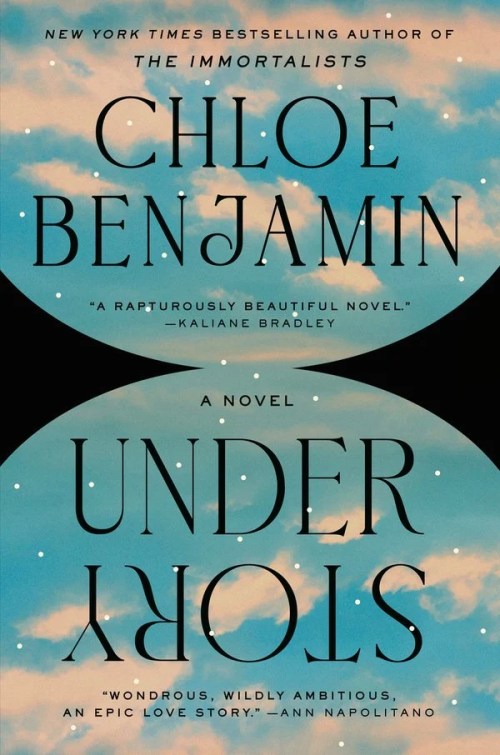
FICTION
Under Story
By Chloe Benjamin
G. P. Putnam’s Sons
September 1, 2026


