


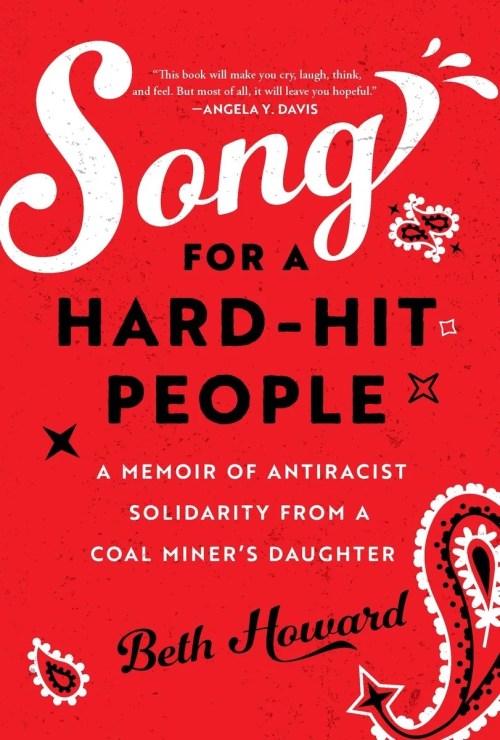
Despite its subtitle, Beth Howard’s Song for a Hard-Hit People: A Memoir of Antiracist Solidarity from a Coal Miner’s Daughter is not primarily about antiracist solidarity but about the experiences that led her to advocate for such solidarity. The distinction does not detract from her work as an organizer for Showing Up for Racial Justice, which enables her to offer valuable insights into contemporary politics, but it does emphasize the strengths of her book. Her argument that meaningful opposition to racism means organizing rather than simply condemning white workers in the rural South is important, but her primary achievement in Song for a Hard-Hit People is her description of rural Appalachia and its inhabitants. Her clear-sighted, sensitive account of her father is particularly good, demonstrating a rare ability to see the value of a conspicuously flawed man, and to understand his failings without excusing them. In a period in which public discourse is characterized by lazy condemnation that entrenches existing positions, this empathy demonstrates the qualities needed to build communities and sustain collective action. Howard’s vision of the future as embodied in “one big working-class multiracial Southern family reunion… where no one is turned away,” offers a model for solidarities that are neither conditional nor contingent.
Countering the “strategic racism” that encourages “working-class white people” to “blame Black people and immigrants for their suffering” has become particularly urgent over the last decade. The necessary process of challenging engrained prejudices and establishing broader alliances between oppressed groups means talking to those too often dismissed as “‘hillbillies,’ ‘rednecks,’ ‘white trash,’ and ‘trailer trash,’” along with everybody else. Howard, who was born and raised in rural Kentucky, is particularly well-positioned to do this; these are, as she repeatedly emphasizes, “my own people.” Her work matters. The description of her antiracist activism amongst white, rural communities nonetheless occupies only a relatively small portion of the text. Song for a Hard Hit People follows Howard’s life from her birth in 1980 to the present; the pivotal training course she attends on race, after which “everything I knew about the world, everything I saw changed,” occurs in 2019. Race is obviously a significant factor in her earlier work as an organizer in the South, and the account of her growing consciousness of its impact, as someone who did not know “anyone who wasn’t white until I was in middle school,” is illuminating, but it is her ability to understand her activism within the context of her upbringing in Appalachia that makes this an original and often moving text.
Howard’s father is not an immediately attractive character. In one of the earliest memories detailed in the text, he arrives home, “drunk as usual” but also “high on cocaine,” smashes all of “Mom’s nice white Corelle dishes” and fires “warning shots into the house.” Howard’s mother is not “sure if he was trying to kill her or terrorize her.” Her uncertainty is understandable, as whilst he “didn’t hit his kids,” he regularly beats his wife. After she finally leaves him, his alcoholism escalates, until he needs a liver transplant. Despite this, Howard insists on his capacity for redemption. Whilst she never loses sight of the fact that he has “caused so much suffering in our lives,” he is “a man I loved” and has significant positive qualities. Even before he stops drinking, he is the person who turns up, “his gun loaded and ready,” to protect “his children and first love” from a violent and controlling ex-boyfriend who stalks Howard’s mother. Once sober, he becomes a “different person”; Howard never sees him “hit or cuss at anyone again” and he makes an effort to “help people out… as much as he had to give.” He slowly rebuilds his relationship with his daughter, and “[a]fter thirty-one years of waiting,” even finds a way to protect her, warning her that her fiancé is concealing his addiction. His insistence that she should not “marry someone like me” demonstrates a hard-won self-knowledge. Dying painfully of cancer, he acknowledges that he “did some terrible shit” but also asks “did I deserve this?” Her answer, “No, Dad, you didn’t” demonstrates a frustratingly rare conviction that people are not defined by their worst qualities and moments.
The Appalachian working class are not the dysfunctional addicts and racists suggested by terms such as “white trash,” which continue to circulate even amongst self-declared progressives. The myth of “Trump country” has reinforced their abandonment by Democratic strategists, who see so-called “red states” as unwinnable, but they must be part of any meaningful radical coalition. There is consequently a need to challenge the loud, persistent voices telling white rural communities that “the reason they don’t have food, shelter, health care, and a safe, well-paying job to feed their family is because Black people, immigrants, and even trans kids are taking everything,” and to remind them they have the same objective interests as their working-class Black and brown neighbors. Lecturing people living in poverty about abandoning their privilege has not been and will not be a successful strategy. As Howard recognizes, too much discussion of race has been driven by “white people… looking for a way to prove their goodness, their purity” rather than effect material and social change. Antiracist solidarity requires a broad coalition that extends to neglected communities, and even to their flawed members.
Song for a Hard-Hit People is an uneven book, but it offers an idea of inclusiveness, not as an empty liberal term, but as a form of political practice. It ends with Howard imagining her father asking whether there is space for “us hillbillies” in emancipatory movements, or whether there is “still room for me.” Until her answer, that there is “room for all of us,” is more widely accepted, little will change.
NONFICTION
by Beth Howard

Haymarket Books
Published on April 21, 2026


