


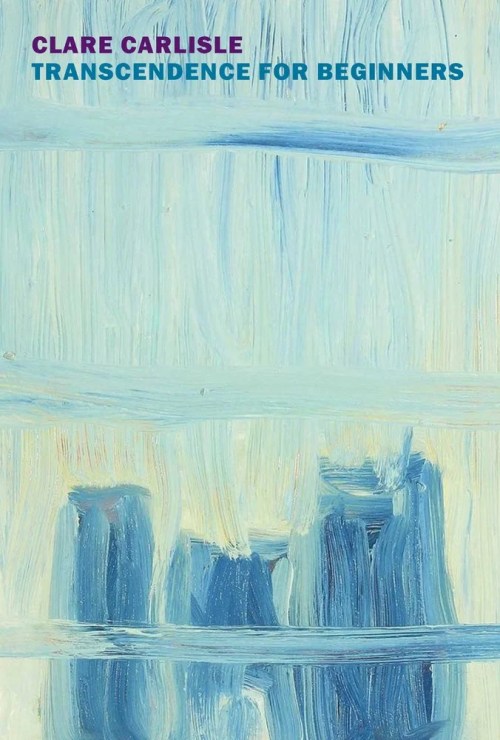
Let’s begin with the word itself, transcendence. Not quite onomatopoeia, yet that initial root “trans” we all know from grade school (‘Latin for ‘across! Like a train chuffing across the countryside!’) slips right into the “send” of the last two syllables, sounding like a soft blasting off of something, or someone, into the ether, past earthly limits, possibly as far-reaching as the webbing on the catcher’s mitt of God. Transcends is what Clare Carlisle’s new book, Transcendence for Beginners, does, on multiple intellectually engaging levels: it’s at once a work of philosophy, of literary criticism, and of aesthetics, mixed with a dash of scholarly self-help. In other words, it chuffs smartly, distinctively, across the countryside of categorization.
A collection of six essays adapted from Carlisle’s 2024 Gifford Lectures, as chapters of a book they don’t read like an incremental assortment of topics. At its heart Transcendence for Beginners details the story of a writing life, how Carlisle’s encounters in biography with such formidable sages as Baruch Spinoza, George Eliot, and Søren Kierkegaard have shaped the contours of her thinking while drawing her deeper into corners of the world’s wisdom. There is a spirituality manifest in these pages, but one that is decidedly not superficial; with the logical mind of a scientist, Carlisle lays out her samples, prods, analyzes them, and reports back, doing full justice in her language to both abstract ideas and personal reminiscence. The thinking engenders the writing and vice versa and onward. I had the pleasure of interviewing Clare Carlisle by email.
This interview has been edited.

Ryan Asmussen
Spinoza plays a large role in Transcendence for Beginners. You call him your “favorite philosopher.” Why is that? How would you pitch him to an audience looking for an intellectual model along the lines of Thomas Carlyle’s “heroes” and Ralph Waldo Emerson’s “representative men”?
Clare Carlisle
When I first studied Spinoza at university, his philosophy changed the way I saw the world in quite a profound way. Thirty years later, reading Spinoza still helps me to make sense of things. I find his rationalism quite soothing. And I enjoy his company, so to speak. So my love of Spinoza is partly to do with the enjoyment I get from reading him, and partly to do with his ideas, his pantheism, for example. Also, he seems to have been a very decent human being. But different people are drawn to different philosophers, and that’s natural. I’m not here to convert anyone to Spinozism. I do think, though, that his courage in criticizing orthodox beliefs, his commitment to joy, and his devotion to philosophy, are exemplary qualities.
Ryan Asmussen
There is a deep sense in which Spinoza’s thought runs concurrently with Vedantic thought. The “porousness” of his boundaries between human beings, his non-dualistic conception of God. Would you clarify for us this tricky nexus?
Clare Carlisle
Spinoza argued that everything is within “God or Nature,” and that everything is interconnected. The idea that we are separate, independent selves is an illusion. This kind of non-dualism is more mainstream in India than in the west. Ever since Spinoza’s own time of the seventeenth century scholars have commented on his affinity with certain Indian philosophies, including Advaita Vedanta. These ideas are difficult to summarize quickly, and I explore them throughout Transcendence for Beginners. I recently wrote an article titled “Spinoza and India” which considers whether Spinoza might have been influenced by Indian philosophy. It is available online if anyone is interested in this question.
Ryan Asmussen
Putting aside José Ortega y Gasset’s opinion of the biographer’s task (which, for him, is to weigh the subject’s actual life with a possible life), what is your opinion of your quote from him: “We all feel our real life to be a deformation of our possible life.”
Clare Carlisle
I don’t like the word “deformation” here, and I’m also suspicious of that claim to know what “we all feel…”. Personally I feel a sort of wonder at my actual life: that it is happening at all, that it is unfolding in this particular shape. It doesn’t make sense to me to see my life—or others’ lives—as deformed versions of some unlived life. Maybe Ortega y Gasset is saying that our possible life is expansive, open-ended in multiple directions, and in contrast to that the lives we actually live are inevitably shrunken, narrowed. Or maybe he literally means that our real lives are deformed, misshapen, whereas our possible lives are these beautiful ideal forms. It is the shape of our real lives that interests me. And any ideal projections of who we might be are part of that shape, aren’t they? All our thoughts, everything we think or feel or imagine, is part of our actual life, because humans are imaginative, reflective beings.
Ryan Asmussen
You write in Transcendence that the “artistic part of us hopes to bring something new and singular into the world; the philosophical part of us wants to declutter it.” As someone who wrestles with these seemingly opposing impulses in his thinking, I heaved a grateful sigh when I read these lines. You argue that, in fact, you’re not looking to draw distinctions here but to see connections.
Clare Carlisle
Yes, I keep thinking about philosophy and art, the ways they are similar and the ways they are different. While I was writing the book, I was picturing philosophy as like housework: sorting things out, putting them in order, an activity that aims at beauty as well as structure. Academic philosophy can feel quite far away from art. But when I think back to the novels and pop songs I loved as a child and teenager, before I knew about “philosophy,” I see that many of those artworks were implicitly or even explicitly philosophical.
Ryan Asmussen
George Eliot comes across in great clarity as much a “representative” woman as any man in these pages. What, do you feel, was her greatest contribution to literature? How did she see the world (or her milieu), write so eloquently about that world, to genuinely contribute to our understanding of things in a way that could rival Carlyle or Emerson, Kierkegaard, or Spinoza?
Clare Carlisle
When I re-read Eliot’s novels, I’m blown away by her philosophical and artistic ambition. She was trying to give shape to the inner and outer worlds: both aspects of human reality at the same time. Likewise, she was constantly trying to bring together thought and feeling in her writing, constantly struggling against the temptation to indulge one at the expense of the other. This mirrors my own experience of holding together my emotional and intellectual life. It seems important to stay connected to both thought and feeling, but often I feel that I’m switching back and forth between them. Either thinking or feeling, but not both together, almost as if these two modes repel one another. Reading Eliot, at her best, can offer moments of integration, while at the same time helping us to understand how difficult it can be. I suspect this is why many of her readers are so devoted, returning again and again to her novels. Also, Eliot’s voice manages to combine being sharply critical and deeply compassionate: we could learn a lot from listening to that voice right now.
Ryan Asmussen
One could read Transcendence, limitedly of course, as something of a love letter to the Gifford Lectures. You express ample appreciation of them and their cultural value. Looking back on your participation in that series, what do you think the opportunity afforded you going forward in your life and career?

Clare Carlisle
When I was invited to give these lectures, I saw them as grand, authoritative, and a little stuffy. I myself feel very far from any of those things. So, although I was flattered to be asked, I couldn’t imagine myself in that role without pretending to be a different kind of person. Then I read some writing by Adam Gifford, who created the lectures in the 1880s, and I was pleasantly surprised to discover that he was actually very cool. He was open-minded and curious, and he thought that everyone should have a chance to learn about philosophy, not just people who went to university, which at that time meant well-off men. If I hadn’t been asked to give the Gifford Lectures, which are specifically about religious and moral questions, I would never have written anything like this book. It made me think, in a deep existential way, what do I have to teach anyone else about what really matters? What have I learned so far in my life that is worth passing on? Who have my teachers been, and what—and how—did they teach me? What can I say that is true? These questions took me back to basics. I thought, one thing I have definitely learned about is loss, and grief. I also know about love. And I know something about writing another person’s life story, because I’ve written two biographies (of Søren Kierkegaard and George Eliot). What does any of that have to do with philosophy? My lectures—and now this book—took shape through an effort to speak and write truthfully about all this.
Ryan Asmussen
You write beautifully of your mother and her influence on you. Thirty years on after her death, what would she think of your writing?
Clare Carlisle
The day after my mother died—it was a sunny day in May—I skipped school and went into the city, where I bought a cute mini backpack made out of denim. Coming home that afternoon, I found myself looking forward to showing it to Mum, and then I thought, oh, no. That little bag was the first of a long series of things, and people, that I’ve wanted to show her: above all my son and my husband, but also my books. One of the many things you lose when someone you love dies is the person you are, the life you live, as seen through their eyes. If my mother was here now, she would be seventy-five years old, and I’m pretty sure I would be a different person, a different writer, maybe not even a writer at all. I’ll never know what she would think of my work. She mainly wanted me to have love and happiness, and wasn’t so bothered about achievement or success. But writing, for me, is one important part of love and happiness, so I imagine she would be glad about it for that reason.
Ryan Asmussen
Philosophy in and of itself. Is there any way we can apply any of its tools, any aspect of its ways of thinking, to help ourselves deal with our age’s savageries? How can philosophy allow us to forbear, even help to heal us and grow, in the midst of this chaos?
Clare Carlisle
Of all your questions, I find this one by far the most difficult. I wonder why that is? There seems to be a disconnect between the scale and seriousness of the question, about the value of philosophy and the troubles of the world, and the triviality of the various responses I could come up with. One easy answer would be a platitude about the unexamined life not being worth living… but is that true? I doubt it. Maybe doing philosophy can be consoling or diverting, but then again, the same goes for gardening or hiking or football or caring for children. Right now I have the good fortune to be safe and comfortable; I’m not oppressed or impoverished or in the line of fire, and from this vantage point it would seem crass to recommend Stoic detachment or Spinozist wisdom or whatever. Also, I wonder if the challenges posed by, as you say, the chaotic and brutal aspects of the world, are more practical and emotional and embodied than intellectual. Sure, people and situations are complicated, but sometimes you can understand well enough what is happening, yet you still feel helpless to change it, and this makes you feel despondent, afraid, frustrated. I realise I haven’t answered your question! Still, it’s worth reflecting on why it is difficult to answer.
Memoir
Transcendence For Beginners
By Clare Carlisle
New York Review Books
Published April 7, 2026


