


Lately I’ve been thinking about the role of art amid so much injustice, systemic oppression, and corruption. Shouldn’t our work as writers be to contend with that? To offer readers a slice of reckoning—to be part of a very needed revolution?
Those are questions I’ve also been thinking about as a reader. While I once used reading as a form of escapism, lately I find myself unable to enjoy novels that don’t at least mention some of the issues we’re facing. Take your pick: racism, sexism, homophobia, transphobia, the rise of AI, ICE, the war with Iran, genocides in Palestine and Sudan, voter suppression, government corruption . . . The list goes on. I want to read novels that speak to the current moment.
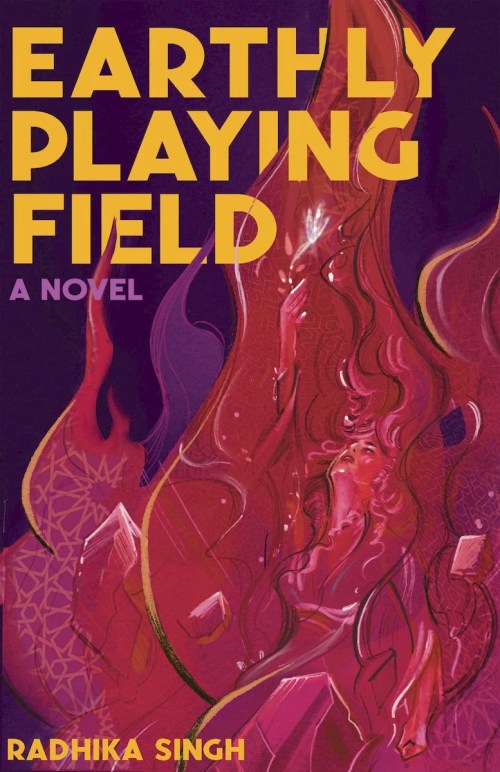
Radhika Singh’s gorgeous forthcoming debut novel, Earthly Playing Field, does just that—it’s extremely timely and relevant. Set in a sci-fi present, the novel deals with AI warfare, the genocide in Gaza, ICE, inequity under capitalism, and the need for a socialist revolution. It’s urgent and searing—I couldn’t put it down.
The novel examines the role of faith and belief in fights for justice, which is something I myself began thinking about with the timing of the war with Iran. I’m grateful to have had the opportunity to chat with Radhika about the topic via Google Docs. I hope you enjoy our conversation and that it convinces you just how smart and talented Radhika is, and why you should preorder not only Earthly Playing Field, but her second forthcoming novel, Weirdly Tuned Antennae.

Rachel León
Before we talk about your book, I want to consider the context in which we’re having this conversation: days after Eid al-Fitr and Naw-Ruz [or Nowruz], after the conclusion of at least two religions’ months of fasting. I think of fasting as something personal, done for one’s own spiritual development, but I also see it as a beautiful communal effort—the idealist part of me likes thinking it carries potent positive energy, which I’d hoped could touch the collective. This war with Iran would be awful no matter when it happened, but it struck me as especially devastating that it started during the holy month of Ramadan.
Radhika Singh
Yes to potent positive energy. I started keeping the Ramadan fast in 2024 as a way to be in solidarity with the struggle in Gaza. Beyond incessantly following the news, fasting became a concrete action: to submit my individual anxieties to a collective united in faith. I felt humbled, also, by those sacrificing their lives on the frontline of resistance (knowing that global imperialism is a scourge that wrecks us all), and how steadfast they stayed even while suffering such crippling blockades.
Fasting felt to me like a type of spellcasting—to discipline my intention alongside millions (billions?) of believers honing light as a political tool against the darkest of human tendencies. Though it’s devastating to experience the violence of sovereignty and destruction of material heritage, fasting this year once again felt like a source of spiritual arsenal, with Iran taking a principled stance against such unprincipled violence.
Rachel León
I love that you began observing the fast as a form of solidarity. And what a beautiful way of looking at it: as a form of spellcasting. I think that’s what I was getting at—I used to see fasting almost like a spiritual amulet. Not like it’d stop global oppression, but I liked thinking of it having this protective quality—so when a literal war broke out, it really made me question the role of religion, faith, and belief amid the injustices the world is facing . . . Which is something your brilliant novel deals with. When I was in Baltimore I had a profound conversation about fasting and prayer with a Lyft driver who was observing Ramadan. By the end of the drive we’d gotten to Iran and the Epstein files and I felt like I bonded with this person in a matter of minutes. ‘Solidarity’ is exactly the word for it.
Radhika Singh
Solidarity, for sure. I’ve met a number of people who’ve been called to fast in this way, compelled by this moment of struggle. Not that the oppression of colonialism hasn’t been present, crushingly so, for generations, or that there aren’t always those guarding the flame of resistance—even when it’s not fashionable to speak about in polite society! But the crests do come in waves.
Now the conversation’s been blown open, and the connections abound in daily discourse—between Empire and the depravity of the Epstein class, and the lack of reverence for life. And, on the other hand, the consciousness that life is something sacred to be safeguarded rather than defiled—and the agency we have as a collective to rise to its defense. Which is a power that can be harnessed through faith.
Rachel León
You’re clearly a very informed, conscientious, and compassionate person. And, since this series is about reading the resistance, I’d also love to hear about your reading habits. Have you found yourself gravitating to different kinds of books lately? I’d also love to hear about your choice to not only include works cited, but a reading list at the end of your novel.
Radhika Singh
I just read The Book of Disappearance by Ibtisam Azem, which hinges on a profound speculation: what if all Palestinians were to simply disappear? How would their memory continue to haunt the imagination, much as it troubles the streets of Jaffa today? It reminded me a lot of Gate of the Sun by Elias Khoury in that it’s a story full of stories, with the underlying resolve of resistance. Storytelling has this familiar, comforting cadence for us as readers, and in both works this device offsets the reality of persevering through something as grueling as occupation. The book that brought me into this project was also a novel of insurrection: Against the Loveless World by the brilliant Susan Abulhawa.
But most of what I read while writing was actually history. In order to envision post-imperialism, I wanted to understand what the world looked like before Western colonization. So I studied the Islamic Golden Age, which stretched from the eighth to the thirteenth century and was interrupted by the Mongol storm that revitalized the Silk Route to China. There was such an abundance of wealth and trade, such highly developed civilization! Such sophistication in art, science, philosophy . . . I was particularly interested in the Sufi orders that made their home in North India, deeply influencing the theology of Punjab, my ancestral land, and Sikhi, my given faith. Sikhi is rooted in both the struggle against worldly oppression and the idea that this life is a battleground for the soul. That’s where the title comes in—Earthly Playing Field.
The Works Cited specifies exact quotes that I included from this research, for the most part verses of mystic poetry that speak to the transcendent nature of love. The Reading List is the broader terrain I wandered while writing, mostly texts that were available to me through the public library system. But the thing I couldn’t detail properly was the sparkling constellation on social media giving voice to a new world order!
Rachel León
I’d love to talk about envisioning post-imperialism and you going back to very old texts, and how different philosophies and teachings informed the novel, because throughout the story, characters engage in philosophical debates. I’m curious how you approached the beliefs of different characters.
Radhika Singh
The central relationships set up some fruitful debates. The novel opens with Roma, the protagonist, arguing with her brother, Ranbir, about Stalinism versus Trotskyism. Ranbir and his partner represent scientific socialism in general, and Marxism-Leninism-Maoism in particular. In contrast, Roma’s sister-friend Maryam is more conservative in her political approach—largely avoiding engagement in favor of functioning at peace in late capitalism. Maryam grew up rebelling against Islam while her ten-year-old daughter is very intrigued by the faith, and its revolutionary potential. Roma finds herself in the midst of all this (and more!), at times defending the very perspective she just found herself deriding.
In terms of dreaming up post-imperialism by reading old texts . . . History was something I feel I could never properly absorb because I didn’t quite understand its relevance to my life. U.S. schooling taught me that before Western colonialism, there was darkness. The Medieval era, or the Dark Ages. It’s not that I didn’t know, for example, how Mughal India flourished: under Akbar’s rule, Hindustan held a quarter of the world’s GDP, surpassing even China! But the research helped me solidify the connections in my own head to imagine a future beyond finance capitalism that doesn’t look apocalyptic or like the end of the world.
Rachel León

Can you talk about the choice to write a speculative novel? Obviously it couldn’t work any other way, but I’m thinking not only about the role of belief and faith, but also imagination. Of envisioning something different. Were those things you were thinking about as you set out to write Earthly Playing Field?
Radhika Singh
This novel is actually a sequel to another I wrote some years ago, which comes out in November. Weirdly Tuned Antennae is set in a liberated future and features a character who time travels to the present day story world of Earthly Playing Field via a plant-based technology . . . that is seeded to aid the current insurgence. So the spec fic element is most obvious in that storyline.
The background events in Earthly Playing Field are pretty faithful to our real life timeline—with probably too much attention given to things like moon phases and whether it was raining on a specific day. So the speculative aspect is almost deeper in this light, because it challenges an American audience to push beyond the guilt of complicity in rampant exploitation, to acknowledge the reality of resistance and champion its righteous victory.
Naturally, for people who are dealing with bombs blowing up their schools and hospitals on a regular basis, their leadership under constant threat of assassination, the imposition of instability on economic, social and political levels, imagining resistance is not a stretch. But for those of us within the imperial core, it’s harder to wrap our minds around the prospect of something like a multipolar world. That’s a lot of what the book is asking—to conceptualize a future where everyone might live free. It feels sci-fi, with the specter of communism haunting the very foundations of modern statehood. But it’s also not that outrageous a possibility.
Rachel León
I love all the mention of the moon phases because I put a lot of faith in astrology, which brings us to the role of faith in resistance. Earthly Playing Field speaks to it in perhaps a more nuanced way than a quick interview answer can, but could you share parting words about that? A sound bite for the road?
Radhika Singh
Astrology is also one of my anchors—I love the idea of a personalized starmap! And, yes, it brings us back to faith. Faith is a new frontier for me. I grew up in the 90s, with nihilism, existentialism, angst and ennui as prevailing cultural conditions imposed by neoliberalism. Capitalism forces atomization, which breeds an intense loneliness. Financialization is a systemic bind that progresses naturally into imperialism—with all the attendant forms of degradation and self-annihilation. There’s an insecurity so great that even a small island like Cuba feels like a threat, even after being throttled by six decades of sanctions.
So witnessing kids speak with love and reverence even after every member of their family has been slain by AI robots really opens up the question of faith. What is that force of light that buoys them while the people around me are languishing in darkness despite all our supposed affluence? I found some answers in Buddhism, Islam, Sikhi, Marxism—systems of faith founded on the same revolutionary principles that motivated Jesus Christ—with a wisdom that endures through culture. That part to me is key. The U.S. is very young—there are trees that have lived longer than this country! Iran’s civilization, like others in West Asia, is ancient. Asia has seen many empires rise and fall. The wisdom of endurance is a guiding light that warns against self-annihilation. What else is the point of this life? Surely not to succumb to robots!
The notion of faith is ultimately bound with that of love. A communal concept of love where we understand ourselves as manifestations of a divine whole, where our existence on Earth is a drama we’re called to play out. Where fasting and feasting are rituals we share to honor that wholeness even as we honor our individual parts. What are we resisting for? For our mothers and fathers and children, for the fortune of collective endurance. It’s a miraculous thing, and not something to take for granted.
FICTION
Earthly Playing Field
By Radhika Singh
Common Notions Press
Will be published May 5, 2026


