


In a time when doomscrolling and artificial intelligence are forced onto people, it doesn’t feel like a coincidence that people are turning more and more to analog activities, like knitting, crocheting, and crafting in general. Media outlets are reporting that 2026 is the year of analog. I recently saw a museum advertising an analog night on social media.
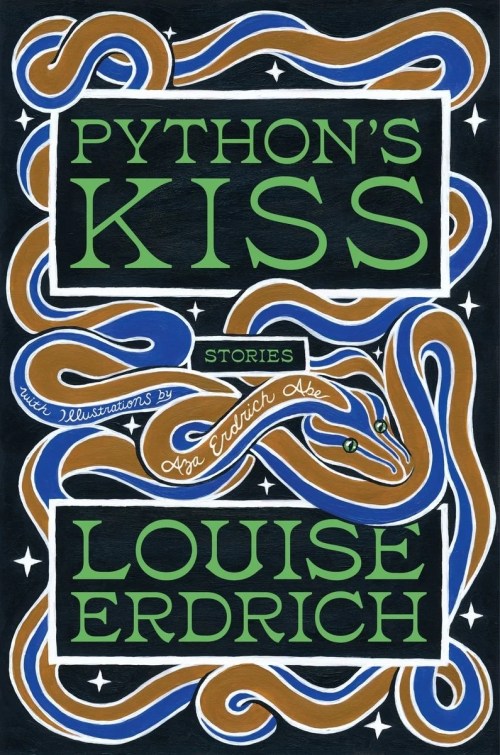
While Pulitzer Prize award-winning author Louise Erdrich, a member of the Turtle Mountain Band of Chippewa, wrote the short stories in her newest book Python’s Kiss over two decades, the book feels like it makes a case for focusing our attention on the material world, rather than the digital one. The thirteen stories explore our relationships with animals, the horrifying spectre of corporate afterlife, and relationships told through wedding dresses, all with Erdrich’s sharp eye. In addition to these timely stories, Erdrich created a book that is worth reading in its physical form with beautiful illustrations with her daughter. (Alas, my advanced reader copy did not have the images).
I had the opportunity to talk with this esteemed author about Python’s Kiss via Zoom.
The interview has been edited for length and clarity.

Elisa Shoenberger
Why is this collection of short stories so important?
Louise Erdrich
It is to me. It’s important that I collect these stories. I felt as though I’d been writing them for a long time. It’s important also because I got to work with two of my daughters. One daughter, Pallas, recorded for the audiobook. My other daughter, Aza Erdrich Abe, is a fantastic artist. She did graphic panels for each story. There’s one for every story.
I always love working with her. She’s done all of the art for the covers. She started my covers. In 2014/2015, the books got new covers, and she did all of their backlist covers. We have a bookstore, so I can look at this shelf of books and think she did every one of them. When you look at the covers, then you realize this is unusual, because most covers are not original works of art. Most covers are in-house covers, at their luckiest.
What I wanted for this book to have an intriguing, powerful cover, and then inside art that people would look back and forth at the art, and then look read along in the story. That’s one of the things I’ve always loved to do as a child. You look at the illustrations and go back and forth. and you get a little extra jolt when you do that.
Elisa Shoenberger
Many stories include relationships with more than human entities, like horses, snakes, and dogs. Can you talk about your choice to kind of explore these more than human entities?
Louise Erdrich
It’s because I have sympathy for animals. For a time, my daughter just rode horses and rode and rode. She was one of those horse girls, and so I became a bit of a groom. I loved being around horses; I’ve thought about them a lot.
I don’t know how it happened. I think it was because I was seeing so much self-righteous, overzealous violence in our country that I had a character kill an animal. Somehow people can read about people suffering grief more easily than relating to an animal suffering grief. I think that’s why dogs are rarely killed in movies or television, because it’s just so wrong and gratuitous. Yet we allow all sorts of forms of violence all the time, let our children watch it.
There are a lot of dogs in my books.
Elisa Shoenberger
We’ve always had rescue dogs. Ours probably has the biggest personality I’ve ever seen. But we know she had a lot of trauma before we got her.
Louise Erdrich
You just don’t know the experiences that rescue dogs have had before we adopt them. My daughter has a beautiful chocolate lab, but she probably had something traumatic happen. I don’t know what, but she is quite wonderful.
But the one that gets to me is this little, tiny dog. I think sometimes little dogs who have big dogs stuffed inside them have the most character. This little guy was so funny. He was a miniature pincher mix. He was one of those dogs who would twirl around in circles when he was joyous, and he would try to bite, but his mouth was so tiny.
Why do I assign these emotions to animals? It’s really because I know they feel these emotions. Horses are very emotional. I think all animals are very emotional. Their emotions are just difficult for some people to see, but they all are emotional, especially dogs. Dogs have evolved right beside us through so many eons and learned how to tolerate us and learn to take care of them in some cases. They have extra sensory perceptions anyway. My dog always knows exactly what I’m thinking, and of course, they do. They read us all the time.
To go back to your earlier question, the other thing about why I put together this collection of short stories is because I have a bookstore and see the books that come out. I wanted to make a book that really meant something physically as a book. I have nothing truly against e-readers or whatever; I listen to audio books, but my vast preference is for a physical book and the physical world.
I have lost so many things that I’ve put on computers, from photographs to manuscripts. If you imagine that what you put online is somehow eternal, you’re wrong. Everything has its time, and you really can’t go back and find a lot of what you’ve done if it’s all on a computer. I write by hand. Then sometimes I get impatient, and I write on my computer, but I always print it out. I always keep my printouts because they’re more durable. I have a lot of physical books and I love houses that have a lot of books in them. I immediately feel at home in libraries and bookstores.
Another reason I like books is you can really take them everywhere with you. I know you can take your phones everywhere too. I love my phone, but it’s boring. IT cuts off this whole wonderful way of interacting with people in a city or anywhere, because people notice what you’re reading on public transportation, in a station, in a restaurant. You can find like-minded people by just reading a book in public. People will always find this is a real way to start a conversation. If you’re interested in talking to somebody, and that’s kind of gone, because you’re not going to say, “Oh, what are you looking at on your phone?” It’s really intrusive. But you can say: “Oh, may I ask about your book?”
Do you remember The Goldfinch by Donna Tartt? People would carry around the book because it was the book that meant you were a thoughtful person who liked art, but who also had a love of thrillers and that you were a literary person. The book was everywhere in people’s hands. I really liked that.
Elisa Shoenberger
Do you think that sort of desire for the physical world may be one of the other reasons why you were exploring animals? In order to interact with another non-human being, it has to be physical.
Louise Erdrich
Yes, it is important. I don’t feel comfortable not having a dog with me, because I feel that I miss the enlargement of my own senses and my own emotions. It’s not because I think a dog is going to bark when I’m in danger. Dogs react to different things, and it’s always interesting. Other animals too. My daughter Pallas and I raised the last crow we’ve had. They’re the most tuned into humans, probably of any bird.
Elisa Shoenberger

Speaking of the opposite of the material world, I was very intrigued by the two more speculative pieces, “Domain” and “Asphodel,” about corporations owning the afterlife. It’s truly terrifying.
Louise Erdrich
I started writing these a long time ago, and I wrote a lot more about these corporate afterlives, and I even had data centers in them, and all kinds of things that have since happened. So I hope this isn’t what’s what’s in the future. I don’t like the phrase “cloud-based” because it’s not a cloud; it’s a data center based afterlife. Of course, the corollary of all of this stuff is that people in this world are working low-wage jobs with almost no resources to put into these enormous data centers. Their lives are devoted to this possible afterlife.
That’s based on a lot of religion, but it is also a matrix world but there’s no spiders. I loved those movies. But I didn’t really think about any other speculative fiction when I was writing these stories. This idea of the corporate afterlife was just something that occurred to me.
Elisa Shoenberger
Another story, “Assassins,” really struck a nerve. I remember playing this game in college, but you added another dimension to it that hadn’t occurred to me. At the time we played, there were school shootings but not the epidemic of today. Now kids are doing active shooter drills.
Louise Erdrich
This game was the rage here, but I haven’t talked to anyone else who played it, or knew people who played it. You’re the first person I’ve really talked to who played it.
Elisa Shoenberger
People took it really seriously. Some folks stopped eating in the dining hall; students would stalk their targets at class.
Louise Erdrich
Here, they had to be really careful where they eat. It was sort of allowed by the police department in Minneapolis—I don’t think that’s the case anymore—but schools were not. Schools were appalled. Parents were appalled.
It’s like having a game of vertigo. It was so compelling to kids. I also realized that the reason they were giddy is because they were terrified. This was a way of dealing with fear as well. The characters in the story tell that to their mother. There’s not much you can say when you know that it’s true. It’s true. They’re not actually doing anything that’s different or wrong. Kids have always played out their terrors and played at war. What is wrong is that we, their parents, are allowing them to be this terrified in their own schools, which should be, at least on a life or death level, safe.
FICTION
Python’s Kiss
By Louise Erdrich
Harper
Published on March 24, 2026


