


The genre of science fiction has been stereotyped and maligned for too long, and two of its contemporary champions, Jo Walton and Ada Palmer, would like to set the record straight.
It’s hard to imagine a pair better suited to the job. They are decorated science fiction authors in their own right. Walton won Hugo and Nebula Awards for Among Others and Palmer earned the Astounding Award for Too Like the Lightning. Only a select few have been so knighted by the science fiction gods, and that alone gives them a unique perspective. But, as they handily demonstrate in their passionate defense of science fiction, Trace Elements: Conversations on the Project of Science Fiction and Fantasy, Walton and Palmer deserve honorary accolades for their voluminous experience as readers. In point of fact, these tremendously well-read authors proudly identify as science fiction and fantasy (SF&F) fans and draw liberally from the well of fandom throughout this rousing and strikingly candid broadside.
Trace Elements is a hefty volume of 30 essays, poems, and asides addressing subjects ranging from the history of SF&F to personal experiences with chronic illness. The book breaks them down into three general categories — genre and the publishing industry, the process of selling novels to agents and editors, and the writing craft. Overall, Walton and Palmer’s argument is that the wider culture can and should try to understand the genre better and stop judging SF&F readers by the conventions of other genres. Crucially, they define genre as essentially a “marketing category” foisted on readers by the publishing industry, rather than an organic, democratic principle. They go on to define science fiction as a “body of literature which always welcomes and asks a certain range of questions, in SF’s case questions about how possessing scientific knowledge and scientific tools of thought affect what it means to think and be human…”
Walton and Palmer write in a cheerily casual voice, casting themselves as our affable guides on this detailed exploration of an oft-misunderstood subject. Their ambitious, 38-page “History of Science Fiction Publishing” delivers a treasure trove of industry insights for readers of all types, especially those who appreciate a little inside baseball. This chapter is fascinating as it is meticulous in its summation of the business side of SF&F, as well as the evolution of the industry with respect to all manner of factors, from the quality of paper to the outsize influence of Amazon. I was surprised to learn that the abbreviation sci-fi was coined in the 1960’s “as a pun on hi-fi” and that the term trade paperback is an abbreviation of “carriage trade, meaning trade intended to cater to people who rode in carriages, that is gentry and affluent buyers.” This expert overview benefits from Palmer’s academic scholarship; she is a professor at the University of Chicago specializing in the Renaissance and the history of ideas.
In “Genre Pacing and Protocols, or What is Genre,” Walton and Palmer analyze the contemporary state of SF&F, attempting to define it and delineate its boundaries over time. They highlight the many splinter communities and narrative forms within and adjoining SF&F — grimdark, anyone? — that bring their own expectations to the reading experience. As it turns out, publishing trends and market considerations do play into the definition of science fiction, but so do generations of literary conventions and traditions that fans uphold with great loyalty, and sometimes with tribal indignation in the face of repeated, external attacks.
Trace Elements shines brightest where it provides useful labels for competing narrative strands. The authors describe the sub-genre of “imprint science fiction” as developing in the 1920’s and evolving into the novels that are written today by studied acolytes and dedicated consumers of science fiction media and fan culture, contrasting it with “external science fiction,” or stories written by dabblers from other literary traditions. By these criteria, C.J. Cherryh is imprint science fiction and some of Margaret Atwood’s work is external science fiction. Also in the mix are magical realism and speculative fiction, sub-genres that defy expectations and frustrate die hard fans, not to mention other traditions within SF&F, from mecha to Yu-gi-oh. “Publishers like to have clear water between their imprint SF …and their other book lines,” they observe. I found this a unique and fascinating breakdown of the moving parts that make up the giant machine of literary culture.
I equally enjoyed their analysis of romance. The genre gets a bad rap, like SF&F, and perhaps this is what draws the authors to it. From the first pages of this essay, Walton and Palmer spring into action, ready to defend the unfairly judged. Their list of common characteristics of romance novels is instructive, especially that all romance is fundamentally about economic concerns.
Sometimes the genre bashing goes both ways. The authors describe mainstream literary fiction as stories where everything is about our “struggle to communicate with our parents.” I do worry that the authors are protective of a certain stubbornness within the SF&F community in terms of the conventions — or what they call the “furniture” — of imprint science fiction. I’m sure they would retort that they are only naming the real expectations that publishing companies and true blue fans bring to the page. All the same, there’s a certain wounded quality at times, such as when they call their community the “table in the corner” of the literary party.

However, overall, an inclusive spirit animates Trace Elements. In a typically frank passage about her reading habits, Jo Walton proclaims, “I don’t see anything either childish or immoral about picking up an old favorite just to spend time with it, because I’m reading for fun, and that can be fun. I’ll do it if I want to. I will defend to the death any adult’s right to re-read trash as often as they want to as long as they enjoy it.” In this, Walton encapsulates the core ethic of the book. There’s something egalitarian and refreshingly guileless about these authors and their orientation toward reading.
Walton and Palmer are celebrated, award winning science fiction writers who have each advanced the genre through their own fiction. Their contributions on the topic will be devoured by fans, not unlike a book about thrillers by Stephen King (see his related essay collection, On Writing) or a book about romance by Nora Roberts. In that sense, this is a savvy release by Tor and a smart and engaging work by Walton and Palmer.
NONICTION
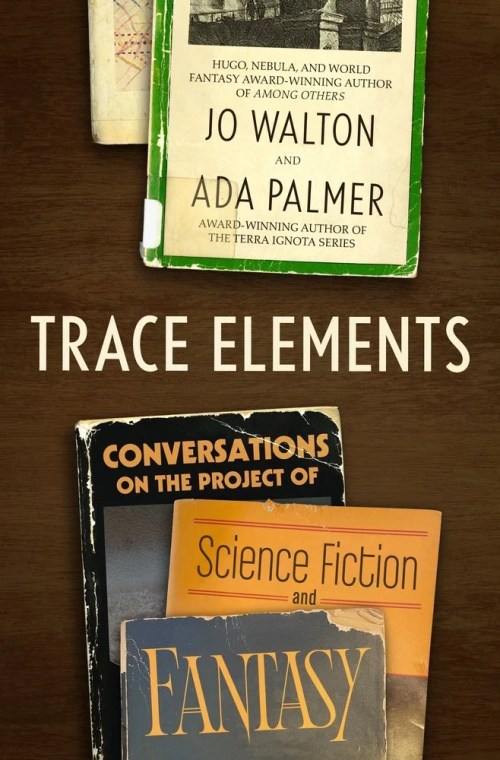
Trace Elements: Conversations on the Project of Science Fiction and Fantasy
By Jo Walton and Ada Palmer
Tor Books
Published March 24, 2026


