


I first encountered Rebecca Serle on the pages of In Five Years long before I met the Bella to my Dannie or could fathom my own apartment, à la Virginia Woolf’s A Room of One’s Own. But I stayed through the dialogue and the heartbreak, because just like the flash in Dannie’s dream, the question ailed me: how does the story end?
The second time I encountered Rebecca Serle was in between the workday in Positano, Italy, long before I ventured to travel on my own. I felt the Mamma Mia magic of falling in love with the people your parents were before you were born.
And, somewhat like Expiration Dates, I long for the answer of when the choice you make is right or validated by some other worldly power.
I met Rebecca Serle for the first time, over Zoom, to discuss her new novel, Once and Again. An intergenerational tale just shy of 250 pages, the book ambitiously weaves the stories of three generations of women, mothers and daughters, as they grapple with secrets unshared before the luck runs out.
As an avid reader of Serle’s body of work, I asked about the hallmarks of her novels: a fascination with time, a writing process that lends itself to discovery over strict outlines, and the power of setting. If readers would like to get more immersed, Rebecca Serle’s ancillary content offers a way to take reading outside the house, including walking tours, book clubs, and recreating iconic dishes. From family to friends, Serle’s novels touch on community with those we love, and the magic in trying to protect them against the persistent nature of time.
This interview has been edited for clarity and length.

Mia Rhee
Where were you when the idea for Once and Again came to be, and what were you feeling when that idea first struck?
Rebecca Serle
It’s such a good question, because I feel like, with the exception of One Italian Summer, I can’t remember the exact moment for any of my books. It’s more like this sort of general percolating, and over the course of, I’m not kidding, probably about a year and a half until the moment that the idea actually crystallizes.
So, the moment the idea crystallizes is actually the one that I always remember–that’s when I have the idea for whatever that midway sort of reversal or twist is going to be, and then I understand what this book is about.
I don’t necessarily remember coming up with the idea of the tickets. I knew for a while that I wanted to talk about the idea of getting to go back and think about what you might have done differently. It felt in conversation with In Five Years, about the idea of getting to go, and so I knew I wanted to talk about that. But it wasn’t until I really gelled in on this relationship between Marcella and Lauren that I began to understand what the book was really capital A about.
Mia Rhee
In this book we get to navigate between three different women. Is there a voice that was the loudest to you or arrived on the scene first, and who was that?
Rebecca Serle
Definitely Lauren. I was very surprised by Marcella and Sylvia’s POVs. If you read my books, you know that I’ve never written multiple POVs. I’ve also never written in third person before. And so Marcella just kind of showed up.
Lauren was definitely the strongest, and I assumed that this book, like my others, would be a first-person narrative, but then Marcella showed up and her voice was in third and it made a lot of sense to me because I feel like she is a character who is very much narrated by the narratives that her family has about her. So it made sense to me that her story would actually be in third and then Sylvia showed up, guns blazing, and she was a lot of fun to write, but I assumed when I sat down, it would be just a straight, first-person narrative, like all of my books.
Mia Rhee
We have three different perspectives into your writing process. Do you handle it by character? Do you handle it by chronology? Do you layer all these pieces like a puzzle and then put them in the order of the novel? What’s that process like?
Rebecca Serle
I don’t mean to sound hokey, but I feel like there’s a really magical thing that happens when you are really present and you pay attention when you’re writing. You will naturally seed gifts to yourself in the beginning of your story that you can then pick up at the end and fully realize, if you’re bringing your whole self to the [beach], it really will happen. And it’s how my books work out.
And so I layered them. I was mostly interested in the touch points between [the characters], like you said, and in their journey as mothers. I mean, obviously Lauren isn’t one, but her journey to become one, and I had an idea of what Marcella’s story was. Her story is so intricately related to Lauren, some of that was also a surprise as I got there. And then Marcella was just fun. I hadn’t anticipated necessarily including her in the manuscript,but when she showed up, she had such a clear backstory that was really fun to write.
I will say one thing that’s a little bit different about Once and Again from my other novels—Once and Again has an origin story to the magic, but none of my other books do. There’s like with my other books. It’s very much like it arrives. It just arrives. In Once and Again there is a history, almost like the fairy tale that’s been passed down from generation to generation amongst these women, the narrative of who they are–and the narrative of who they are is magic. I keep saying that Once and Again is a little bit like my Practical Magic, in a way, and I had a lot of fun generating that backstory.
Mia Rhee
I was actually going to ask you a little bit about that origin story, because I was curious what influenced your decision to embed the origin story within Lauren’s narrative, and what the writing process was like when you were conjuring this origin story? Did it arrive after you had written this larger narrative, or did you come up with this origin story and this lore and the whole story was born from it?
Rebecca Serle
Once and Again is ultimately a story about generations and the passing of information, the passing down of this gift, and also the transferring of the torch of motherhood. That, to me, really needed some kind of foundation. It didn’t seem like it was enough that there was this ticket, and they didn’t really know how it had arrived there. I wanted them to have ownership of their lineage in a way that only narrative can really provide. The stories we tell about our families are the most powerful.
Mia Rhee
When you conjure setting across all of your novels—In Five Years is very, very New York, and then One Italian Summer, is Positano, Italy, and then Expiration Dates is in LA—they all have a rich sense of place. How do you conjure that sense of setting in your novels?
Rebecca Serle
Yeah, Once and Again is a story that takes place in Malibu, and I don’t know how to write without feeling the sensory, tactile, like the sea air, and tasting the salt water, the spaghetti and white wine on the deck, the peeling paint. It’s what I love in books, and it’s also, for me, the deliciousness of building a world. My favorite thing is that people visit the places that are in books.

I went to seventh and eighth grade and high school in Hawaii, on Maui, and I feel like Hawaii and Malibu have a lot in common. I mean, number one: surf culture, which is huge in Once and Again. I went to one of those high schools where kids would show up in the parking lot with wet hair and boards in pickup trucks in the morning. So I feel like I understand that rhythm and the water just made a lot of sense for this book, because I think ultimately it is a book about presence and time, and I can’t think of a better way to illustrate that than the ocean: the presence that it requires to surf, being in the water, you have to be so aware in the moment, like no other activity, you really have to pay attention in a different way.
The ocean and surfing really dovetailed nicely with the themes of the book. And I had a lot of fun being able to use a little bit of that knowledge that I have from growing up on Maui and put it here.
Mia Rhee
Why thematically do you always return to this concept of time?
Rebecca Serle
It’s the most precious resource on the planet, and it’s the thing that is not self-generating, and it’s the thing that we know that we’re getting out of and yet our whole life is in opposition to that fundamental reality, which is that none of this is indefinite, it’s all finite.
As a writer and a person who is curious about the world and thinks a lot about macro issues, I think a lot about time in my own lifeEspecially since getting married and having a family of my own, it’s hard to escape, especially as parents, so I’m always writing to make sense of how I feel about my own life, or how I feel about the big questions that I’m asking in my own life.
The idea of time feels very perennial, the fantasy that we would get to manipulate in some way: like when I was single, the fantasy of getting to go forward and see if it is going to work out the way I want it to. Am I going to meet somebody? Am I going to be able to have a family of my own?
The fantasy now is that I have those things to go back to and maybe get to live them again, or honestly, have more time with the people that I love now while they’re here. It’s never something that I’m not thinking about, it’s always going to end up in the work.
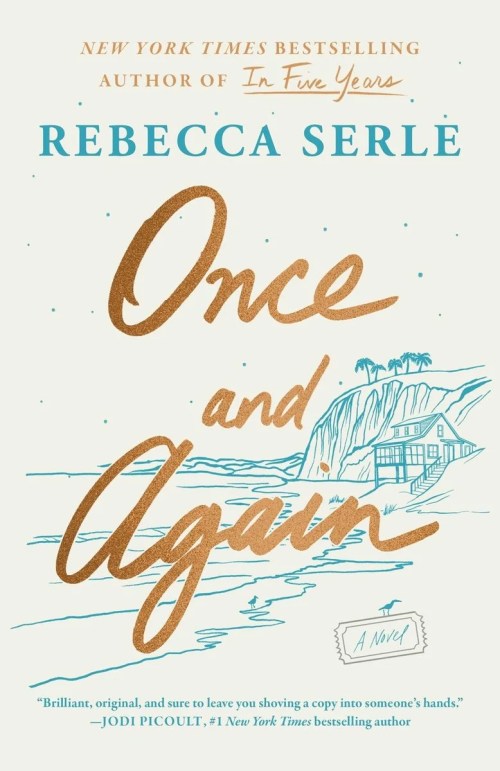
FICTION
by Rebecca Serle
Atria Books
Published on March 10, 2026


