


A. Natasha Joukovsky’s first novel, The Portrait of a Mirror, reimagined the myth of Narcissus as a modern novel of manners. Her new novel, Medium Rare, is even more ambitious, braiding together the myths of Icarus, Cassandra, and Phaeton with March Madness brackets, political ambition, and female friendship.
Led by an unreliable narrator named Cassandra, the book follows what happens when a friend stumbles into the perfect March Madness bracket—and the aftermath of his success. It’s a book that moves quickly between the NCAA tournament, Washington intrigue, and friendships made and betrayed, all summing up to a book somehow equally of the moment and timeless, and always, always fun to read.
We spoke on Zoom ahead of Medium Rare’s publication.
This interview has been edited for length and clarity.

Denise S. Robbins
Why bring Greek mythology into your contemporary novels?
A. Natasha Joukovsky
Myth is this evergreen territory where there’s always more to explore and do. The superimposition of contemporary concerns onto these stories, which have resonated for centuries, provides a fertile basis for considering the world, anchoring social observation, and developing psychosocial insights. Both of my novels are novels of ideas. I want to understand human nature—how people work, how I work. Myths are not just a relevant way to get at that, but a really fun one. Ovid, in particular, had the greatest sense of humor, of recursive interplay. His multi-level weaving of metamorphic myths is very rich from an inspirational standpoint.
Denise S. Robbins
Do you think it’s possible to write a fully original story, or does everything sort of stem from these myths, whether or not you’re aware of it?
A. Natasha Joukovsky
I don’t know whether everything stems from these myths, but I don’t put a lot of stock in blank-slate originality. Tradition is often a better vehicle for innovation. Are there totally new, novelistic paradigms that we could find? Maybe, but it’s not what I’m personally interested in. I’m more interested in how influence builds over time, the connections and webs we see between authors, the way different (ahem) mediums interact over centuries. Bruegel’s painting Landscape with the Fall of Icarus, for instance—which gets a lot of play in the book—is later interpreted by Auden in his poem “Musée des Beaux Arts,” which is one of the epigraphs for Medium Rare. I love connecting these threads through history, through mediums, and adding to them. Doing something new and old at the same time, as opposed to doing something only new—I don’t even know what the latter would look like.
Denise S. Robbins
The love for Greek mythology definitely comes through in the book, as does the love for basketball. Which came first?
A. Natasha Joukovsky
I had no great love for basketball before writing Medium Rare, but Greek mythology has been an interest since I was a child. I remember reading Edith Hamilton with my father very young, before encountering Metamorphoses in college and reading it several times. It was rather the statistics side of March Madness that drew me to this premise, the idea of something that was both incredibly rare and incredibly dumb, questioning the value of rarity in and of itself. March Madness seemed like the perfect vehicle for that because the media is always touting how unlikely a perfect bracket is. It was when I actually started watching the 2019 UVA games—because all of the basketball in Medium Rare is based on that actual championship run in 2019—that I got really into it, way more into it than I could have even imagined, and my own growing interest in it contributed to how I wrote Cassandra’s growing interest in it.
Denise S. Robbins
Do you still watch it? Are you going to watch this year?
A. Natasha Joukovsky
Yes! I’ve always liked March Madness—I’ve always filled out brackets—just more for the mathematical novelty than the basketball. I am more interested in basketball now. I recently went to my first NBA game for my husband’s birthday, and I’m sure I’m going to want to pay some extra attention to the NCAA tournament this year.
Denise S. Robbins
Back to the Icarus myth: Is there something about that myth that feels particularly relevant right now? Why did you choose to focus on that for the story?
A. Natasha Joukovsky
Well, I know it’s billed as Icarus from a marketing perspective, but a huge portion of my fascination here is the nature of the twin myths of Icarus and Phaeton. Icarus is more famous—flying close to the sun, trying to escape Crete with his father, the artist Daedalus. But Phaeton is a very similar myth. You have a mortal son of a god who wants to be claimed by his father, Sol, and Sol says (basically), “to show you that I’m your dad, ask me for anything, I’ll give it to you.” And what Phaeton asks for is to drive Sol’s chariot, the Chariot of the Sun. This does not go well for him. He, too, flies too close to the sun, and not only burns himself up in the process, but it’s kind of an anti-flood great-floodish fire myth where the whole world gets burned up, before Zeus and Sol come in and rectify things. So there are these two Ovidian stories of sons flying too close to the sun and things falling apart. In Medium Rare, this twin nature is reflected in Cassandra and Phil being different yet the same—the whole idea in the novel of the huge feeling of very small differences.
Denise S. Robbins
You have so much fun with Cassandra’s narrative style. Is she telling the truth? Is she not telling the truth? She’s admittedly unreliable. Is she prophetic? Is she not prophetic?
A. Natasha Joukovsky
The prophecy thread is a thick one. Originally, I had two different novels in mind: an Icarus/Phaeton flying-too-close-to-the-sun novel, and a separate idea for Cassandra as a millennial mom. When the two came together, I realized I had a full book and was able to take it beyond the first chapter I had written. Cassandra’s voice fleshed out the book for me.
As for whether she’s telling the truth, the questions are more important than the answers to me. One question that I am absolutely asking is: what is the relationship between narrative and prophecy? And this kind of goes back to your previous question on “why now” with flying too close to the sun. Trump is a character in this novel. We are in a period where the relationship to truth is pretty precarious; there’s a lot of flying close to the sun going on. And everybody’s obsessed with prediction these days. DraftKings. Polymarket. Part of what I was doing was exploring all of the different veins of connection between seemingly disparate spheres, the consistencies of human nature underlying differences in the Hollywood world versus the political sphere versus the sports arena; a Cassandra figure versus an Icarus/Phaeton figure. But I’m not being prescriptive about any of it. What do you think? Your answer’s as good as mine there.
Denise S. Robbins
I always enjoy an unreliable narrator, and even if it’s admittedly unreliable, it’s the truth—or at least one type of truth.
A. Natasha Joukovsky
That’s part of the idea: that in fiction, incredibility is credible. When you’re saying you’re unreliable in fiction, isn’t that reliable? The whole idea of novelistic truth—the deeper truth—that’s what I’m looking for here: the truth that is truer than fact.
Denise S. Robbins

Do you think fate exists in this novel?
A. Natasha Joukovsky
It’s a big question I’m posing, and I’m deliberately not coming down exactly on one side or the other. If you’re asking me personally, probably no, because the novelist is the god of her novel. Fate has this connotation of coming from somewhere else, and one of the great things about being a novelist is getting to make all of the decisions, god-as-architect style.
Denise S. Robbins
I loved the narrator’s relationship with Raleigh. Their strong friendship seemed like the heart of the novel. Yet at first, the narrator says she feels very different from her and couldn’t imagine being friends with her.
A. Natasha Joukovsky
This goes back to what I was saying about the over-magnification of small differences. Part of what Cassandra is realizing with Raleigh and Phil is how much more similar they are as human beings than different—as man versus woman with Phil, or as slightly different types of women with Raleigh, for example, in her presentation of more feminine, artificial beauty versus Cassandra’s equally intentional “natural” look. These are superficial differences relative to how humans work, tick, and respond to incentives and disincentives.
Denise S. Robbins
You bring both political parties into the novel—Phil switches from Republican to Democrat—but the story is more about the characters.
A. Natasha Joukovsky
Oh yes, I’m an equal opportunity critic across the political spectrum. I’m looking for the truth, and the truth is everybody’s flawed and out to maximize status just in slightly different spheres. We have so much more in common than not.
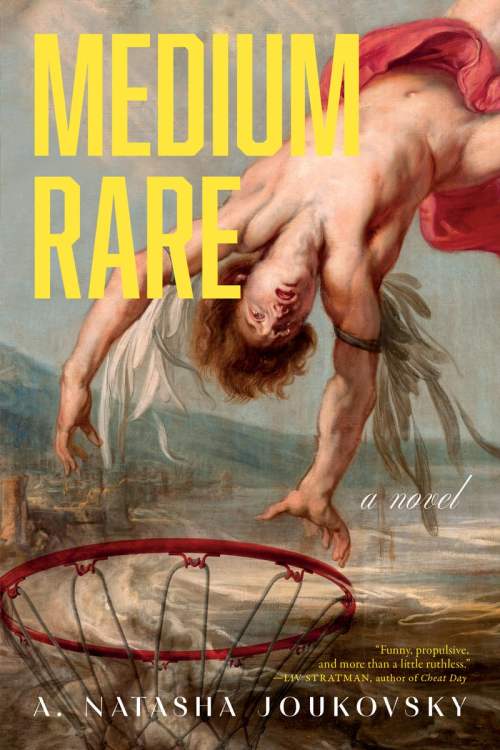
FICTION
By A. Natasha Joukovsky
Melville House
Published March 3, 2026


