


We sometimes talk about a writer’s writer: someone whose books only resonate for people who write. Tayari Jones writes for her readers. She’s the kind of writer who’s able to balance an engrossing plot with vivid language and memorable characters. Her books have stayed with me long after the last page, and her new novel is no different.
I met Tayari at Rutgers University-Newark, where I was her student in the MFA program. We reconnected a few weeks before the publication of her much-anticipated fifth novel Kin. The book explores the friendship and lives of two motherless girls raised in Honeysuckle, Louisiana. Vernice (“Niecy”) leaves home for Spelman College, determined to find stability within a world of affluence, while Annie, obsessed with finding her mother, winds her way to a sharecropping whorehouse in Mississippi and eventually to Tennessee.
Our conversation spanned writing during political turmoil and the pandemic, Tayari Jones’s first historical novel, and motherhood. This interview has been edited for length and clarity.

Aarti Monteiro
On Facebook you recently did a “What Took Me So Long” series where you talked about the process of writing this book and all that happened between An American Marriage and Kin. You shared that you’d started writing another novel about gentrification in modern Atlanta, but it didn’t feel right so you pivoted to what eventually became Kin. What was that experience like?
Tayari Jones
You know how you can be writing a novel and you’ve got subject-verb-object, subject-verb-object, but the magic isn’t happening? It’s like going on a date with someone, and there’s nothing wrong with them, they’re just not your person. There was just a certain sparkle that wasn’t happening with the prose.
I decided I would do what I call word doodling, where I just get a piece of paper and a pencil, not even a pen, just to see what’s out there. No expectations, just writing for writing’s sake. I knew [the girls] were always friends and I started writing about them and I thought, certainly this is backstory. One of these people must be my main character’s mother, because I am not writing a historical novel, I am not a historical novelist. I am deeply committed to the contemporary, and when I was about 100-150 pages in, I had to accept that no, this is apparently the novel.
This is the first time in my entire experience as a writer—I’ve been publishing novels for 25 years now—that I have felt that a story kind of came to me. It was very unsettling. I like knowing what I’m writing and why I’m writing it. I always say, I write to find out what the ending is, but I don’t write to find out what the plot is or who the characters are or what the setting is!
Aarti Monteiro
It sounds like the last few years have had a lot of ups and downs. How do you respond when you’re blocked creatively?
Tayari Jones
You just keep trying. That’s all you can do. You read more, you sleep more, but you know what? There was a moment when I realized that I was blocked because of guilt. I felt a certain guilt because I felt like with An American Marriage that I had gotten so much already compared to some of my friends and colleagues who are just as deserving. Who was I to ask for more? I felt like I had already been given this huge portion, and it just seemed rude. Then I realized that if you say you’ve had more than your share, it’s saying you didn’t deserve what you had. I never thought of myself as a person that didn’t feel worthy. So I made my word of the year “worthy,” and I spent a lot of time kind of processing that. But here’s the thing: when I started thinking of myself as worthy of all I had received, I also didn’t do any work. I just lay on the couch and felt the love. I realized the link between feelings of unworthiness and ambition, you gotta earn love, earn attention. So once I had the worthy year in my pajamas, I made “discipline” my word of the year. I just sat there with the page, and I just tried, and that’s when I did the word doodling, etc. I said, I cannot control whether or not I can write a book. I can only control if I try to write a book.
Aarti Monteiro
Kin is set in Atlanta, Tennessee, and Louisiana. You moved back to Atlanta in 2018 after spending a decade in Brooklyn. Has it been different to write about the South while living there versus writing while living away?
Tayari Jones
I think when I was writing away from home, I wrote with longing and also with a little bit of a chip on my shoulder. You know, the South has such a bad rap up north. People act like you came to Brooklyn on the Underground Railroad. That kind of infected my writing. But one thing I did notice when I was living in Brooklyn is that my characters were spending more and more time indoors because I felt like I was losing my grip on the physical landscape. I felt very confident that I understood the culture of the South, the language, the rhythms, but Atlanta is changing. Things have changed, and I did not have that confidence in the physical space. Now that I’m home, my characters get to go outdoors and do all manner of things because I feel confident having them there.
Aarti Monteiro
All of your novels are just so rich in character and in language, but none of that is at the expense of plot and the story moving forward. How do you develop the plot? Is that something that comes first for you or does it develop as you’re getting to know the characters?
Tayari Jones
I feel like it all developed to me simultaneously because once you find the characters, they have to do something. I like to read a plotty novel, and I write a plotty novel. I was just writing an introduction to Song of Solomon by Toni Morrison. And I feel that Morrison, she’s very plotty. One goes on and on about language, because her language is exquisite. But in Song of Solomon, that thing is a cliffhanger, it ends on a cliff. The people are on a cliff! She does not shy away from big plot movements. And I feel that her example is that you don’t have to choose character or plot. You don’t have to choose whether or not you want to engage with big ideas or to do language. You can do it all. You can do as [much] as your mind can accommodate.
Aarti Monteiro
I would say that you also aren’t choosing. You’re able to do it all too! You mentioned earlier that you’re not a historical novelist. This novel is set in the 1950s and a lot of what the characters experience are of that time. How do you think that research impacts your writing? Do you feel like it expands your imagination, or is it hard to write within the confines of a specific era?
Tayari Jones
The main thing I had to think about was: what is the same? Because sometimes when we think about people of another era, we forget that they had the same range of human experience that we do.
I do think that part of what was challenging was researching the specific history of Atlanta. Atlanta desegregated early, so I had to pick up this whole book and move it back three years because I was determined to have Niecy go see a movie at the segregated Fox Theater, and I found out how early Atlanta desegregated. But I had a great fun time researching things like the clothing people wore. People wore such complex undergarments in the 50s! Niecy always has on a full complement of undergarments.
Another thing of the research, though, is that I realized how recent slavery was. I used to be on the team of people complaining that slavery is so overrepresented in African American literature. But then Nikole Hannah-Jones said that for the majority of Black people’s experience in America, they have been enslaved. And that was really on my mind here in this story.
Aarti Monteiro
Even though this is your only historical novel, there are a lot of connections between your books. An American Marriage begins with one of the main characters, Roy, saying, “There are two kinds of people in the world, those who leave home, and those who don’t.” In Kin, both Niecy and Annie leave home, though they come from the same place and are both yearning to be mothered. Why do you think life takes them in such different directions?
Tayari Jones
The question is a question of hope, and is hope an asset or a detriment? Annie has hope. Annie hopes that she will find her mother, and she organizes her life around that hope. Niecy knows she will not find her mother, so she’s not chasing some kind of long shot dream. I think that’s the main difference in how their lives turn out.
I knew it fairly early on when Aunt Irene brought this up to say, Don’t be jealous of Annie because her mother’s out there. She said, Annie is young, so hope is fun for her, when she gets older, it will wear her down like the heel on a loafer. Because, she said, she wakes up hopeful every day, [and] she goes to bed every night, disappointed. I think that is the main difference in their lives.
Aarti Monteiro
Parenthood is a theme that runs throughout all of your books, and motherhood specifically is a central theme in this one of course. Niecy and Annie are two motherless girls, and that’s a big part of how they come together and what’s driving them. They both find parent figures throughout the novel: Annie with Lula Bell and Niecy with Mrs. McHenry. There are other characters who also act as mother figures. What do you think makes parenthood so ripe for fiction, and what draws you to these themes?

Tayari Jones
Well, everyone has a parent at some point, so it is like one of the few universal experiences. Everyone had to come from somewhere. I think that’s one thing that drives that. It’s also a nurture versus nature question embedded in there. Niecy is able to embrace Mrs. McHenry as a mother, because she knows she doesn’t have another mother, but Annie is still holding out for the fantasy of biology.
Aarti Monteiro
Has writing about it changed the way that you think about parenthood or mothering?
Tayari Jones
I think writing this book gave me a different kind of compassion for my own mother, for any mothers of that generation where my motherhood was compulsory. I feel people are better parents now than they were before. We think about this term planned parenthood, it’s become what they call a word sandwich. You don’t really think about the two words separately and what they mean, but it has completely changed the way people understand their relationship with their children now that people are parents more voluntarily. I’m not saying that there aren’t people who are forced into parenthood, but it’s just a different expectation. And even if you are forced into parenthood, people planning their parenthood all around you has changed the culture of parenting.
Aarti Monteiro
One of my favorite lines was when Niecy’s Aunt Irene always says, “Lord, I don’t know how to talk to children.”
Tayari Jones
I thought this book was a little funny. I feel like so few people say that because it has all these other things going on, but it’s kind of funny. I was amused myself. Life is funny! Life is a predicament. This is my most Southern novel. I think because all the characters are characters. That’s a hallmark of Southern writing. The characters are all unique, and some of them are larger than life, and they talk a lot of trash. They’re funny.
Aarti Monteiro
The humor really adds a lot when writing about heavier subjects. You’ve talked a little bit about writing during the pandemic and the election, and there’s still so much horror in the world. What do you think is the role of the artist in moments like this?
Tayari Jones
I don’t know what the artist is, but I can say this artist. When the fiction is going really well, I can vanish into it. It actually moves me out of the moment too. It’s also part of why I had such trouble writing in 2020, because it seemed selfish and wrong to vanish into my imagination. I had to accept that writing novels is a very incremental way to change society. You work so hard on it, but when it’s all done, it’s a modest offering. I had to humble myself and say, I’m going to give this everything I have and at the end, I’m going to have a modest offering.
When you’re studying to get your MFA, you really talk about literature like it changes the world. Poetry is like bread. It nourishes the people. I think that when you’re finding your legs as a writer, you really need that. But I think that part of maturing is to be able to be motivated to write, despite the fact that you know the role of your work is but a small push, but that hopefully it will join with others, doing whatever their gift is, their skills are, and together, we can change the world. But this is what you have. It’s like the little drummer boy. It’s your rump-a-pum-pum.
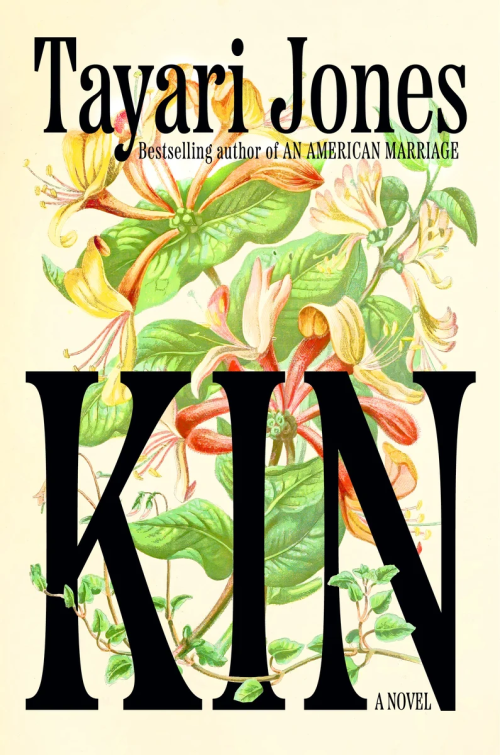
FICTION
Kin
By Tayari Jones
Knopf
Published February 24, 2026


